Live data from Hacker News

Barrier Reef doomed as up to 99% of coral at risk, report finds

smh.com.au

31–40 of 147 posts

Re: Barrier Reef doomed as up to 99% of coral at risk, report finds

#31
What kind of annual sustained global emissions reductions would be necessary to have a 50-50 chance of limiting global warming to 1.5 degrees? [0]

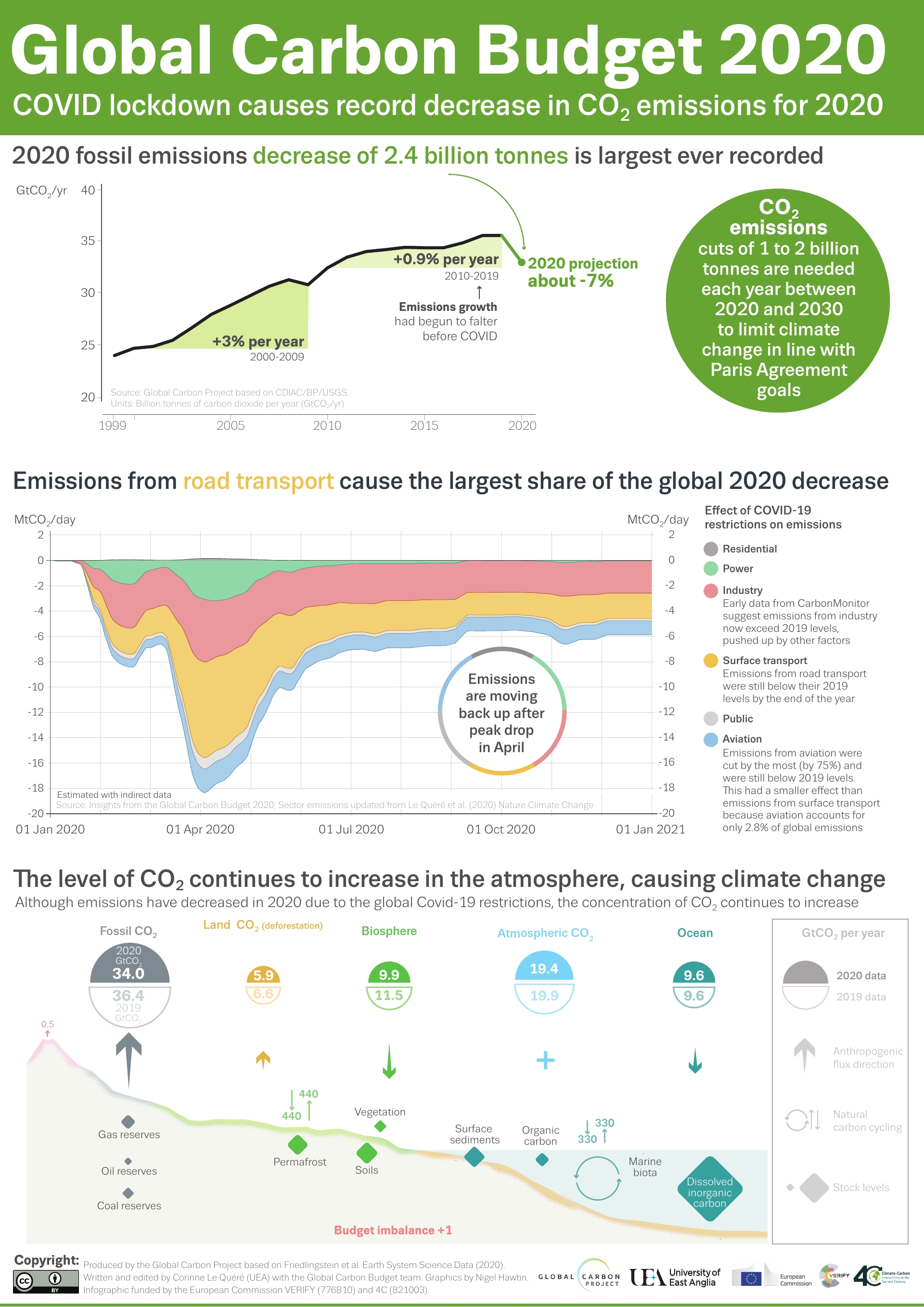
2018 estimates of the carbon budget remaining for a 50% chance of less than 1.5C warming: 200 Gt CO_2-e -- 800 Gt CO_2-e [1]. Lots of uncertainty, I will ignore tails on both sides. Assume current global emissions are around 35 Gt CO_2-e / year [2][3]. Since it is now 2021, not 2018, subtract about 105 Gt CO_2-e from the remaining budget, giving a range of around 95 -- 695 Gt CO_2-e remaining.

Crude estimate of years remaining until carbon budget for 50% chance of limiting warming to 1.5C is exhausted: 2 years -- 20 years, assuming steady 35 Gt CO_2-e / year emissions.

Let's make things easier and relax the target and aim to reduce emissions to 5% of current levels -- a massive drop of 95%, not the full 100%. This relaxed target does not try to achieve net zero emissions, but to merely get us into the ballpark of where that a zero net emissions goal could perhaps be reachable with enough additional effort.

Supposing we are unlucky and reality is consistent with the scenario where we have two years of carbon budget remaining. To stay within the relaxed budget we would need to consistently sustain 78% annual drop in emissions per year for two years.

Supposing we are lucky and reality is consistent with the scenario where there are twenty years of carbon budget remaining. To stay within the relaxed budget we would need to consistently sustain 14% annual drop in emissions per year for twenty years.

What might sustained 14% annual drops in emissions feel like? It seems like world annual emissions dropped 7% in 2020 vs 2019 [3]. In the trailing decade 2010-2019 we were seeing about 1% annual growth in emissions. So if we assume Covid is entirely responsible for that difference, that's a 8% emissions reduction -- perhaps transient that will bounce back -- from a one-off event. If we consistently had two different Covid-scale economic shocks every year for twenty years, each with a corresponding _permanent_ reductions in emissions, that might suffice to maintain the 14% _permanent_ annual drop in emissions necessary to reduce emissions to 5% of current levels by 2041.

To benchmark against reality and pick on my own country: Australia's federal government reckons it is on track to reduce emissions to 480 Mt CO_2-e by 2030, from 540 Mt CO_2-e in 2019 [4]. This corresponds to sustaining a 1.1% annual drop in emissions for eleven years.

[0] I don't think limiting warming to at most 1.5 degrees C is a goal that is intentionally reachable from within the current human system. It is worth doing some back of the envelope accounting exercise every now and again to get a feel for the remaining carbon budget & the scale of the challenge.

[1] https://www.carbonbrief.org/analysis-how-much-carbon-budget-...

[2] I am being optimistic and rounding down to 35 Gt from 36.4 Gt in 2019 to make the numbers easier. Let's ignore 2020's data as not representative of what humans do in a typical year, due to the pandemic shock, although hopefully some of the behaviour change will be sticky (WFH, etc).

[3] https://www.globalcarbonproject.org/global/images/carbonbudg...
[4] https://www.industry.gov.au/data-and-publications/australias...

Re: Barrier Reef doomed as up to 99% of coral at risk, report finds

#32

I find it hard to believe that ancient creatures that have lived through this many times in history are somehow unable to do it again. The temperature estimates in the article do not eclipse highs in fairly recent history. https://en.wikipedia.org/wiki/List_of_periods_and_events_in_... Nor does the rate of change exceed that of what the earth experienced as recently as 8k years before present. https://en.wikipedia.or…

To add to this, "coral reef bleaching" is not a coral reef die-off event, it means that the colorful symbiotic alge that coexist with the coral (many corals are a lot like flamingos, they are themselves generally colorless, but other factors in their environment cause notable color) have left the coral that make up the reef, leaving it white. The coral it self (an animal by definition, not an algae) is still alive, although stressed, in a bleaching event.

Reefs see bleaching happen on an annual basis, and extended bleaching can cause a die-off (the algae produces additional food for the coral) but the concept that hot water -> dead coral is, perhaps, not a direct impact. There's a couple of books by prominent marine biologists on this topic, that annual bleaching happens both in warm water and cold water corals. I'll dig up the citations if there's enough interest.

That said, no comment on acidification, that is a different topic and I don't have any factoids on that

Re: Barrier Reef doomed as up to 99% of coral at risk, report finds

#33
post #12
post #3

Perhaps a stupid question, but why wouldn't coral reefs naturally move to colder areas (closer to the poles)? EDIT: turns out they do: https://e360.yale.edu/features/as-oceans-warm-tropical-coral...

My understanding is that temperature is only part of the problem. Acidification is ongoing, due to increased CO2 in the atmosphere. That's a global problem: the ocean is literally starving for oxygen, everywhere. If the thermohaline cycle in the Atlantic continues slowing down, there will be significantly less water circulating. There's a risk that bigger & bigger parts of the ocean just sit, don't flow, and thus nev…

[deleted]

Re: Barrier Reef doomed as up to 99% of coral at risk, report finds

#34
post #9

This is so incredibly sad, and I feel so helpless that this is slipping through our fingers. I fear I’ll never get a chance to see a coral reef in real life, and it looks almost certain that my children won’t. Is there anything we can do as individuals to help? I tried looking into conservation efforts but it seems like any amount of money we could hope to donate isn’t going to make a drop of difference to sea temper…

Vote.

Should I vote for the party that thinks bottle recycling will save the world, or the party who thinks recycling is a socialist tax sham sent to oppress us? Those are my two choices.

Re: Barrier Reef doomed as up to 99% of coral at risk, report finds

#35

Earlier quoted context omitted.

Vote.

This is a weak, low-effort responce. There is only so much that can be done by governmental mandate. People have become used to unsustainable lifestyles and it takes lifestyle changes at the individual level to shape our broader impact.

Unfortunately this is the correct answer and I’m just now realizing it. Basically this means everyone going mostly or entirely vegetarian, restricting air travel, clean transport and energy and reduction of general production of crap (not only because the crap itself produces warming but also the shipping).

Re: Barrier Reef doomed as up to 99% of coral at risk, report finds

#36
post #30

Earlier quoted context omitted.

tigers and pandas have such small natural habitats now that they’re effectively extinct in the wild; i’m not advocating for it, but it seems like nothing outside of large scale ecoterrorism can do anything fast enough to save our charismatic megafauna for anything other than morbid exhibition

Actually, wild tiger population has doubled (in India) in the last 12 years. https://www.businessinsider.in/science/environment/news/indi... https://www.bbc.com/news/world-asia-india-49148174

it’s easy to double when numbers are under 5,000. Many ecologists are not as rosy as the indian government about this... 95% of their range is gone at this point and there’s not a lot of genetic diversity; a single disease can wipe out of the population. We’d need nearly 100,000 tigers to have the diversity to avoid this, and we’re not on track for that by a long shot.

https://news.stanford.edu/news/2014/april/tigers-genetic-div...

Re: Barrier Reef doomed as up to 99% of coral at risk, report finds

#37
post #34

Earlier quoted context omitted.

Vote.

Should I vote for the party that thinks bottle recycling will save the world, or the party who thinks recycling is a socialist tax sham sent to oppress us? Those are my two choices.

> Should I vote for the party that thinks bottle recycling will save the world, or the party who thinks recycling is a socialist tax sham sent to oppress us? Those are my two choices.

Where? Because I don’t know of a major party anywhere in the world that matches the first description.

Re: Barrier Reef doomed as up to 99% of coral at risk, report finds

#38
post #9

This is so incredibly sad, and I feel so helpless that this is slipping through our fingers. I fear I’ll never get a chance to see a coral reef in real life, and it looks almost certain that my children won’t. Is there anything we can do as individuals to help? I tried looking into conservation efforts but it seems like any amount of money we could hope to donate isn’t going to make a drop of difference to sea temper…

Vote.

I'm pretty sure that's what got us into this mess.

Re: Barrier Reef doomed as up to 99% of coral at risk, report finds

#39

Earlier quoted context omitted.

Your comment is most likely being downvoted because it is ideological flamebait, not because people disagree with your opinion. https://news.ycombinator.com/newsguidelines.html

I can accept that in broader society, climate change is an "ideological" concept. I cannot accept that it would be inside a well educated circle like hackernews. It should not be any more controversial than flat earth theory or moon landing conspiracies. So, I think it's reasonable for me to try to understand, anthropologically speaking, the mindset of a modern climate change denialist. My uncharitable and editoriali…

I think you’re expectations are sadly misplaced. In reality it turns out that a community of people interested in technology doesn’t really equate to it being that much smarter in terms of critical thinking, evaluating science, so forth, than the general population. Liking technology doesn’t automatically mean people have decent critical thinking skills, or are naturally inclined/trained to think scientifically and skeptically. You see people applying motivated reasoning repeatedly, avoiding agreement on the facts because they don’t seem to like the consequences of them, rather than being able to separate how they feel about it, the morals, their values, so forth from what are simple facts. Shows up in lots of topics.

Re: Barrier Reef doomed as up to 99% of coral at risk, report finds

#40
One lens to think about this is the lens of species extinction [+]. The world is currently experiencing species extinction at a rate significantly higher than the background rate, due to direct and indirect human causes:

> In contrast to the the Big Five [mass extinction events], today’s species losses are driven by a mix of direct and indirect human activities, such as the destruction and fragmentation of habitats, direct exploitation like fishing and hunting, chemical pollution, invasive species, and human-caused global warming.

> If we use the same approach to estimate today’s extinctions per million species-years, we come up with a rate that is between ten and 10,000 times higher than the background rate.

> Even considering a conservative background rate of two extinctions per million species-years, the number of species that have gone extinct in the last century would have otherwise taken between 800 and 10,000 years to disappear if they were merely succumbing to the expected extinctions that happen at random.

[...]

> It would likely take several millions of years of normal evolutionary diversification to “restore” the Earth’s species to what they were prior to human beings rapidly changing the planet.

-- https://theconversation.com/what-is-a-mass-extinction-and-ar...

I tried to find a source for the claim of "several million years of normal evolutionary diversification" to restore the previous level of biodiversity. After backtracking through a few layers of citations, we find this pair of studies:

> Lu, P. J., Yogo, M. & Marshall, C. R. Phanerozoic marine biodiversity dynamics in light of the incompleteness of the fossil record. Proc. Natl Acad. Sci. USA103, 2736–2739 (2006)

> Alroy, J. Dynamics of origination and extinction in the marine fossil record. Proc. Natl Acad. Sci. USA105, 11536–11542 (2008)

The more recent of the two studies concludes the following:

> The new [marine invertibrate fossil record] data show that two biotic mechanisms have hastened recoveries from mass extinctions and confined diversity to a relatively narrow range over the past 500 million years (Myr). First, a drop in diversity of any size correlates with low extinction rates immediately afterward, so much so that extinction would almost come to a halt if diversity dropped by 90%. Second, very high extinction rates are followed by equally high origination rates. The two relationships predict that the rebound from the current mass extinction will take at least 10 Myr, and perhaps 40 Myr if it rivals the Permo-Triassic catastrophe. Regardless, any large event will result in a dramatic ecological and taxonomic restructuring of the biosphere.

-- https://www.pnas.org/content/105/Supplement_1/11536.full

In the event where coral reefs were killed, and all the species they support became extinct, in 10 -- 40 million years we might expect to find that biodiversity had recovered again -- perhaps unlikely to see reefs again, but perhaps something rich and strange.

[+] : reduction of habitat doesn't necessarily imply species extinction, although it is going to put populations that depend upon those habitats under more stress -- stress that they may not be able to recover from

Post reply on HN