Anyone know Venetian Snares' business model?
I don't believe he has such a thing.
31–40 of 46 posts
I don't believe he has such a thing.
My biggest issue with that article is how much weight it seems to place on the "lucky idiot" theory: why assume that the cycle of the guy who 'makes it' for a few weeks of popularity and then abandoned for the next hot thing actually implies anything general about "making it" in electronic music? I don't want to jump to conclusions, but I detect a hint of an entitlement complex there -- namely that if one wishes to be a musician badly enough and works hard enough at it with enough genuine passion and self honesty, that person deserves a career. That's ridiculous. Those qualities are always important, but being a working artist of any kind requires an audience--that's not just an afterthought that's tacked on after the fact or something which can be separated from the production process itself, but something that's embedded into the whole creative process.
If you are not able to discover a desire to experience something that a large group of people express and are not able to find, why should you get any money or indeed any indication for you to continue your current strategy of earning a living by producing art? You can't ever just jump on a bandwagon and ignore your own individual vision, but you need to balance it with an ability to connect with supply and demand forces of a market if you want to making a living out of it. You can complain all you want about the imperfections of the current system (it has its warts), but shouldn't you be focusing more on continuing to develop an audience whose desires align with your creative vision, and just generally experimenting with the understanding that some experiments fail? I don't understand how anyone can ever feel entitled to being an artist as a stable, full time job without the risks, hard work and inevitable rejection that must be dealt with along the way.
Further thought about the "lucky idiot" idea: of course fashion trends exist and have their girth, but the cultures connected to various strains of art (along with their surrounding environment) are always a more meaningful lens to look through. Of course, I am looking at this through the eyes of someone who loves composing, mixing, experiencing and thinking about the nature of electronic dance music while simultaneously being skeptical about committing to making it a full time job. It's certainly possible, but it's not guaranteed--there's a lot of competition and a tough market, which requires a decent exit strategy if one tries and fails at it. I know some talented musicians who do not have trouble making music their day job, but they 1) are talented, 2)understand and have experience with the reality of being a performing artist, and 3)have a direct connection and investment in their audience. The last bit is the most important part for me -- the direct connection part. I am not sure if I will ever want to make music my day job, but it is an important part of my life, so I invest a lot of care into it--I've got to say, the environment for making electronic music nowadays with just ONE site (Soundcloud) is wonderful.
For what it's worth, I really love Soundcloud. As a programmer, I really have to admire how minimalistic and useful its design is as well as how it well it implements the freemium model. The free account is usable, but the premium levels are worth their costs, enough for me to actually have one because of the value it provides to me. That's pretty cool. As an artist, It's probably the web application that has helped my artistic endeavors the most in a way that I really don't think would be so possible without. It has succeeded in creating an application that connects an enormous community of musicians with each other through as directly as possible: the music. It's really cool to observe how it has actually made a geographic space from the virtual space of the signal trace of an audio clip -- when you comment on a track, you can make either a general comment or a timed comment. For a timed comment, a blip appears over the point in time in the track that you're making the comment over, so anyone who subsequently listens to that track can experience not just the music as it plays back in real time, but what other people have said about certain parts of it, as those parts come up when you listen to it. For someone who creates music, this opens up the way you and your social network connect to music. If someone starts following you, you can immediately grasp some of the music they've written and the responses they've got and vice versa. If there's a producer you really dig, you can muster up the courage to send them a track of yours and ask for their feedback -- I've done that lately, and I've been amazed that they even respond at all. They're producers that have enormous followings and are already really successful, but they can still find the time to listen to a track I wrote and give me feedback.
To witness a producer you respect and admire give you positive feedback about a track you wrote is a pretty incredible and deeply validating feeling; that kind of feeling is the kind that motivates you to keep working on your music and keep going on it despite how challenging it is. It's also independent of your ability to turn it into a profession. I dunno, but that throughout the article, I never got the impression that the author's analysis was aware of that whole evolutionary process of creating music, connecting to others who create music and giving/receiving feedback that I experience/am in awe of with my soundcloud. (http://soundcloud.com/airlab-am if you're curious--I feel weird about plugs but I think it makes sense in this case so you can contextualize how I am responding to this article's description of the music making process relative to my music own music)
Goodness. That's a really long wall of text. I hope someone enjoys it. I'm glad that this kind of thread can come up on hackernews and get this kind of a lively discussion though!
Anyone know Venetian Snares' business model? I don't believe he has such a thing.
The electronic music scene has always had lots of very unusual and interesting business models going on, right back to the late 80s. People in the early rave scene in london were doing stuff in the early 90s that looks modern today. Consider the idea that there have always been some records out there that DJs consider too good to even play, except at very particular and infrequent times and places. There are artists…
* Or was it Grandmaster Flash? I wish I could find the TV documentary I remember this from.
Techno was in a big way about cheap synths in thrift shops, and I think it's coming full circle: mixers and samplers are the new wave.
Earlier quoted context omitted.
I've experienced this a lot while going to Dubstep parties, there are a lot of DJs that indeed have those special ocassion records laying around. First party I went to a DJ called Skream played a track, later I found out it's one that he would never release and has a bit of a legendary status on the boards etc surrounding Dubstep. It was indeed amazing to experience it.
It should be noted that some of the time this is because the tracks in question have a massive, unclearable sample from a major label artist. Eg. https://www.youtube.com/watch?v=2RJy2-F2irA It pains me that I will likely never get to own this record. However I have already paid to go and see someone who played it, and this was certainly part of my decision to do so. They've probably made more money off me from that t…
The electronic music scene has always had lots of very unusual and interesting business models going on, right back to the late 80s. People in the early rave scene in london were doing stuff in the early 90s that looks modern today. Consider the idea that there have always been some records out there that DJs consider too good to even play, except at very particular and infrequent times and places. There are artists…
I've experienced this a lot while going to Dubstep parties, there are a lot of DJs that indeed have those special ocassion records laying around. First party I went to a DJ called Skream played a track, later I found out it's one that he would never release and has a bit of a legendary status on the boards etc surrounding Dubstep. It was indeed amazing to experience it.
These days, the tools and techniques of DJing have been largely demystified, so DJs and producers trade in a currency of unreleased tracks, otherwise there's precious little to differentiate their sets from those played by any number of technically qualified local DJs.
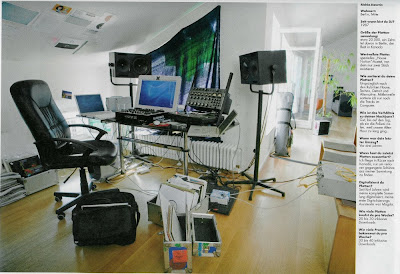
Looking at the "Closer to what today’s typical studio looks like" picture, it appears this setup is sans speakers, and I don't think the two Apple Macs compensate for this...
richie hawtin's set up - looks quite similar to it actually.
I used plugins and Cubase for years, then I bought the greatest analogue synth ever (Oberheim Xpander) for a fortune - noting that it's gone up in value - and then in 2009 I bought some mixing desks, 2 samplers, and a 24-bit, 96k Emu soundcard for mastering. The basic idea was, if everyone else is doing it with plugins, I'll make it sound different by using analogue gear everyone is throwing out cheap on Ebay. Techno…
Earlier quoted context omitted.
I've experienced this a lot while going to Dubstep parties, there are a lot of DJs that indeed have those special ocassion records laying around. First party I went to a DJ called Skream played a track, later I found out it's one that he would never release and has a bit of a legendary status on the boards etc surrounding Dubstep. It was indeed amazing to experience it.
It should be noted that some of the time this is because the tracks in question have a massive, unclearable sample from a major label artist. Eg. https://www.youtube.com/watch?v=2RJy2-F2irA It pains me that I will likely never get to own this record. However I have already paid to go and see someone who played it, and this was certainly part of my decision to do so. They've probably made more money off me from that t…