This is just a spam ad for a Blockchain promoter "Internet of Blockchain"
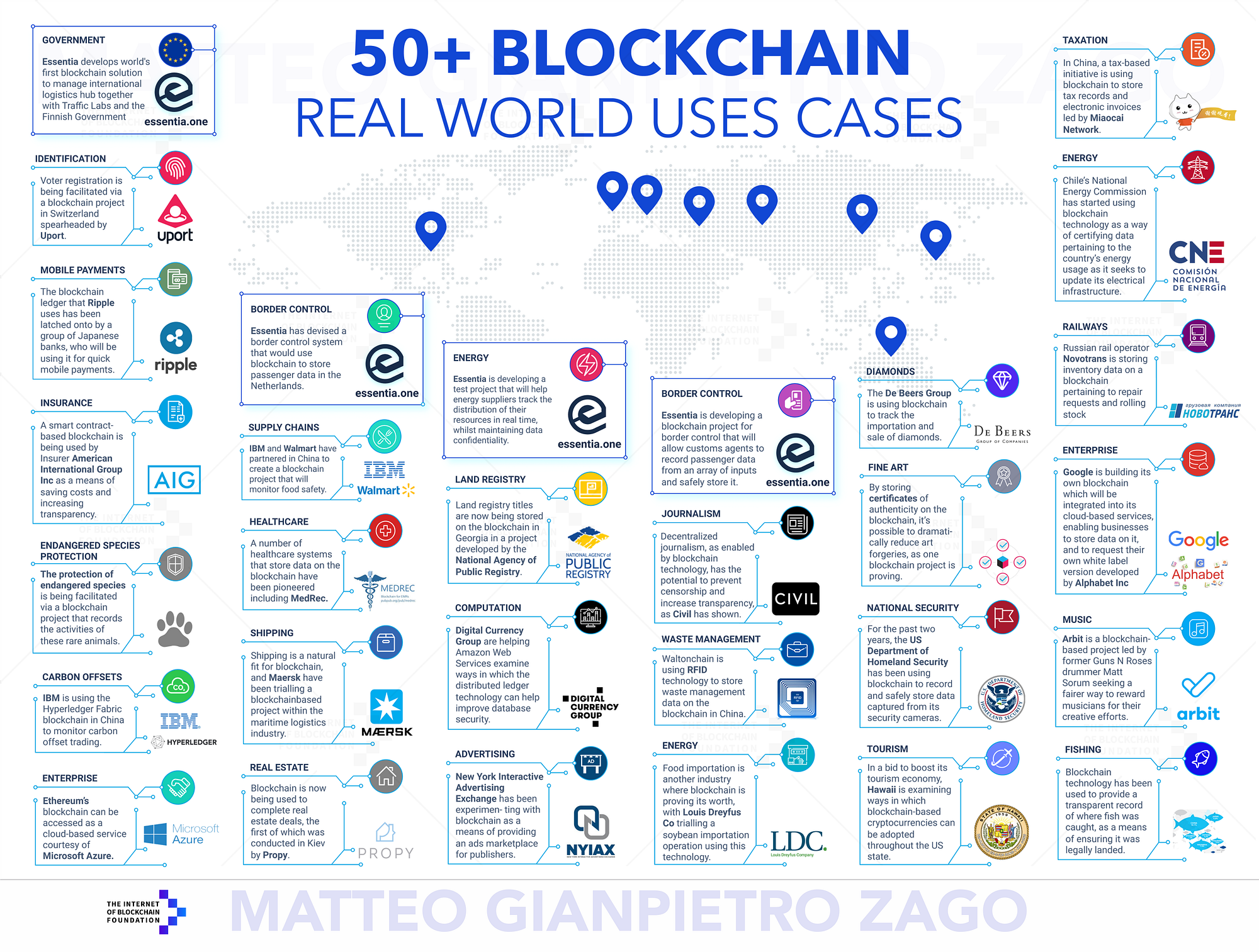
50+ real world use cases built on blockchain architecture
31–40 of 44 posts
Re: 50+ real world use cases built on blockchain architecture
#32I'm shocked IOTA isn't on this list.
Companies like Bosch and Fujitsu are already creating uses for it in IoT.
There're already a few IOTA-powered electric vehicle charging stations in Europe. It's instant and fee-free, with very little overhead (no power consumption problem).
Since it cannot be mined via PoW, there are already efforts to create "mining pools" were universities can rent CPU/GPU power from "miners" using IOTA, that way miners are performing valuable computations rather than just a bunch of redundant math.
Re: 50+ real world use cases built on blockchain architecture
#33Earlier quoted context omitted.
Indeed it doesn't. 51% attacks don't allow you to steal something you've never owned, because there's no valid transaction that transfers ownership to you. The only way a 51% attack allows you to steal anything is by reverting a transaction you made that sends something from you to me, and immediately replacing it with a transaction that sends the same thing from you to yourself. This is only useful if you convinced…
You can prove it, you have the signed transaction from him that can't be included in the blockchain because their inputs were spent. If you know who you were dealing with that did the double spend, you likely would have a very good case against them of fraud.
There's two potential issues: Can I prove they control the private key that goes with that transaction? Can I prove that that transaction was originally used to settle a specific invoice (or something equivalent)? Sometimes, one of the two will be true and I have a strong case. In others, I have neither and it's my word against theirs.
Re: 50+ real world use cases built on blockchain architecture
#34Real world use cases?
is developing a, that would use, will be using, it is possible to, as it seeks to, is building, which will be, seeking a way, has been experimenting, ...
Sounds more like a maybe future fantasy world.
Re: 50+ real world use cases built on blockchain architecture
#35There are only 30, it's full of typos, doesn't include any finance stuff, and some aren't actually real use cases.
And a lot seem to be "...is experimenting with..."
Yeah those are the "not real use cases" I was calling out.
And I am heavily exposed to enterprise blockchain... This kind of half-assed thing doesn't build much of a case in favor of the industry.
Re: 50+ real world use cases built on blockchain architecture
#36Seems like most of these can be done without blockchain. Some are not even 'real world' at this point, but just experimenting. As others have pointed out, when in doubt - 'do you need a blockchain? no'. Overhyping them for use cases where they are not needed will have a negative effect on trying to get support for the places where they might actually be useful.
Re: 50+ real world use cases built on blockchain architecture
#37Almost all of these would have been possible without a blockchain. Either through a web of trust or even simple cryptographically signed messages with timestamps stored in a normal DB. Some of these aren't even "real world use cases" like Hawaii trying to boost tourism by something-something blockchain. Civil is a notable exception, though I'm not unconvinced that it couldn't be done without one. In the end though, i…
Namecoin is the best example of a real world use case, a proper replacement of a DNS with no central authority. This is clearly one which is very difficult to replicate reliably without a blockchain.
All the blockchain systems have serious scalability issues with, for example, bitcoin transactions times slowing remarkably over time. I don't see how this would be a practical match for a DNS system.
Moreover, at the end of the day, even DNS is a matter of "real world truth" and there's no reason a vote by miners would be particularly reliable source of this truth.
Re: 50+ real world use cases built on blockchain architecture
#38Earlier quoted context omitted.
Even if blockchain DNS systems were production quality - which they're far from - why is a 'central authority' inherently bad? The entirety of cloud computing, and the modern internet, is based on the pretense of giving your entire infrastructure to a centralized authority. "Oh, but what if your centralized cloud provider is actually evil and incompetent", the free markets allow you to change providers until you have…
If my cloud provider is bad, I can switch to another one or self-host. You can't switch from the ICANN, no matter which domain you chose, it depends on them, they effectively have a monopoly. I want to self host my domain name.
There was AlterNIC, it didn’t have a lot of success.
Re: 50+ real world use cases built on blockchain architecture
#39Earlier quoted context omitted.
Namecoin is the best example of a real world use case, a proper replacement of a DNS with no central authority. This is clearly one which is very difficult to replicate reliably without a blockchain.
All the blockchain systems have serious scalability issues with, for example, bitcoin transactions times slowing remarkably over time. I don't see how this would be a practical match for a DNS system. Moreover, at the end of the day, even DNS is a matter of "real world truth" and there's no reason a vote by miners would be particularly reliable source of this truth.
For namecoin, the blockchain doesn’t need to be involved with grabbing the data, just creating a public record of intent.
Right now, accurate propagation of settings throughout DNS kind of assumes a lot. I don’t think Namecoin captures incentives properly either, but I can imagine some blochchain system connecting the dots.
Re: 50+ real world use cases built on blockchain architecture
#40"But why???" is the question I keep asking myself after reading each entry.
I wrote a Blockchain to learn the tech. I now have a pretty good understanding. Now that I get it I keep looking for legitimate reasons to use it and frankly I haven’t found many. Eliminating property title insurance via an immutable set of property ownership records/txns is one that seems reasonable. It fits because the txn volume is low. Many “forced” uses would be better served by more standard architectures.