Live data from Hacker News

Corporations in the Age of Inequality

hbr.org

31–40 of 75 posts

Re: Corporations in the Age of Inequality

#31

Earlier quoted context omitted.

Meanwhile, global inequality has gone down, because desperately poor Indians and Chinese have grown significantly wealthier. https://s3.amazonaws.com/content.washingtonexaminer.biz/web-... I feel so bad for those rich westerners with a house, running water, 24/7 electricity, free schools, etc.

The fact that living conditions improving for people in the 3rd world makes you feel better maybe doesn't do as much for "rich westerners" whose jobs have moved overseas.

Helping the less rich Americans does nothing for the 1% either. What's your point?

Re: Corporations in the Age of Inequality

#32
post #3

I take issue with the "Average Company Salary" graph at the center of the article. The article claims that "This means that the rising gap in pay between firms accounts for the large majority of the increase in income inequality in the United States." However, when CEOs make on average 300 times more than their workers, it kinda screws up that crucial average, doesn't it. Then there's the other executives messing up…

I think looking at CEO-only pay is a red herring. The CEO of a company like Google might be paid a lot, but if you cut that pay to zero and redistributed to the rest of the company, the impact wouldn't be massive. To wit, the CEO of google was paid $100 million in 2015, and Google has about 50K employees, resulting in a $2K difference for everyone.

Do you believe that if all corporations just reduced the pay of the top 1% of the pay grade, that within-US inequality rises would be majority eliminated? What's the evidence either way?

Re: Corporations in the Age of Inequality

#33
> In an increasingly winner-take-all or at least winner-take-most economy, the best-educated and most-skilled employees cluster inside the most successful companies, their incomes rising dramatically compared with those of outsiders.

US median income is $52K, software developer is maybe 100K, so around double. But to make that you have to live in an area with a much higher cost of living, and the various governments take more than a quarter of the difference in taxes and more than a quarter of the difference in disqualifications from income-based benefits programs. While you work 80 hours a week.

Someone making $100K in San Francisco is not doing better than someone making $50K in Houston. (You have a serious problem, however, if you make $50K in San Francisco.)

And the people clearing a million aren't typically silicon valley developers, they're Wall St quants and investment bankers. And those same people are generally paying the lower capital gains rate rather than the higher earned income rate, and losing a smaller percentage in benefits phase outs because by then everything is already phased out.

The numbers in the article are also including people who aren't working -- it has the 25th percentile income as zero and the median as something like $25K, which it probably is if you include retirees and homemakers and students, but how is that "income inequality"? For it to mean anything you have to be comparing people who are actually working full time. Anyone working obviously makes infinity times more than anyone with zero income.

As to the central thesis of "winner take most", markets like Facebook with network effects are the exception and have existed before (e.g. AT&T). In most other markets you can really blame regulatory compliance costs and regulatory capture. More paperwork to do and lawyers to hire and fees to pay to do business today than in 1970. The higher the cost of operating a business, the more advantage to consolidation.
Re: Corporations in the Age of Inequality

#34
post #3

I take issue with the "Average Company Salary" graph at the center of the article. The article claims that "This means that the rising gap in pay between firms accounts for the large majority of the increase in income inequality in the United States." However, when CEOs make on average 300 times more than their workers, it kinda screws up that crucial average, doesn't it. Then there's the other executives messing up…

I think looking at CEO-only pay is a red herring. The CEO of a company like Google might be paid a lot, but if you cut that pay to zero and redistributed to the rest of the company, the impact wouldn't be massive. To wit, the CEO of google was paid $100 million in 2015, and Google has about 50K employees, resulting in a $2K difference for everyone. Do you believe that if all corporations just reduced the pay of the t…

No I don't believe that. Never implied anything of the sort.

You made a fair point about the number of employees, but I was careful to also mention other senior executive pay. I mentioned a host of other factors such as political corruption and rent-seeking behaviours being likely far more important factors. Jumping to the conclusion implied in your question is unfair, and might point to a bias you're walking around with, I think.

Do you believe, as this article claims, that :the majority: of inequality in the US is due to how much Google and other top companies choose to pay their employees?

Regardless, do you believe that this article employed convincing analysis and evidence to back up such a belief?

Re: Corporations in the Age of Inequality

#35
post #12

Earlier quoted context omitted.

In a global economy, workers have no leverage. If a group tries to form a union, the work goes elsewhere. Globalism exploits the fact that there are people willing to work for $1/hr, and leads to many of the problems of capitalism predicted by Marx and friends in the early 1900s. As long as globalization is allowed to continue, inequality within the US will just grow worse.

Globalization is not the enemy. Centralised globalization with a handful of megacorps dominating the global economy is fucking awful however. Protectionism is at best a short term solution that comes with a host of other problems. The major threats to our existence are global problems like climate change and nuclear arsenals. Fighting against all globalization will only divide us. I believe that the best leverage wor…

> Globalization is not the enemy.

The problem is there are two kinds. The classic one, and the one you can easily defend, was just eliminating tariffs. Don't discriminate against foreign businesses; treat them the same as local businesses.

But there is another one that generally gets called "harmonization", and that's the one that kills everything. Because what it means in practice is the undemocratic international enforcement of regulations created via regulatory capture. You enforce the same rules everywhere, those rules are created by megacorps to give them an advantage and the predictable result obtains.

Re: Corporations in the Age of Inequality

#36

Earlier quoted context omitted.

The fact that living conditions improving for people in the 3rd world makes you feel better maybe doesn't do as much for "rich westerners" whose jobs have moved overseas.

Helping the less rich Americans does nothing for the 1% either. What's your point?

I think he means you're taking from one to give to another, which eventually results in the former being as worse off as the latter was, so the sum total of your "humanitarian effort" ultimately amounts to zero. But that's a guess.

Re: Corporations in the Age of Inequality

#37
post #12

Earlier quoted context omitted.

In a global economy, workers have no leverage. If a group tries to form a union, the work goes elsewhere. Globalism exploits the fact that there are people willing to work for $1/hr, and leads to many of the problems of capitalism predicted by Marx and friends in the early 1900s. As long as globalization is allowed to continue, inequality within the US will just grow worse.

Globalization is not the enemy. Centralised globalization with a handful of megacorps dominating the global economy is fucking awful however. Protectionism is at best a short term solution that comes with a host of other problems. The major threats to our existence are global problems like climate change and nuclear arsenals. Fighting against all globalization will only divide us. I believe that the best leverage wor…

>> I believe that the best leverage workers of the world can have is the ability to live a decent life without the threat of starvation or extreme poverty. This dream is attainable, and worth planning for and building towards as a species.

What do you mean by "ability"? Opportunity? I don't see how any particular economic status of anyone can be guaranteed with regards to what you're saying.

How I see it: The rich get richer and the poor, poorer. Once the rich have all the wealth, they go elsewhere with it. Corporations move to Singapore to save money. Automation will only benefit those who own it. Once things are automated, most people will lose their jobs and won't be able to afford even the things that are produced by automation. The rich aren't going to share, and if they do, they do it with strings attached so they can manipulate the spending and promote their own agendas (which is what they do now anyways).

The biggest problem is simply human selfishness. Because of it, there will never be peace. There will always be people seeking more than they need, always seeking their own survival over that of others, always seeking to crush others to give themselves a boost physically/economically/egotistically/etc. There will never be world peace as long as people are selfish, which basically makes world peace a pipe dream. Sorry to step on toes, but that's life.

Re: Corporations in the Age of Inequality

#38
> News outlets reported that people had thrown rocks and a bus window had been smashed.

Do poor people really want to settle their resentment issues with violence? Because it seems to me that they will lose, at least if rich people defend themselves.

Re: Corporations in the Age of Inequality

#39

Earlier quoted context omitted.

Helping the less rich Americans does nothing for the 1% either. What's your point?

I think he means you're taking from one to give to another, which eventually results in the former being as worse off as the latter was, so the sum total of your "humanitarian effort" ultimately amounts to zero. But that's a guess.

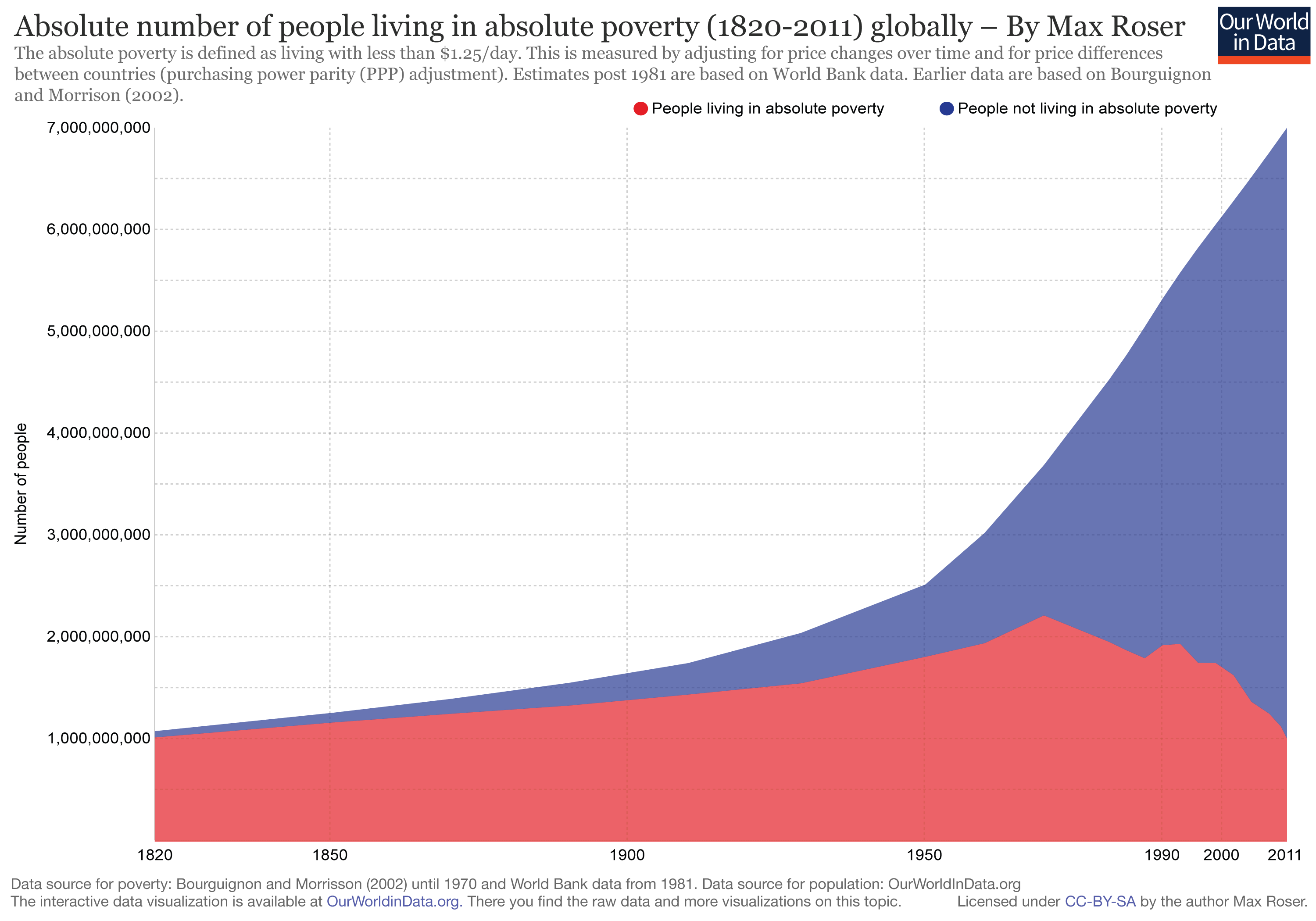
That's actually not true. The number of people living in absolute poverty (for various definitions of it) has gone down drastically.

http://ourworldindata.org/wp-content/uploads/2015/07/ourworl...

http://siteresources.worldbank.org/DEC/Images/84796-11797610...

https://cdn.static-economist.com/sites/default/files/images/...

Really, the only issue seems to be a loss of status (not goods and services) by some rich white westerners. (Non-white westerners seem to have improved their situation by quite a bit also.)

Re: Corporations in the Age of Inequality

#40
post #12

Earlier quoted context omitted.

Globalization is not the enemy. Centralised globalization with a handful of megacorps dominating the global economy is fucking awful however. Protectionism is at best a short term solution that comes with a host of other problems. The major threats to our existence are global problems like climate change and nuclear arsenals. Fighting against all globalization will only divide us. I believe that the best leverage wor…

> Globalization is not the enemy. The problem is there are two kinds. The classic one, and the one you can easily defend, was just eliminating tariffs. Don't discriminate against foreign businesses; treat them the same as local businesses. But there is another one that generally gets called "harmonization", and that's the one that kills everything. Because what it means in practice is the undemocratic international e…

The classical one does quite a bit harm too.

Western/1st/etc world (used to?) treat workers well. The rest of the world didn't. Once tariffs are eliminated, all countries join the rat race to the bottom. How can western countries with good social safety net, reasonable work hours and good wages compete with cut-throat conditions in Asia? Naturally the conditions equalise. The good ones get worse, while bad ones adopt a thing or two.

Post reply on HN