Live data from Hacker News

Virus and Two Types of Bacteria as Major Causes of Alzheimer’s

neurosciencenews.com

31–36 of 36 posts

Re: Virus and Two Types of Bacteria as Major Causes of Alzheimer’s

#31
post #6

The problem really lies with the fact that within the more than 100,000 published studies on Alzheimer's disease you are bound to find a random association between this disease and many other things. This is especially true for observational studies in people, and also true for low-powered studies in experimental animals. Experimental science, however, demands that one establishes a cause and effect relationship. The…

From the wording of the article, it's pretty clear that the researchers that the authors are aware of the degree of circumspection that such findings typically raise -- and that this isn't just a matter of a single associational study; but rather, a retrospective finding over many studies. Which the researchers feel should forces to consider the fact that we may be close to a tipping point, with regard to the proposed etiology at hand.

Hence statements like "We can't keep ignoring the evidence", "landmark editorial", etc.
Re: Virus and Two Types of Bacteria as Major Causes of Alzheimer’s

#32

slightly off topic but i remember a study from 2010 where it was found beetroots could help with older adults brain health the sample size was not huge (14 i think) and it was cited nitrates are the beneficial agent. It would be interesting to see if there is any association between the suggested offending microbial activity and nitrates in vitro before moving on to some sort of in vivo model https://www.sciencedaily…

Your reference to nitrates reminded me of this other topic that was on hacker news today about migraines being caused by microbes in the mouth interacting with foods containing nitrates....https://news.ycombinator.com/item?id=12747773

Re: Virus and Two Types of Bacteria as Major Causes of Alzheimer’s

#33
post #21

Earlier quoted context omitted.

What, if not correlation, does imply causation?

I'm sorry, is that an incredibly lazy way of arguing that correlation does imply causation, but you feel like reversing it and dumping the burden of proof onto me? No.

Correlation suggests causation, but does not prove it.

Re: Virus and Two Types of Bacteria as Major Causes of Alzheimer’s

#34
post #33
post #21

Earlier quoted context omitted.

I'm sorry, is that an incredibly lazy way of arguing that correlation does imply causation, but you feel like reversing it and dumping the burden of proof onto me? No.

Correlation suggests causation, but does not prove it.

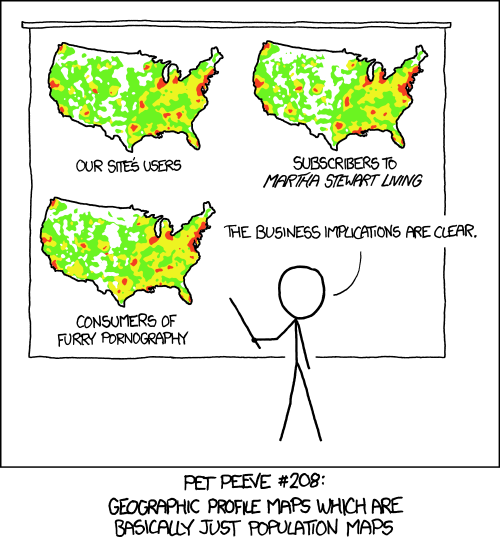
It suggests correlation; get a big enough dataset and you'll find correlations all over the place. They don't imply a causal relationship, at all.

http://imgs.xkcd.com/comics/heatmap.png

Re: Virus and Two Types of Bacteria as Major Causes of Alzheimer’s

#35
post #6

The problem really lies with the fact that within the more than 100,000 published studies on Alzheimer's disease you are bound to find a random association between this disease and many other things. This is especially true for observational studies in people, and also true for low-powered studies in experimental animals. Experimental science, however, demands that one establishes a cause and effect relationship. The…

There is a known cure for early Alzheimer's. https://www.aging-us.com/article/9R5JsRe8k4Jq7uTXj/text Bredesen DE. Reversal of cognitive decline in Alzheimer's disease. Aging (Albany NY). 2016 Jun;8(6):1250-8. doi: 10.18632/aging.100981. Bredesen DE. Reversal of cognitive decline: A novel therapeutic program. Aging (Albany NY). 2014; 6:707-17. doi: 10.18632/aging.100690.

The reviews of this work conclude that it is dubious, example: https://www.sciencebasedmedicine.org/mend-protocol-for-alzhe...

Re: Virus and Two Types of Bacteria as Major Causes of Alzheimer’s

#36
post #34
post #33

Earlier quoted context omitted.

Correlation suggests causation, but does not prove it.

It suggests correlation; get a big enough dataset and you'll find correlations all over the place. They don't imply a causal relationship, at all. http://imgs.xkcd.com/comics/heatmap.png

Indeed, correlations are not sufficient to establish cause. However... things that do cause a specific effect also tend to correlate. So correlations are a basis for hypotheses that can be experimentally tested.

To wit, the hypothesis presented in the post linked to by OP can be tested by treating people with Alzheimer's disease with antimicrobial agents.

Unfortunately, in what concern people (disease and dying) experiments on humans (aka clinical trials) are expensive, with uncertain returns. So the experiments that could test hypotheses concerning Alzheimer's disease in real actual people are rarely performed to the level statistically needed.

Instead we get a plethora of studies in mice with "suggestive"implications for what might occur in humans. Along with random studies that are not worth more than anecdotes (see those I commented on above).

Post reply on HN