Live data from Hacker News

Why Economic Growth Will Fall

nybooks.com

31–40 of 176 posts

Re: Why Economic Growth Will Fall

#31

I agree that it's impossible for the rates of economic growth and lifestyle improvements we saw since the late 1800s to continue indefinitely, but the key to growth is investment. And from the late-1800s till the mid-1900s, there were huge government investments made in building new and innovative infrastructure in the US--railroads, the phone network, state universities and K-12 public education, electricity generat…

>Very-low cost higher education was a thing in mid-20th-century America--it was possible to attend your in-state university for a few thousand bucks in today's dollars. What happened? As long as we pretend these things are too expensive to invest in, then we're sure to enter a long slow decline.

I don't think your point about education makes sense. You want more investment, but then bemoan the fact that it costs more, as if that signifies low investment. People are investing in their education at record levels!

Maybe you think student loans are a problem for other reasons, but they certainly aren't stopping people from going to college. Again, they're going in record numbers and spending record money to do so.
Re: Why Economic Growth Will Fall

#32

I agree that it's impossible for the rates of economic growth and lifestyle improvements we saw since the late 1800s to continue indefinitely, but the key to growth is investment. And from the late-1800s till the mid-1900s, there were huge government investments made in building new and innovative infrastructure in the US--railroads, the phone network, state universities and K-12 public education, electricity generat…

> What happened? As long as we pretend these things are too expensive to invest in, then we're sure to enter a long slow decline.

I'll go on the Marxist side of things and say that "quantitative differences have turned out into qualitative ones". What I want to say is that scale matters. Regarding investment in higher-education, it was relatively ok and feasible to give Government subsidies for all the students attending university when only 1%-2% of the students finishing high-school were going to university (I think that happened up until the mid-50s, but maybe I'm wrong), but once you've got 30-50% of the students finishing high-school going to university then the money just isn't there anymore.

And to add to that, it always baffled me how Malthus's name has always had such a bad reputation. The economics for handling a planet inhabited by 1.5 billion people in the late 1800s (we only reached 2 billion people in 1927) are totally different from the economics of a planet inhabited by 7+ billion people, going on 10. Our resources are finite, no matter how much we try to hide it.

Re: Why Economic Growth Will Fall

#33
post #16

Considering we live in an infinite universe I do not see why economic growth can not continue even accelerate. Especially seeing that sometime this century we will get cheap space travel (getting there) and AI (getting there) and transition from fossil fuels to renewables and fusion (getting there) Tho' yes seeing how some of our best and brightest are working on how to serve more ads and how to get people spend thei…

How do you know the size of the universe we live in? (To be pedantic, even in an infinite universe the size of the human-sphere couldn't grow faster than a ball expanding at the speed of light.)

To be pedantic, there are possibilities of FTL travel, such as an Alcubierre drive.

Re: Why Economic Growth Will Fall

#34
post #16

Earlier quoted context omitted.

How do you know the size of the universe we live in? (To be pedantic, even in an infinite universe the size of the human-sphere couldn't grow faster than a ball expanding at the speed of light.)

Because that is the prevalent scientific opinion We are on a course for a confluence of some major technologies this century which could result in another great leap forward. Anyways i forgot why i dont bother to reply much on this site, got down voted for my above comment yet no indication as to why (is it my comment about working on advertising? its ok that's what I work in too myself have to pay bills somehow, but…

The observable universe is very much finite. (And if speed of light is a barrier, than the observable universe is about the biggest thing we can ever influence.)

Sure, there will be lots of nice technology coming over the next century. No doubts about that.

Re: Why Economic Growth Will Fall

#35

Considering we live in an infinite universe I do not see why economic growth can not continue even accelerate. Especially seeing that sometime this century we will get cheap space travel (getting there) and AI (getting there) and transition from fossil fuels to renewables and fusion (getting there) Tho' yes seeing how some of our best and brightest are working on how to serve more ads and how to get people spend thei…

Finite matter tho.

From our observations made from this solar system, it does appear that way. However, they may not be entirely accurate.

Re: Why Economic Growth Will Fall

#36

I agree that it's impossible for the rates of economic growth and lifestyle improvements we saw since the late 1800s to continue indefinitely, but the key to growth is investment. And from the late-1800s till the mid-1900s, there were huge government investments made in building new and innovative infrastructure in the US--railroads, the phone network, state universities and K-12 public education, electricity generat…

[deleted]

Re: Why Economic Growth Will Fall

#37
Bill Gates' review of this book takes a techo-optimist view of it.

https://www.gatesnotes.com/Books/The-Rise-and-Fall-of-Americ...

"Most reviews have focused on the “fall” indicated in the title: the last hundred pages or so, in which Gordon predicts that the future won’t live up to the past in terms of economic growth. I strongly disagree with him on that point, as I discuss below. But I did find his historical analysis, which makes up the bulk of the book, utterly fascinating"

Re: Why Economic Growth Will Fall

#38
post #32

I agree that it's impossible for the rates of economic growth and lifestyle improvements we saw since the late 1800s to continue indefinitely, but the key to growth is investment. And from the late-1800s till the mid-1900s, there were huge government investments made in building new and innovative infrastructure in the US--railroads, the phone network, state universities and K-12 public education, electricity generat…

> What happened? As long as we pretend these things are too expensive to invest in, then we're sure to enter a long slow decline. I'll go on the Marxist side of things and say that "quantitative differences have turned out into qualitative ones". What I want to say is that scale matters. Regarding investment in higher-education, it was relatively ok and feasible to give Government subsidies for all the students atten…

> And to add to that, it always baffled me how Malthus's name has always had such a bad reputation. The economics for handling a planet inhabited by 1.5 billion people in the late 1800s (we only reached 2 billion people in 1927) are totally different from the economics of a planet inhabited by 7+ billion people, going on 10. Our resources are finite, no matter how much we try to hide it.

I still don't get how Malthus's name got that bad rep in the first place. As for the difference between the late 1800s and now, it's smaller that one may think. Back then people were hitting the ceiling of Earth's capability to feed people. We got through that, and grew beyond 2 billion people, thanks to a series of scientific and technological flukes, like Haber–Bosch process[0]. We were lucky then, this doesn't imply we'll be lucky this time.

[0] - https://en.wikipedia.org/wiki/Haber_process

Re: Why Economic Growth Will Fall

#39

I agree that it's impossible for the rates of economic growth and lifestyle improvements we saw since the late 1800s to continue indefinitely, but the key to growth is investment. And from the late-1800s till the mid-1900s, there were huge government investments made in building new and innovative infrastructure in the US--railroads, the phone network, state universities and K-12 public education, electricity generat…

This, and the wasteful misallocation of resources to bloated and unproductive industries like finance, insurance, advertising and entertainment.

Re: Why Economic Growth Will Fall

#40

I agree that it's impossible for the rates of economic growth and lifestyle improvements we saw since the late 1800s to continue indefinitely, but the key to growth is investment. And from the late-1800s till the mid-1900s, there were huge government investments made in building new and innovative infrastructure in the US--railroads, the phone network, state universities and K-12 public education, electricity generat…

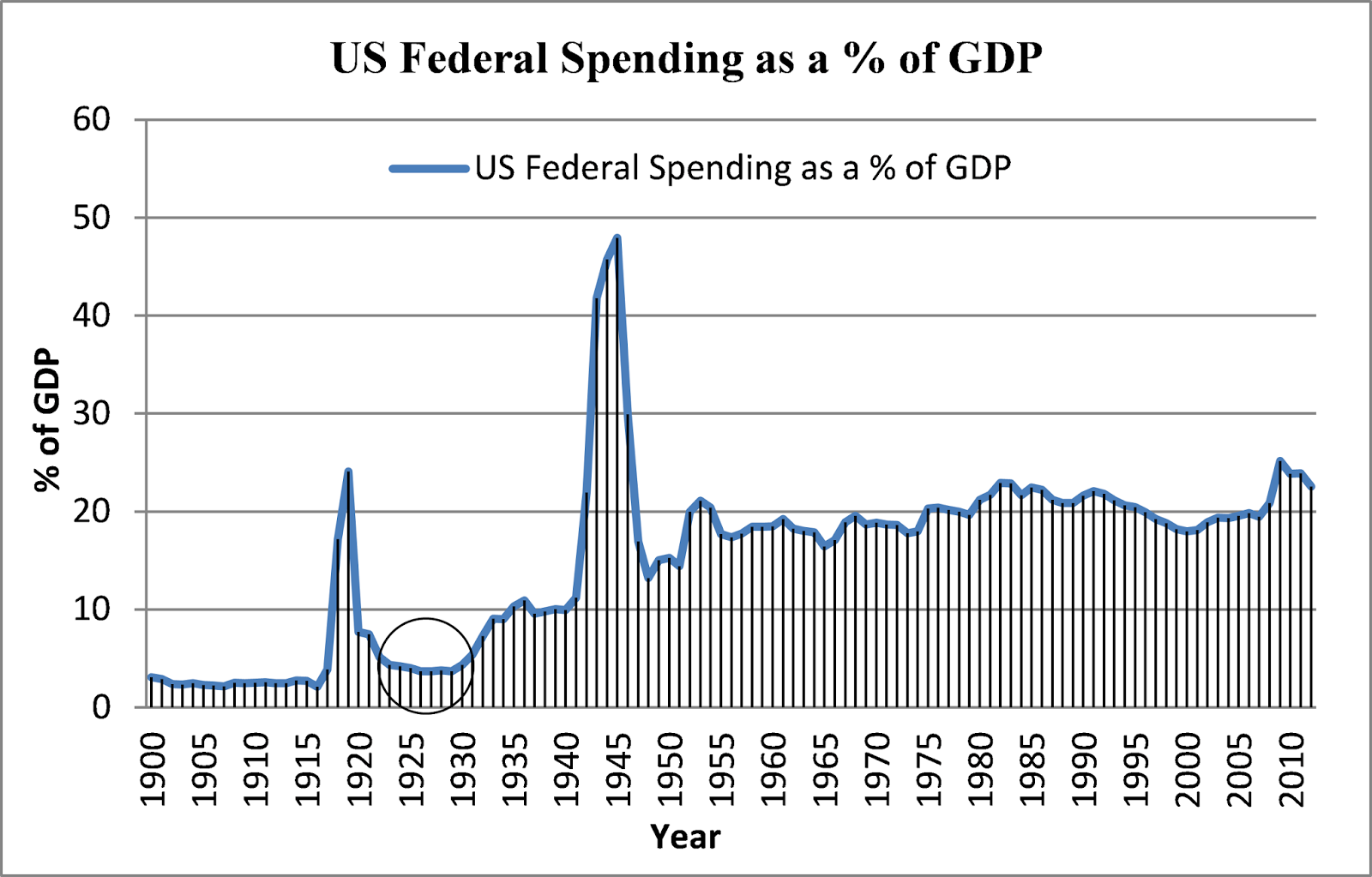
> And from the late-1800s till the mid-1900s, there were huge government investments made in building new and innovative infrastructure in the US--railroads, the phone network, state universities and K-12 public education, electricity generation and distribution, highways, airports.

Excluding the world wars, US government spending was much lower during that period than it is today. It increased greatly with the New Deal in the 30s, and has continued to increase until the present day.

http://3.bp.blogspot.com/-ccxOaz-W_p0/UsgZkuJp-jI/AAAAAAAAAR...

In the late 19th and early 20th centuries, there was huge private investment in infrastructure and basic research (e.g., Edison's research lab).

Post reply on HN