How Wired Is Going to Handle Ad Blocking
31–40 of 390 posts
Re: How Wired Is Going to Handle Ad Blocking
#32> We know that there are many reasons for running an ad blocker, from simply wanting a faster, cleaner browsing experience to concerns about security and tracking software
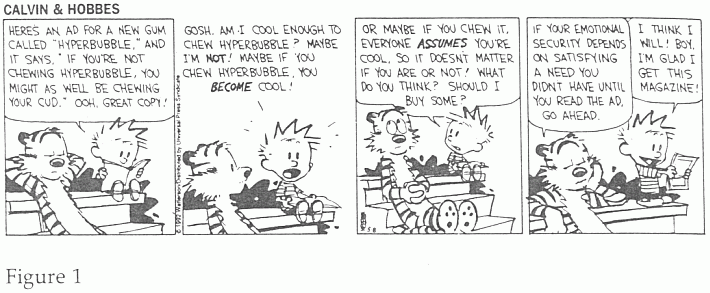
Sigh, again, these are just the incidentals of ads. I wish everyone was just completely honest about what ads are for: they are ploys to manipulate viewers into buying things that they did not need until they watched that ad. Ads are not some goodwill clever mechanism to keep magazines in business. The purpose of ads is not to keep Wired in business.
That being said, I think Wired is completely in their right to escalate in the adblocking arms race. I just wish that they were honest about the rules of engagement: either you are open to the possibility of acquiring a purchasing need that you did not have until you watched an ad, or you do not read Wired's articles.
Or like Hobbes said to Calvin...
Re: How Wired Is Going to Handle Ad Blocking
#33> So, in the coming weeks, we will restrict access to articles on WIRED.com if you are using an ad blocker. Good luck with that, Wired. The people-who-will-never-pay group will split into two: People who never visit your site again, and people who up the ante in the ad-blocking escalation. While you may think that you don't care about the people-who-will-never-pay group, the latter subgroup will release their improve…
Your comment doesn't make any sense?
Don't view ads. Wired doesn't care about you. You contribute nothing back anyway.
So by making it a little harder, at least some of those people with morals will be pushed in the right direction to pay or white list ads for free content.
Re: How Wired Is Going to Handle Ad Blocking
#34If there's an arms race between ad-blockers and ad-blocker-detectors, the latter will win. All of the money and incentives are set up for them to do a better job.
I'd need you to clarify your idea of "winning", but I'm pretty sure I'd take the opposite side of this bet. Ad-blockers will win because people find ads very annoying.
My contention is that if you want to, you can make ads nearly indistinguishable from "content".
On the extreme side, I would say that I have won this bet already; if you pick up something like the Wall Street Journal and count the number of articles that someone involved wanted printed, you'd find that most of what you're reading is one kind of ad or another.
But there are technical solutions as well. Obfuscation beats machine parsers for at least the foreseeable future.
Re: How Wired Is Going to Handle Ad Blocking
#35Forbes has been doing this for a while on its website. (Or, at least for a while it has been detecting the ad blocking-software that I have been using for much longer.) I have basically stopped reading Forbes (which maybe was a good idea on other grounds) and have learned to appreciate stories from competing publications. If Wired doesn't want my eyeballs to visit its site, I'll just stop bringing them there.
Wired is in the business of making money. You don't pay them any money directly, so they make it up by showing you ads. If you're going them to prevent them from making money that way, then they don't give a hoot about your eyeballs.
> so they make it up by showing you ads.
Correction: they make it up by giving third parties the ability to lift each and every bit of identifiable information available from your browser, to profile you, to sell your demographic information (lat/lon/approximate age/wealth/family situation/etc, etc) to middlemen who will then in turn sell the opportunity to advertise to you in a real time bidding process to the highest bidder, some ad agency that bought campaign inventory.
If it was just the ads I highly doubt there would be any issue at all.
Re: How Wired Is Going to Handle Ad Blocking
#36I don't mind ads but I do mind tracking.
* If Wired would implement a solution that provides confidentiality to users, following the approach of The Intercept [1], I would have no problem with it.
* If Wired would show me ads I was interested in, I'd be happy to see them (assuming my confidentiality is preserved).
* If Wired would provide a way to pay them without having to go through another website registration and credit card payment process, I'd pay them. I don't have time to register for and pay every website I read using the current systems, and Wired isn't at the top of my list.
If users are so annoyed by part of your website that they are investing time and effort in disabling it, perhaps the problem is with your website.
[1] https://theintercept.com/2015/11/04/what-the-intercepts-new-...
Re: How Wired Is Going to Handle Ad Blocking
#37Cue all the people who say "Fine, then I won't ever go to Wired's site again." That's kind of the point, you know.
While there may be some benefit to avoiding free riders, that definitely is not the goal. The goal is to hopefully prevent some new installs of ad blockers with a hope that some of those existing free riders disable their ad-blockers on Wired or pay a subscription.
Re: How Wired Is Going to Handle Ad Blocking
#38I'm sure market research has been done. But 52 dollars a year is probably too high a price for an ad free version of wired. I would pay maybe three or four dollars a year, which has to be more money than they would possibly make off of the advertising revenue I would generate in a lifetime.
Re: How Wired Is Going to Handle Ad Blocking
#39How are they going to detect ad blocking? They're going to have to spend a long time fighting anti-ad block detection. You can't trust the client. Ads are displayed in the client. It would take hardware level ad serving to make ad serving and anti-ad blocking feasible.
Trivial answer: the webpage is a monolithic PNG. Good luck building a general-purpose image parser & modifier, especially on a webpage with embedded animations. There are ways to make it very difficult to distinguish between content and ads, that's all you need to do. At the highest level, the content is the ads, which is usually what ends up happening to trade publications anyway.
A monolithic PNG wouldn't have annoying animated ads or videos that push down content, they wouldn't pop over. They wouldn't be serving malware since it would come from wired. I would miss the ability to select text, but I wouldn't be bothered by the ads anymore.
Maybe now if they served a canvas element, and put all the content in that with animated ads, that would be more bothersome.
Re: How Wired Is Going to Handle Ad Blocking
#40> So, in the coming weeks, we will restrict access to articles on WIRED.com if you are using an ad blocker. Good luck with that, Wired. The people-who-will-never-pay group will split into two: People who never visit your site again, and people who up the ante in the ad-blocking escalation. While you may think that you don't care about the people-who-will-never-pay group, the latter subgroup will release their improve…
Your comment doesn't make any sense? Don't view ads. Wired doesn't care about you. You contribute nothing back anyway. So by making it a little harder, at least some of those people with morals will be pushed in the right direction to pay or white list ads for free content.
> some of those people with morals
As opposed to those without morals who won't white list the trackers or pay up?
As opposed to those moral upstanding citizens that run the advertising industry?
I don't think that the 'morals' bit needs to be in there, in fact it would be stronger without.