Live data from Hacker News

US Navy will replace touchscreen with mechanical controls on its destroyers

theverge.com

291–300 of 458 posts

Re: US Navy will replace touchscreen with mechanical controls on its destroyers

#291

Wait. Let me get this straight. Touchscreens, which are ideal for representing multiple user unterfaces in an intuitive way, but requiring constant visual contact are being replaced by a physical user interface that can be used by both touch, and memory? Why was touchscreen ever even a consideration for controls you're not looking at? Touchscreen is great for phones. It is awful for keyboards (see macbook pro). And i…

Well, it worked on Star Trek. Then again, that was addressed in a Voyager episode when Tom Paris designs the helm in their new runabout with old fashioned buttons and switches because he wanted to actually feel the controls much to Tuvok's dismay. Though, on a serious note, I work in industrial automation and user interfaces, aka HMI's have been touch oriented for quite some time. It was and still is common to see gr…

It's not surprising that for brains evolved to deal with a physical world, physical controls feel more natural.

You can add all the haptic and UI flair you want in, but it's not going to make my nerves tingle in the way my brain expects.
Re: US Navy will replace touchscreen with mechanical controls on its destroyers

#292

Earlier quoted context omitted.

> Unexpectedly, it turned out to be faster for users too. I'm not anti-touchscreen by any measure, but did you really find that surprising? It seems common knowledge to me that keyboard shortcuts are faster than touchscreens for most tasks.

Ever since mouses and GUIs were invented it was common knowledge that "ordinary" users don't bother to learn keyboard shortcuts. That common knowledge is wrong, but it comes from an important truth: brand new users who are not yet committed to your product will get frustrated if the thing they need to do is hidden away as a key-binding or command-line command. So successful products optimise for the UX of a user who…

> So successful products optimise for the UX of a user who doesn't yet know how to use the product well. And such users really love touchscreens.

I think the problem is that touchscreens get ported to applications where there should be a reasonable expectation that the end user is an expert in the system. For example, cars, and aircraft. Touchscreens are great when you have portable systems that have to condense a lot of functionality into a small device, but I don't want to be in a position where a pilot has to touch the correct button on a touchscreen in the middle of serious turbulence. Likewise, no driver should be taking their eyes off the road to navigate to the air-conditioning tab. Applying touchscreens in these situations is not only bad engineering, it's outright dangerous. You have to demonstrate competent control of a vehicle just to operate it, so we shouldn't be assuming operators are brand new users that aren't committed to the product.

Re: US Navy will replace touchscreen with mechanical controls on its destroyers

#293

Earlier quoted context omitted.

Ever since mouses and GUIs were invented it was common knowledge that "ordinary" users don't bother to learn keyboard shortcuts. That common knowledge is wrong, but it comes from an important truth: brand new users who are not yet committed to your product will get frustrated if the thing they need to do is hidden away as a key-binding or command-line command. So successful products optimise for the UX of a user who…

But I wasn't talking about onboarding. I was talking about the speed of people using your software to do work on either a touchscreen or a keyboard.

The decision makers in UI design often design for "someone ripped from plow by grenade", as the saying goes in Poland - someone who has no idea about the product at all. Others tend to follow this.

All of that results in undiscoverable interfaces designed for first-time users and horrible for everything else, and thus cult of first mouse, now touchscreen.

Re: US Navy will replace touchscreen with mechanical controls on its destroyers

#294

Earlier quoted context omitted.

Right, to sense location, not rotation. Rotation goes through Bluetooth, as with any number of existing knob controllers.

What if the metal base of the rotatable knob has a certain rotationaly asymmetric pattern instead of being completely flat? We would then be able to receive that pattern and understand how the knob is rotated. What’s the resolution of todays touchscreen?

It's an interesting thought. You'd want to use a full bandwidth data channel (e.g. Bluetooth) for anything complicated.

But for simple things, if possible without affecting the other parts of the screen, it'd be amazing to have a broadly supported, low bandwidth standard.

Re: US Navy will replace touchscreen with mechanical controls on its destroyers

#295

Earlier quoted context omitted.

Right, to sense location, not rotation. Rotation goes through Bluetooth, as with any number of existing knob controllers.

Funny, I have a whole sketch for this. Well the cat is out of the bag, we might as well complete this to prevent any patents. I envision using cam levered suction cups to hold on rotary and linear sliders that had touch screen sensitive rubber tips. One could go as far to 3d print arbitrary interaction devices that could get attached to the face of the touch screen. You can use the multitouch sensor w/o the screen bu…

Yep, any number of other controls besides knobs would work under the same basic principle. A linear slider control would be an obvious one, as would calculator-style membrane buttons.

I'd be surprised if the concept weren't already patented, though, just because the idea of a generalized capacitive control surface seems fairly obvious, and the patent office doesn't really apply an "obviousness" test. What definitely surprises me is that, patented or not, I can't just go out and buy these sorts of controls.

Re: US Navy will replace touchscreen with mechanical controls on its destroyers

#296

Wait. Let me get this straight. Touchscreens, which are ideal for representing multiple user unterfaces in an intuitive way, but requiring constant visual contact are being replaced by a physical user interface that can be used by both touch, and memory? Why was touchscreen ever even a consideration for controls you're not looking at? Touchscreen is great for phones. It is awful for keyboards (see macbook pro). And i…

> Touchscreens, which are ideal for representing multiple user unterfaces I am no expert on this, but from talking to people in the aviation industry I noticed slow a trend away from the cockpit-with-2,000 controls and towards using computer screens which switch between display multiple things. Or rather, there still are 2,000 controls, but thanks to the computer-screens, the number hasn't blown up to 200,000. So my…

Aviation tends to multiple-function displays with somewhat common controls used for them. Started with softkeys around the screens, on recent A350 you have two keyboard/mouse sets for both pilots, plus extra buttons, and a bit complex setup of which screens can display what.

No touchscreens for in-flight, though, although iPads became common as replacement for paper charts.

Re: US Navy will replace touchscreen with mechanical controls on its destroyers

#297
post #252

Earlier quoted context omitted.

Honest question: Why don't modern cars yet monitor humidity in and outside the car and make the correct decisions to keep your windows clear? Why are we focusing on self-driving cars while our cars are too dumb to do this much on their own?

This is the Airbus v Boeing problem. There are two schools of thought, one being that you the operator can control all the settings including the ones necessary to avoid the fogging. There are others that do so automatically. So many times people would be aggravated that my a/c would turn on with the heat in my Audi. What they didn’t realize was how that prevented fogging of the windows which inevitably would happen…

Automatic things are annoying IF the user isn't sure what is happening or why.

Heat randomly turns on -> human is confused, maybe uncomfortable, and might think the car is broken/haunted.

Heat randomly turns on, car displays "Preventing windshield fogging" -> human is thankful car is thinking ahead.

Re: US Navy will replace touchscreen with mechanical controls on its destroyers

#298
post #110

Great. If only monitor manufacturers would do the same thing. I have a monitor with exactly 2 inputs (1 DP, 1 HDMI). What do I need to do to switch between them? 1. Press the Menu button 2. Move the option to Input Source 3. Select Input Source 4. Move from one to the other 5. Press Select Some monitor will compress 1-3 into a single Input Source option. Still, 3 presses? Why does literally NO ONE make a monitor with…

I really believe we would be better off if every piece of technology we used was open source. All the display manufacturers really want is to make displays. Making the OSD doesn’t have to be their doing, and an open source community could build a common interface with some basic button requirements. We could maintain a list of supported manufacturers and before long you know to avoid devices that don’t support it. Th…

This is a great idea.

Or make monitors have a USB device profile, or just use the serial profile and have a command response protocol (http rest) for query and setting configuration. Standardize this protocol.

Now all displays could be configured using external standardized logic. I'd prefer something over SPI, but either is really ok.

Re: US Navy will replace touchscreen with mechanical controls on its destroyers

#299
post #114

Earlier quoted context omitted.

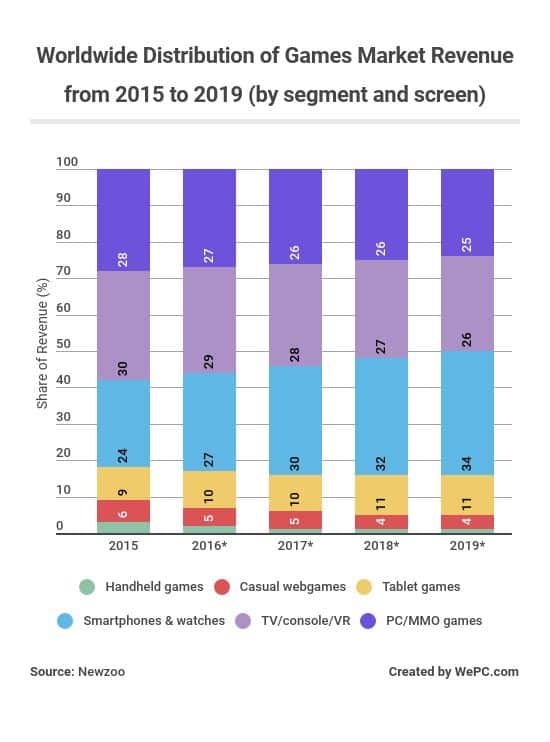
>I suspect there are more PC gamers than console gamers Source for this? Random search yields this: >Steam now has more than 65 million active accounts. [...] Microsoft's Xbox Live has 48 million accounts [...] and Sony's PlayStation Network claims 110 million. https://www.theverge.com/2013/10/30/5045830/steam-65-million...

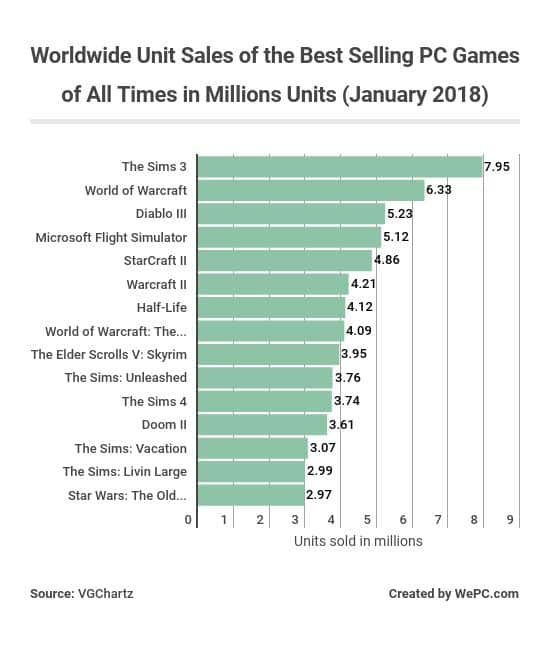
Here's one - > "After reading the interview, I went back to my own conversation with Raptr CEO Dennis Fong, who reminded me there are a staggering 900 million PC gamers worldwide. Contrast that data with global consoles sales of, say, Nintendo's Wii, Microsoft's Xbox 360, and Sony's PlayStation 3: About 262 million units. Combined. Granted, that's according to VGChartz which isn't a perfectly reliable snapshot, but e…

It says Steam has 75 million users while bulk of the rest of active games are all MMO games like Roblox which has 100 million and League of Legends at 70M by itself.

https://www.wepc.com/wp-content/uploads/2018/06/worldwide-di...

https://www.wepc.com/wp-content/uploads/2018/05/worldwide-un...

Re: US Navy will replace touchscreen with mechanical controls on its destroyers

#300
post #226

"Fun" touchscreen story - I had to file a warranty claim for my not so cheap blender that had mechanical controls. The company replaced it with the newer model, that had, you guessed it - touchscreen control. Not long after that, I was working in the kitchen, moving stuff into the blender, when a drop of water made it to the screen. The thing started at full speed throwing liquid everywhere, which worsened the situat…

>If I had to guess the next touchscreen everywhere will be misuse of AI, not in a malicious way, but in a really stupid one.

Reminds me of a talk someone gave. I forget who. Elon Musk perhaps. A quick google didn't turn it up.

Anyhow, they laid out a hypothetical scenario where humans were driven to extinction by a run away AI. Rather than being some sort of Skynet scenario where the machines are explicitly trying to kill all humans, it is an AI whose job was to maximize strawberry production. The AI converted the earth's entire surface into strawberry fields and inadvertently wiped out everything else in the process.

Arguably a more plausible scenario than Skynet.

Post reply on HN