Live data from Hacker News

What an unprocessed photo looks like

maurycyz.com

281–290 of 418 posts

Re: What an unprocessed photo looks like

#281

But does applying the same transfer function to each pixel (of a given colour anyway) count as "processing"? What bothers me as an old-school photographer is this. When you really pushed it with film (e.g. overprocess 400ISO B&W film to 1600 ISO and even then maybe underexpose at the enlargement step) you got nasty grain. But that was uniform "noise" all over the picture. Nowadays, noise reduction is impressive, but…

> But does applying the same transfer function to each pixel (of a given colour anyway) count as "processing"?

In some sense it has to, because you can include a parametric mask it that function which makes it possible to perform local edits with global functions.
Re: What an unprocessed photo looks like

#282
post #113

Earlier quoted context omitted.

Just wait a few years, all of this is still getting better.

Except it seems to be going in the opposite direction, every phone I've upgraded (various Androids and iPhones) seemed to have more smoothing than the one I'd had before. My iPhone 16 night photos look like borderline generative AI and there's no way to turn that off! I was honestly happier with the technically inferior iPhone 5 camera, the photos at least didn't look fake.

If you can get raw image data from the sensor, then there will be apps to produce images without AI processing. Ordinary people love AI enhancements, so built-in apps are optimised for this approach, but as long as underlying data is accessible, there will be third-party apps that you can use.

Re: What an unprocessed photo looks like

#283

Earlier quoted context omitted.

I wrote the raw Bayer to JPEG pipeline used by the phone I write this comment on. The choices on how to interpret the data are mine. Can I tweak these afterwards? :)

I found the article you wrote on processing Librem 5 photos: https://puri.sm/posts/librem-5-photo-processing-tutorial/ Which is a pleasant read, and I like the pictures. Has the Librem 5's automatic JPEG output improved since you wrote the post about photography in Croatia ( https://dosowisko.net/l5/photos/ )?

Yes, these are quite old. I've written a GLSL shader that acts as a simple ISP capable of real-time video processing and described it in detail here: https://source.puri.sm/-/snippets/1223

It's still pretty basic compared to hardware accelerated state-of-the-art, but I think it produces decent output in a fraction of a second on the device itself, which isn't exactly a powerhouse: https://social.librem.one/@dos/115091388610379313

Before that, I had an app for offline processing that was calling darktable-cli on the phone, but it took about 30 seconds to process a single photo with it :)

Re: What an unprocessed photo looks like

#284
Nice illustration.

To be a bit picky, there’s no unprocessed photo. They start with a minimally processed photo and take it from there.

The reason I clicked is that when I saw the title, I’m tempted to think they might be referring to analog photo (ie film). In that case I think there’s a well defined concept of “unprocessed” as it is a physical object.

For digital photo, you require at least a rescaling to turn it to grayscale as the author did. But even that, the values your monitor shows already is not linear. And I’m not sure pedagogically it should be started with that, as the authors mention later about the Bayer pattern. Shouldn’t “unprocessed” come with the color information? Because if you start from gray scale, the color information seems to be added from the processing itself (ie you’re not gradually adding only processing to your “unprocessed” photo).

To be fair, representing “unprocessed” Bayer pattern is much harder as the color filter does not nicely maps to RGB. If I were to do it I might just map the sensor RGB to just RGB (with default color space sRGB) and make a footnote there.

Re: What an unprocessed photo looks like

#285

I studied remote sensing in undergrad and it really helped me grok sensors and signal processing. My favourite mental model revelation to come from it was that what I see isn’t the “ground truth.” It’s a view of a subset of the data. My eyes, my cat’s eyes, my cameras all collect and render different subsets of the data, providing different views of the subject matter. It gets even wilder when perceiving space and ti…

> I imagine a sort of absolute reality that is the universe. And we’re all just sensor systems observing tiny bits of it in different and often overlapping ways.

Fascinatingly this is pretty much what Advait Vedant (one interpretation of Hinduism) says.

Alan Watts has talked a lot about this topic, if you’re (or anyone else is interested) his stuff is a more comfortable place to understand (compared to classical texts).

Re: What an unprocessed photo looks like

#287
post #159

Earlier quoted context omitted.

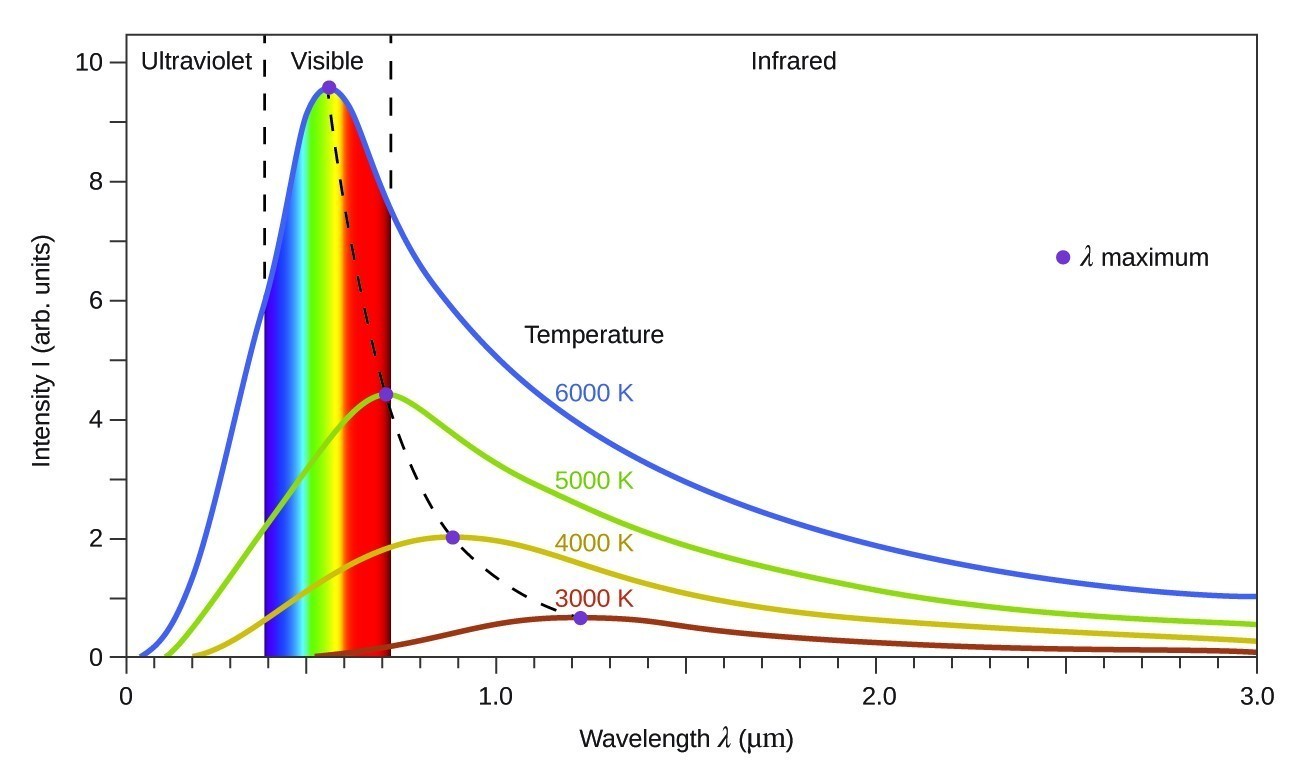
Green is the highest energy light emitted by our sun, from any part of the entire light spectrum, which is why green appears in the middle of the visible spectrum. The visible spectrum basically exists because we "grew up" with a sun that blasts that frequency range more than any other part of the light spectrum.

That comment does not make sense. Do you mean the sun emits it's peak intensity at green (I don't believe that is true either, but at least it would make a physically sensical statement). To clarify why the statement does not make sense, the energy of light is directly proportional to its frequency so saying that green is the highest energy light the sun emits is saying the sun does not emit any light at frequency hi…

> Do you mean the sun emits its peak intensity at green

That's presumably what they mean. It's more or less true, except the color in question is at the green / yellow transition.

See e.g. https://s3-us-west-2.amazonaws.com/courses-images-archive-re...

Re: What an unprocessed photo looks like

#288
post #6

I think everyone agrees that dynamic range compression and de-Bayering (for sensors which are colour-filtered) are necessary for digital photography, but at the other end of the spectrum is "use AI to recognise objects and hallucinate what they 'should' look like" --- and despite how everyone would probably say that isn't a real photo anymore, it seems manufacturers are pushing strongly in that direction, raising iss…

One thing I've learned while dabbling in photography is that there are no "fake" images, because there are no "real" images. Everything is an interpretation of the data that the camera has to do, making a thousand choices along the way, as this post beautifully demonstrates. A better discriminator might be global edits vs local edits, with local edits being things like retouching specific parts of the image to make d…

Another low tech example - those telephoto crowd shots that were popular during covid. The 'deception' happens before the light hits the sensor, but it's no less effective

https://www.theguardian.com/australia-news/2020/sep/13/pictu...

Re: What an unprocessed photo looks like

#289

Earlier quoted context omitted.

I was actually researching why PAL YUV has the same(-ish) coefficients, while forgetting that PAL is essentially a refinement of the NTSC color standard (PAL stands for phase-alternating line, which solves much of NTSC's color drift issues early in its life).

It is the choice of the 3 primary colors and of the white point which determines the coefficients. PAL and SECAM use different color primaries than the original NTSC, and a different white, which lead to different coefficients. However, the original color primaries and white used by NTSC had become obsolete very quickly so they no longer corresponded with what the TV sets could actually reproduce. Eventually even for…

Worse, "NTSC" is not a single standard, Japan deviated it too much that the primaries are defined by their own ARIB (notably ~9000 K white point).

... okay, technically PAL and SECAM too, but only in audio (analogue Zweikanalton versus digital NICAM), bandwidth placement (channel plan and relative placement of audio and video signals, and, uhm, teletext) and, uhm, teletext standard (French Antiope versus Britain's Teletext and Fastext).

Re: What an unprocessed photo looks like

#290

Earlier quoted context omitted.

It is the choice of the 3 primary colors and of the white point which determines the coefficients. PAL and SECAM use different color primaries than the original NTSC, and a different white, which lead to different coefficients. However, the original color primaries and white used by NTSC had become obsolete very quickly so they no longer corresponded with what the TV sets could actually reproduce. Eventually even for…

Worse, "NTSC" is not a single standard, Japan deviated it too much that the primaries are defined by their own ARIB (notably ~9000 K white point). ... okay, technically PAL and SECAM too, but only in audio (analogue Zweikanalton versus digital NICAM), bandwidth placement (channel plan and relative placement of audio and video signals, and, uhm, teletext) and, uhm, teletext standard (French Antiope versus Britain's Te…

(this is just a rant)

Honestly, the weird 16-239 (on 8-bit) color range and 60000/1001 fps limitations stem from the original NTSC standard, which considering both the Japanese NTSC adaptation and European standards do not have is rather frustating nowadays. Both the HDVS and HD-MAC standards define it in precise ways (exactly 60 fps for HDVS and 0-255 color range for HD-MAC*) but America being America...

* I know that HD-MAC is analog(ue), but it has an explicit digital step for transmission and it uses the whole 8 bits for the conversion!

Post reply on HN