Live data from Hacker News

Classical statues were not painted horribly

worksinprogress.co

281–290 of 351 posts

Re: Classical statues were not painted horribly

#281

Earlier quoted context omitted.

If you think medieval artists lacked skill, check out Villard Honnecourt’s sketchbook, especially the insects on folio 7 and Christ in Majesty on 16: https://www.medievalists.net/2024/12/sketchbook-villard-honn... Medieval art is very stylised, but the quality of the lines, the details in the clothes, the crispness of the composition, all that requires a lot of skill. Check out Jean Bondol’s work for instance https:/…

You convinced me that they lack skill. The clothing does often look good. In folio 16v ( https://www.medievalists.net/wp-content/uploads/2024/12/Vill... ), it's been overdone and appears to be far wrinklier than fabric could support, suggesting that Jesus is embedded in some kind of strange plant. The faces are terrible in all cases. In general, perspective is off, anatomy is off, and you get shown things that aren't…

Are you aware there are artistic styles beyond photorealism?

Re: Classical statues were not painted horribly

#282
post #28

I will die on this hill, because I'm right. Painters put on the first layer in saturated colors like this, then add detail, highlight and shadow. The base layer stuck to the statues, and the rest was washed away. This whole thing just won't go away because many people are operating outside their area of expertise on this subject. Painters layer paint, starting with a saturated base color. These archaeologists are sim…

I have a degree in fine art painting and drawing and that's not correct for oil painting. We would first put on a layer of earth tones, and work from the shadows to the mid tones. Once you got the form correct, you would work on things like adding color, details, and highlights. In no way would you start with saturated colors. One, they're very expensive, so why would you apply them, just for most to be painted over?…

Romans didn’t have oil paints

Re: Classical statues were not painted horribly

#283
post #28

I will die on this hill, because I'm right. Painters put on the first layer in saturated colors like this, then add detail, highlight and shadow. The base layer stuck to the statues, and the rest was washed away. This whole thing just won't go away because many people are operating outside their area of expertise on this subject. Painters layer paint, starting with a saturated base color. These archaeologists are sim…

I have a degree in fine art painting and drawing and that's not correct for oil painting. We would first put on a layer of earth tones, and work from the shadows to the mid tones. Once you got the form correct, you would work on things like adding color, details, and highlights. In no way would you start with saturated colors. One, they're very expensive, so why would you apply them, just for most to be painted over?…

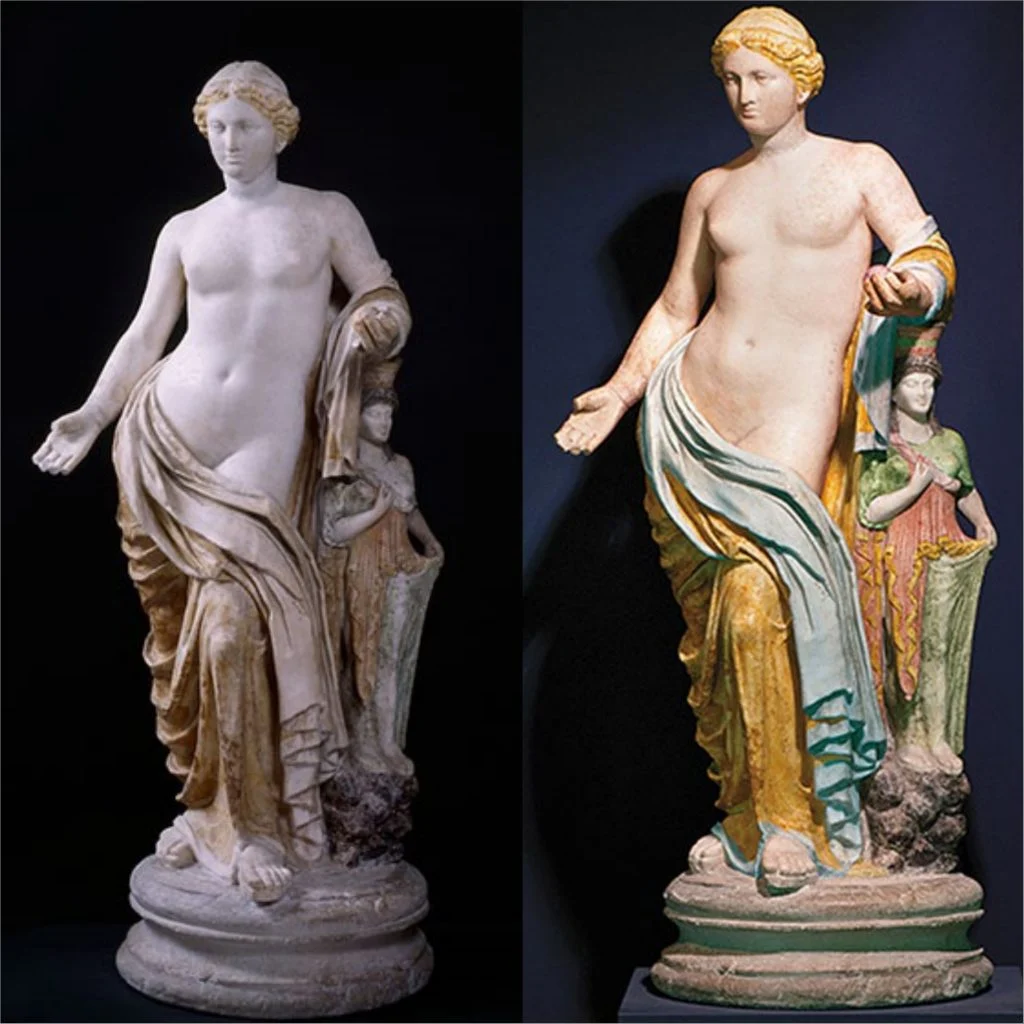
As the article points out, the more of the original color scheme that has survived, the better the reconstructions look.

Example: https://www.dailyartmagazine.com/wp-content/uploads/2022/09/...

The author suggests that this minimizes the opportunity for mischief, but tbqh it's likely that the ancients were simply much better artists than the people carrying out these reconstructions today.

I'd love to see a modern artist attempt one of these reconstructions using original materials but with greater artistic freedom.

Re: Classical statues were not painted horribly

#284

Earlier quoted context omitted.

I’m reminded of a Reddit thread long ago about a reconstruction of Roman garum by some American scientists. In their paper they conclusively declared that it tasted foul and a Filipino Redditor replied saying “This actually sounds a lot like the fish sauce we use in SE Asia. I wonder if people from a different culinary tradition would find it less off putting or even tasty?” Cue a bunch of Redditors downvoting the po…

There might even be a directish connection, one way or the other, between garum and SE Asian fish sauce, since Roman coins have been found in Vietnam. Can't find the better source on that specifically now but this is a nice article about the Roman trade with India and mentions the coins found in Vietnam and even Korea about half way down https://www.thecollector.com/why-was-the-roman-indian-ocean-... On the other han…

I read that what's now 'soy sauce' also started off as a kind of fish sauce originally.

Re: Classical statues were not painted horribly

#285
post #111

Earlier quoted context omitted.

Yes, this is what tfa says, and it's a good point. But tfa also points out that the archaeologists/reconstructionists know that what they're producing differs from the original. The thing is the discipline of reconstruction means that they only use pigments that they have direct evidence of, and this is just the saturated underlayers. The problem is this is seldom explained when the reconstructions are presented to t…

Reconstructioniats say that they only show th colours they can prove existed. The article suggests they obstinately do this because they know it creates a spectacle. I think there's another explanation - if they use their own judgement to fill in the gaps (making the statues more classically beautiful) then everyone will accuse them of making it all up, even if they were to base it on fairly rigorous study of e.g. th…

This is crucial. From the article:

>As a result, we internalized a deep-seated attachment to an unblemished white image of Greek and Roman art. We became, to use David Bachelor’s term, chromo­phobes. It is this accidental association between Greek and Roman art and pristine white marble, we are told, that accounts for the displeasure we feel when we see the statues restored to color.

And there's indeed been quite a bit of push-back since the story first broke. Unspoken is the reason. Primacy bias is probably a part of it, but what really accounts for the intensity of the attachment to the idea of white marble finishes? I'm sure you can imagine.

>Bond told me that she’d been moved to write her essays when a racist group, Identity Evropa, started putting up posters on college campuses, including Iowa’s, that presented classical white marble statues as emblems of white nationalism. After the publication of her essays, she received a stream of hate messages online. She is not the only classicist who has been targeted by the so-called alt-right. Some white supremacists have been drawn to classical studies out of a desire to affirm what they imagine to be an unblemished lineage of white Western culture extending back to ancient Greece. When they are told that their understanding of classical history is flawed, they often get testy.

https://archive.is/qTreQ#selection-1695.0-1695.693

So, yes, it was important to categorically falsify the notion that the statues, frescoes, etc., were unpainted. Anything that left it open would have been something for the worst sorts of people to latch onto. Now that that's out of the way, possibly even more accurate explanations can be given the time of day, instead of being stuck having to hash out, "Oh, but were they even colored at all?"

Re: Classical statues were not painted horribly

#286
post #28

I will die on this hill, because I'm right. Painters put on the first layer in saturated colors like this, then add detail, highlight and shadow. The base layer stuck to the statues, and the rest was washed away. This whole thing just won't go away because many people are operating outside their area of expertise on this subject. Painters layer paint, starting with a saturated base color. These archaeologists are sim…

I have a degree in fine art painting and drawing and that's not correct for oil painting. We would first put on a layer of earth tones, and work from the shadows to the mid tones. Once you got the form correct, you would work on things like adding color, details, and highlights. In no way would you start with saturated colors. One, they're very expensive, so why would you apply them, just for most to be painted over?…

friendly knuckle cracking I wouldn't normally do this, but I did say I'd die on this hill. I'm a tenured professor of art at a major research university. Firstly, maybe I shouldn't have said "saturated," but then again, you wouldn't argue that your earth tones, for example Yellow Ochre or Burnt Sienna aren't saturated in color?

I have a particular expertise in historical scenic painting, (granted, largely for theatrical and ceremonial practice, but that's where we have the oldest examples of painting a fake thing to look real, see trompe l'oeil https://www.britannica.com/art/trompe-loeil )

In these examples, it's clear that the painters started with relatively saturated midtones, and used washes to take the shadows down and clay filled light colors (think gouache) for the highlights: https://masonicheritagecenter.org/backdrops-gallery/

As to the expense of saturated colors, it's the scholars claiming saturated colors, so the expense was made, obviously. But was yellow the final color, when it is the perfect base coat for a two part skin tone using first yellow, and then pink? In the first image in the article, you can see that half of the face is yellow, but that the other half is light colored skin. This exact theatrical layering practice has been used, first yellow, and then pink.

The fourth and eighth images in the article looks extremely similar to the scenic backdrops I've linked above, but one is from the same time period as these statues, and the other is from hundreds of years later. There is a clear similarity in the final work. I believe it's obvious that both painters used dry pigment mixed down to a thin consistency, and used a series of 5 to 7 quick layers to achieve fast, one session results.

This practice doesn't have anything to do with what we call oil painting today, which can be quite laborious and is normally achieved over multiple sessions. These artists would have wanted to knock out a work and get down off the ladder.

Happy to discuss further, all the best.
Re: Classical statues were not painted horribly

#287

Earlier quoted context omitted.

I have a degree in fine art painting and drawing and that's not correct for oil painting. We would first put on a layer of earth tones, and work from the shadows to the mid tones. Once you got the form correct, you would work on things like adding color, details, and highlights. In no way would you start with saturated colors. One, they're very expensive, so why would you apply them, just for most to be painted over?…

friendly knuckle cracking I wouldn't normally do this, but I did say I'd die on this hill. I'm a tenured professor of art at a major research university. Firstly, maybe I shouldn't have said "saturated," but then again, you wouldn't argue that your earth tones, for example Yellow Ochre or Burnt Sienna aren't saturated in color? I have a particular expertise in historical scenic painting, (granted, largely for theatri…

How much of that major research is related to art?

Re: Classical statues were not painted horribly

#288

Earlier quoted context omitted.

friendly knuckle cracking I wouldn't normally do this, but I did say I'd die on this hill. I'm a tenured professor of art at a major research university. Firstly, maybe I shouldn't have said "saturated," but then again, you wouldn't argue that your earth tones, for example Yellow Ochre or Burnt Sienna aren't saturated in color? I have a particular expertise in historical scenic painting, (granted, largely for theatri…

How much of that major research is related to art?

Well my team brought in several million dollars this year, but your point is still valid. :)

Re: Classical statues were not painted horribly

#289

Earlier quoted context omitted.

You convinced me that they lack skill. The clothing does often look good. In folio 16v ( https://www.medievalists.net/wp-content/uploads/2024/12/Vill... ), it's been overdone and appears to be far wrinklier than fabric could support, suggesting that Jesus is embedded in some kind of strange plant. The faces are terrible in all cases. In general, perspective is off, anatomy is off, and you get shown things that aren't…

Are you aware there are artistic styles beyond photorealism?

Yes, but in that case, as this article argues, you'd expect something that looked good. https://static.wikia.nocookie.net/teentitans/images/e/e3/TTO...

The Honnecourt illustrations strongly suggest that (a) photorealism is the goal, but (b) Honnecourt doesn't know how to draw it. He does things like place a person's right eye at a different angle to the rest of the face than the left eye has. But hey, how likely is it that viewers will notice a malformed human face?

Re: Classical statues were not painted horribly

#290
post #251

This reminds me of efforts to reproduce Ancient Greek music. [1] It's very similar in that there's a lot of hints, but still enough missing parts that there seem to be two schools of thought, that can even present within the same project. That linked audio is unpleasant, but perhaps they just liked it? Yet, this solo [2], comes from the exact same project - and is amazing. I do not think tastes can change to such a d…

Hijacking this to point out Peter Pringle, who researches Sumerian music and even makes replica instruments for the songs: https://youtu.be/QUcTsFe1PVs

Wow. I did not expect singing like that in this sort of domain.
Post reply on HN