Live data from Hacker News

Why has college gotten so expensive in the last 30 years? A blank check in 1993

medium.com

281–290 of 588 posts

Re: Why has college gotten so expensive in the last 30 years? A blank check in 1993

#281
post #10

> the feds should handle student loans the same way they handle medicaid/medicare reimbursement. I'm not sure how anyone looks at our health care reimbursement system and the decides that's the approach to apply to fix anything else? Personally, I'd like to see: * Employers are allowed to test students to see what they can do, but not evaluate them based on whether they went to school or where. * Make student loan de…

> but not evaluate them based on whether they went to school or where.

This is akin to how you can fire someone for ANY REASON, except a few forbidden reason.

Guess which reason Timmy is fired for? Certainly not for trying to start a union.

Re: Why has college gotten so expensive in the last 30 years? A blank check in 1993

#282

"The question then becomes a matter of how we fix this without diminishing access to a college education." This is the crux of it that everyone needs to get over. Universality, High Quality, Low Cost. Pick two. By letting the government meddle you have guaranteed no one can afford college and will be long in debt to a loan they cannot discharge in bankruptcy. I'd rather have cheap college then universal access for ev…

Universality, High Quality, Low Cost Oh come on, we do not need the facilities, sports stadiums, plush housing, food options, gaudy offices for professors, and non-professor bureaucrats, and grade inflation in modern "education". None of that actually contributes to High Quality. You absolutely could have low cost and universality and produce well-educated undergraduates by the current standard of US education.

How do you quantify 'High Quality' other than developing connections? College was a class vehicle but is now just a method for people to party away from home and walk away with massive amounts of debt.

Read 'Paying for Party' if you'd like a sobering view at how fucked everything is (graduated in 2009 and it was so true even at that point)

Re: Why has college gotten so expensive in the last 30 years? A blank check in 1993

#283

Earlier quoted context omitted.

> CAs tax rate when you factor in federal tax is comparable to the EU Nominal rates might be, but tax burden is not. California tax burden is well under 15% GDP, and federal collections in the state are a tiny bit higher than state tax revenues, together still under 30% tax burden. EU overall tax burden is over 40% of GDP.

How do these numbers look when you count health care/insurance cost for CA instead of only for EU?

> How do these numbers look when you count health care/insurance cost for CA instead of only for EU?

Then you are counting the cost of the thing you are complaining about not getting for your supposedly-equivalent taxes in order to try to justify the claim that the taxes are equal.

Re: Why has college gotten so expensive in the last 30 years? A blank check in 1993

#284
post #267

It's expensive because people can pay for it and we know they can because they do. All this talk about debt is mostly a non issue in real life but generates a lot of heat online. American jobs pay vastly more than any other country on the planet and paying back the debt is quite easy. Otherwise people wouldn't keep enrolling. From a European point of view, US taxes are low, salaries for professionals are sky high, ut…

I have a friend in France who is getting an art education for free. Is she going to be in debt for her whole life? I don’t think so. Yes, some jobs pay very well in the US, but not all of them. Average job often pays enough for rent and living expenses plus a little bit. Student debt has interest and people end up paying that interest for many many years. I’m writing in the declarative, affirmative tone, but it is on…

> Is she going to be in debt for her whole life?

No, but she's probably going to pay way more taxes for everything, including income tax, VAT, taxes on petrol, electricity and will earn less.

People who complain about it are concentrated in threads like this, but all real life Americans I've talked with (whom I know for different reasons) said the debt may be annoying psychologically but at the end of the day, white collar professionals can easily pay it.

However, it may be the case that more people go to college in America due to marketing and other influences than actually should. Also, students tend to get pushed through the system and are pampered and have an entitled customer attitude and the colleges have a service provider attitude. The end result may be that even people with bad job prospects move through the system and then get surprised at the end. In Europe, universities quickly fail these students and push them out of the system so the students face reality earlier.

Also, Americans seem to value the "service provider", "resort" type college, with all kinds of non-academic services, personal mentoring, sports stadiums and teams etc. compared to the bare bones approach of European universities.

EDIT: just saw it's an art degree in question. Spending years on studying art has always been the luxury of wealthy people at all times, in all places. You'll have difficulties finding a job (assuming no connections) anywhere with an art degree. The meme of having to work at McDonald's is also alive and well in European countries.
Re: Why has college gotten so expensive in the last 30 years? A blank check in 1993

#285

Earlier quoted context omitted.

>Universities in Europe are generally high quality and low cost. The cost is low for the student but it's pretty high for the taxpayers. Not US high but still, it's not free, there's lots of bloat in the system that thrives on volume of students not on quality so they try to push forward legislation and programs to increase the number of students, especially from abroad and build more faculties/universities with more…

> The cost is low for the student but it's pretty high for the taxpayers. That is a supposition that proves to be false. The same happens for health care. To have a centralized state sponsored education or health care system allows it to be more efficient that smaller for profit institutions that have incentives to increase cost to the students as their profit depends on that. Also, I would like to notice, that for E…

>To have a centralized state sponsored education or health care system allows it to be more efficient that smaller for profit institutions that have incentives to increase cost to the students as their profit depends on that.

An institution whose survival depends on profits is incentivized to...reduce costs, not increase them. All profits are, are the difference between what is consumed and what is produced. Either your argument is: institutions who produce more than they consume are bad or a service provider ("centralized state education") can be granted a monopoly to the service and will, more efficiently, produce the service. Typically monopolies charge monopoly prices (bad for everyone except the monopolist), if the granted monopoly has its prices legislated to address these concerns (the case in Europe), it must sacrifice either on {cost, quality, quantity, quickness of delivery} of the product.

If you really do think that monopolized industries outperform markets with "wasteful profits" you might study the history of the CCCP and democratic welfare states.

The market manipulation that started in US education is a result of price fixing -- the price of education is a molested price: service purchasers don't select on electing a provider based on cost because that market price has been pushed up by government-secured debt to which a party cannot default on (otherwise know as selling yourself into slavery). Since producers have less competition on price, they compete on quality, quantity, and quickness. It's the same issue that resulted in the FAA price-setting airline tickets - airlines couldn't compete on cost so they had an ever increase set of luxury options to attract customers.

See:

https://en.wikipedia.org/wiki/Airline_deregulation#Civil_Aer...

https://fee.org/articles/the-effects-of-airline-regulation/

Re: Why has college gotten so expensive in the last 30 years? A blank check in 1993

#286
Not to be another commenter claiming to know the real reason college costs so much but...

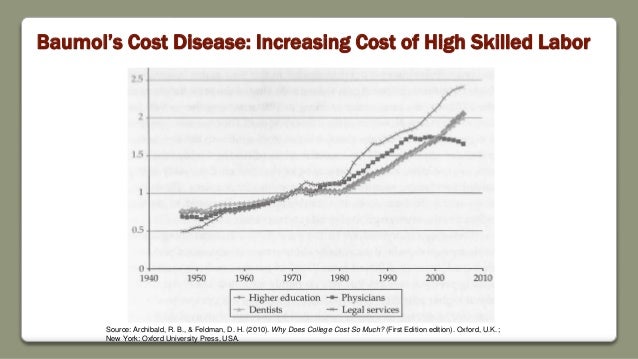
The real reason college costs so much is that the price of all services provided by people with doctorate Or professional degrees has risen. The cost of higher education has risen at the same rate as the cost of dentist services and legal services. See: https://image.slidesharecdn.com/disruptiveinnovationinhigher... Archibald and Feldman, 2010

The reason the cost of all services provided by people with doctorate or professional degrees has risen is complicated and could arise from many factors. For instance, it could be that there’s more industry demand for highly educated labor.

The rise in college costs relates primarily to overall changes in labor costs, not to anything wrong with the education system in particular.

Re: Why has college gotten so expensive in the last 30 years? A blank check in 1993

#287

Earlier quoted context omitted.

How do these numbers look when you count health care/insurance cost for CA instead of only for EU?

Count school fees and student debt too - public schools in most of the EU are good enough that you don’t have to go private the way the US does.

You don't need to go private in the US, either, that's largely a status display and a mechanism for non-educational social benefits more than an actual educational benefit; like the difference between outcomes in different public schools outcomes, the vast majority of difference between education outcomes in private and public schools is explained by factors outside of the school attended that determine educational outcomes (socioeconomic status, parental educational attainment, engaged parenting, etc.)

Re: Why has college gotten so expensive in the last 30 years? A blank check in 1993

#288

Earlier quoted context omitted.

Are Universities in Europe really that high quality? Certainly some are, but as a parent researching schools I have been really surprised by how many European colleges are a bit mediocre by the criteria I was evaluating. For example, Spain and Italy have some of the oldest colleges in the world. But in many ways there are four or five colleges in California that are better, four or five colleges in Texas, and across…

My issue with the rankings is how they emphasise research. Why would it matter to an undergraduate how highly decorated his prof is? We used to joke that the more titles a guy had, the worse he was at teaching. I think this is true because the guys with the titles have moved on to managing research and finding funding, rather than having daily tasks to do with the research. I went to a very well known university that…

Well, a few things:

1. Research is part of the pedagogy. Getting involved in a research lab as an undergraduate is a great way to land in the top 5-10 percentile.

2. I think what you're saying is roughly correct, but would warn that you can very easily go way too far in the other direction. For example, check out some of the smaller colleges and state branch campuses launching data science departments staffed entirely by non-stats/non-CS faculty who have 0 days of work experience. Mostly because their math courses are under-subscribed and they've gotta do something with those bodies. The quality of these programs is about what you'd expect. So, you don't need top-tier faculty. However, you do need faculty who have at least a relevant terminal degree and/or significant work experience. Otherwise, it's the blind leading the blind.

3. Curriculum does vary radically between universities! C.f., Stanford and a random branch campus of a state school.

4. As you noted, cohorts can also vary even more radically.

Re: Why has college gotten so expensive in the last 30 years? A blank check in 1993

#289
post #10

> the feds should handle student loans the same way they handle medicaid/medicare reimbursement. I'm not sure how anyone looks at our health care reimbursement system and the decides that's the approach to apply to fix anything else? Personally, I'd like to see: * Employers are allowed to test students to see what they can do, but not evaluate them based on whether they went to school or where. * Make student loan de…

> Employers are allowed to test students to see what they can do, but not evaluate them based on whether they went to school or where.

One of my father's arguments, in trying to motivate me to focus on a degree, was that it helped show future employers that I can stay on task over a period of time.

I'm not sure how much of a role that really plays, but to whatever degree that matters to employers and a degree is helping to demonstrate it, it would be difficult to test directly in anything resembling an interview setting.

Re: Why has college gotten so expensive in the last 30 years? A blank check in 1993

#290
post #267

Earlier quoted context omitted.

I have a friend in France who is getting an art education for free. Is she going to be in debt for her whole life? I don’t think so. Yes, some jobs pay very well in the US, but not all of them. Average job often pays enough for rent and living expenses plus a little bit. Student debt has interest and people end up paying that interest for many many years. I’m writing in the declarative, affirmative tone, but it is on…

> I have a friend in France who is getting an art education for free. Unpopular to admit: we need doctors / engineers / farmers more than we need another art major. As a US taxpayer, I wouldn't want to subsidize just anyone's education. I'd rather incentivize and subsidize engineering / STEM / agricultural science. You don't get to just get a free education regardless of what you want to study - different work/study…

Even in free-tuition countries, there are caps on the number of students admitted to various study programs under state subsidy. The government can incentivize more productive degrees by allocating more spaces to them.
Post reply on HN