Live data from Hacker News

Friday night’s near-disaster at JFK airport

viewfromthewing.com

271–280 of 372 posts

Re: Friday night’s near-disaster at JFK airport

#271

Earlier quoted context omitted.

Where was the miscommunication? The pilot readback was correct.

> Where was the miscommunication? The pilot readback was correct. "Runway 4L was being used for takeoffs. The American Airlines aircraft did not follow air traffic control instructions. ATC audio shows they were told to “”cross runway 31 Left at Kilo” and instead crossed runway 4 Left at Juliet, in front of the accelerating Delta Boeing 737." Crossing a runway, which you're not cleared to cross is a pretty bad case o…

That's the case when the readback is incorrect or missing, i.e. the pilot heard something that wasn't said. In this case, the instruction was communicated correctly on both ends. But it wasn't followed correctly.

Re: Friday night’s near-disaster at JFK airport

#272

Earlier quoted context omitted.

Fasten those seatbelts! Something I realized growing up, and perhaps this is a bias for others too: I always perceived of airline accidents as being crashes where everyone dies. Hence all the conspiracy silliness of “they just want to know what seat you were in to identify the body.” But my goodness there’s so many ways to be badly hurt without a big crash. In a way this feels akin to the highway bias: highways are f…

> But my goodness there’s so many ways to be badly hurt without a big crash. I remember an incident involving a private jet about a decade ago. The jet was at cruising altitude when suddenly it hit an air pocket and precipitously lost altitude. This being a private jet the occupants (some Greek businessmen) were drinking champagne or whatever, fact is they weren't wearing their seatbelts. A few of them died right on…

This is the top (but not only) reason keeping your baby/toddler in your lap instead of in their own seat, buckled into a carseat, is a terrible way to fly. Lap infants are far more likely to be injured in-flight than other children: https://journals.lww.com/pec-online/fulltext/2019/10000/in_f...

The carriers don't make this easy: they have conflicting rules on carseats for in-cabin use, especially if you're flying between the US and Europe, both of which have stringent carseat regulations, but absolutely no models that are approved for use in both. In practice, United allowed the EU carseat (used, bought specifically for the trip) and Lufthansa allowed a US carseat (more compact, bought for car use in the US), but both of their sites stated that they only allowed carseated approved by the airlines' local authorities: NHTSA (United) or TÜV (Lufthansa).

Re: Friday night’s near-disaster at JFK airport

#273

Earlier quoted context omitted.

These days you could point a handful of cameras at the taxiways, hook it to a computer, and have a realtime display of everything on the taxiways and runways. Then, the computer could detect potential collisions and alert.

You don't need cameras for that, they wouldn't work in lower visibility. Typically ground radar is used for this at large airports.

If the visibility is that low, wouldn't the airport be shut down?

Cameras are far cheaper than radar.

Re: Friday night’s near-disaster at JFK airport

#274

Earlier quoted context omitted.

These days you could point a handful of cameras at the taxiways, hook it to a computer, and have a realtime display of everything on the taxiways and runways. Then, the computer could detect potential collisions and alert.

They already have a real-time display. I can’t say for American airports but I have been involved in European air traffic control research and I can say that using algorithms isn’t very very well received by air traffic controllers. Computers tend to do better than humans in optimal situations, but can also completely fail in other situations. One example is the sun magnetic waves disturbing the radars. For cameras I…

> For cameras I can think of many things that can fail, wabbits eating the cables, snow of the lense, or the local cloud provider having a downtime

If the people in the tower can see the operations, then a camera in the tower can see them, too. Don't need a local cloud provider.

> So because computers can fail and humans are the backup, humans must be always present and have the best situation awareness

Think of the video system as the backup. It's like the system in the car that will hit the breaks automatically if you're about to hit a wall.

BTW, I infer from your post that there STILL are no cameras pointed at the taxiways. Heck, a good chunk of homes have an always-on camera in their doorbell. This is not rocket science, and is not expensive.

Remember when that SST caught fire taking off? No video of it. The accident investigation had to do a lot of investigation to figure out when it caught fire. Because of the lack of a simple, cheap camera like you'd find in convenience store.

P.S. There are plenty of wabbits in my yard. So far, none of them have eaten through the power or phone cables. I must be just lucky :-/

Re: Friday night’s near-disaster at JFK airport

#276
It reminds me of an air disaster that happened about 20 years ago for the same reason. [0]

In that case, the pilot of a plane misread the taxiway number (he confused R5 with R6 [1]) and entered the runway while another plane was taking off.

[0] https://en.wikipedia.org/wiki/Linate_Airport_disaster

[1] This is what the junction between R5 and R6 looked like that day: https://it.wikipedia.org/wiki/File:Disastro_Linate-02.png

Re: Friday night’s near-disaster at JFK airport

#277

Earlier quoted context omitted.

People die at intersections with stop signs every day, but we don’t do it on our roads for the exact same reason.

McKinsey style interview question. How many road intersections are there in the US?

I'm guessing three to four orders of magnitude more than there are intersections between runways and other runways or taxiways.

Re: Friday night’s near-disaster at JFK airport

#278

Earlier quoted context omitted.

This speaks to the need to implement systems with inherent safety. Traffic circles for cars. I don't know what the corresponding term would be for taxiways, though I expect the reply here will be spelled 'not practical'.

If you limited a design to traffic circles for taxiways, it wouldn’t be possible to cross any runways. Because planes can’t go around turns in the middle of their takeoff or landing. But if you wanted to prohibit any crossing of runways you could also just not have taxiways mid-runway. Probably not the most practical solution.

It would certainly be rate-limiting if every landing plane had to roll to the very end of the runway before turning off on "the taxiway". In principle this could be reduced by having planes with shorter rollouts leave the glideslope and continue level for some predetermined distance before touching down but that's got a bunch of new hazards even without adding any interesting wind.

Re: Friday night’s near-disaster at JFK airport

#279

Earlier quoted context omitted.

This speaks to the need to implement systems with inherent safety. Traffic circles for cars. I don't know what the corresponding term would be for taxiways, though I expect the reply here will be spelled 'not practical'.

Yes, it's impractical to have a roundabout in the middle of a runway which an airliner must negotiate during its takeoff roll.

Given how the passengers squeak with moderate turbulence, imagine how they'll take high-speed veering during takeoff? But of course a roundabout only works because all vehicles approaching are preparing to come to a complete stop if another vehicle will intrude upon their path, which can never be compatible with "accelerate steadily to racing car speed"

Re: Friday night’s near-disaster at JFK airport

#280

For those thinking about preventative solutions, there are some existing, all very expensive of course. The simplest is placing a row of red lights in the ground at all intersections to runways. When an airplane is cleared for takeoff and until it is airborne the controller presses a button and turns all these lights red. Pilots are instructed that regardless of clearance, a red light over-rides that, and to never cr…

I believe that the causes for errors in perception and communication can be rather subtle, and therefore successful mitigations can be as well. If the root error of the pilot here happened not at the runway crossing, but earlier, when confusing the K and J taxiways, then that's the location where possible preventative solutions should be considered. Because once a pilot has subconsciously convinced herself that she's…

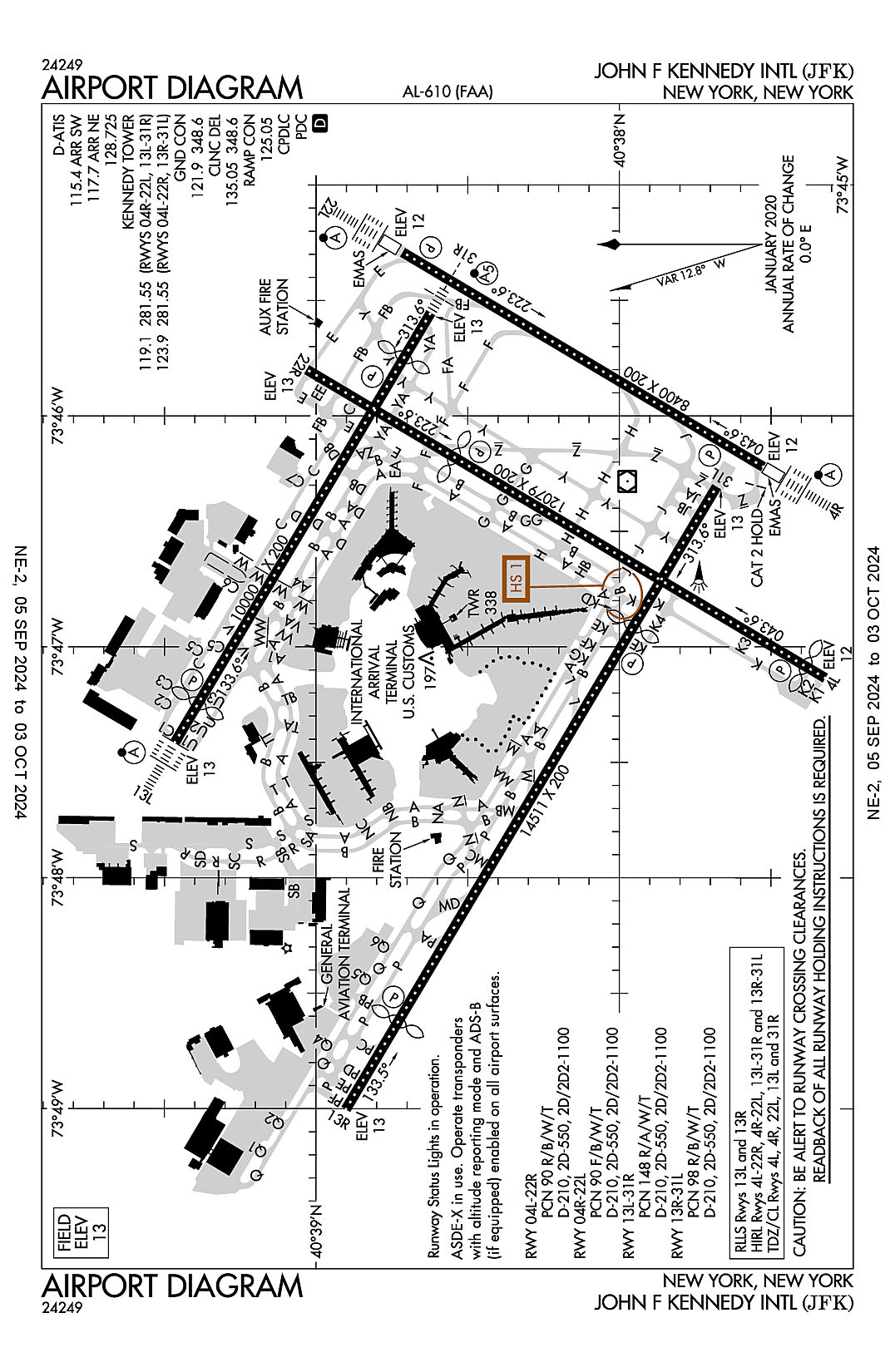
If you take a look at the airport diagram (https://www.faa.gov/air_traffic/publications/atpubs/aip_html...), it just takes one wrong turn to end up on taxiway J instead of taxiway K. And, also from that diagram, once the American plane took the wrong turn, the controller had very little time to see that and stop it before it crossed the runway.

But still, if pilots internalize via training that "if you are about to cross a line of red lights, you are entering an active runway without having permission to do so, so don't do it", that should be one more layer of safety to prevent situations like this. Of course, none of these layers are 100% foolproof, but taken together...

Post reply on HN