Live data from Hacker News

Music theory for nerds

eev.ee

271–280 of 390 posts

Re: Music theory for nerds

#271

Earlier quoted context omitted.

Not to mention that A minor is generally considered to contain two additional notes compared to the A natural minor scale (AKA the A Aeolian mode).

In jazz A minor generally implies A Dorian

Yeah, in my reading, it never seems that there was a compelling reason to chose Aeolian vs. Dorian as the definitive "minor". I think it's largely because common practice evolved to much more frequently approach the tonic from below instead of above. That would favor harmonic minor over Dorian. I suspect that this is because it allows for very similar cadences as major keys.
Re: Music theory for nerds

#272
post #4

This has got to be some of the worst jargon and notation for anything, ever. Indeed. I'm a musician, and something non-musicians often ask (especially techies, it seems) is why we use such an archaic notation system. The reason is simply that a certain number of musicians have developed the skill of sight reading which is the ability to perform a composition directly from a written sheet, with little or no rehearsal.…

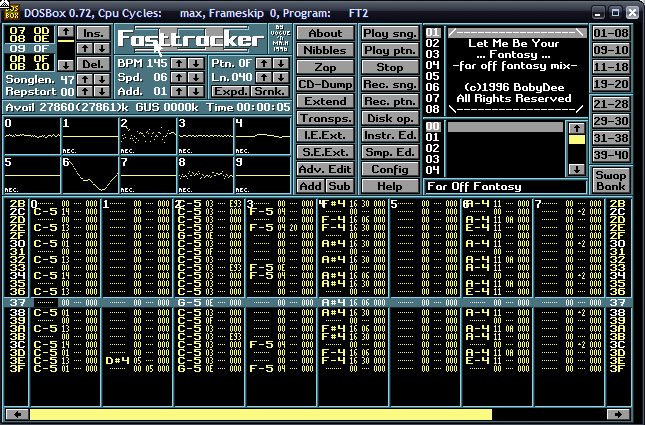
Have you played with trackers?

2d grid, time is down, instruments(channels) are right, each cell can have a note or "stop this channel". There also can be modifiers in each cell (louder, start tremolo, slide this note into the next, etc).

It's most applicable to keyboard music, I think. Sight-reading this without rehaersal would be trivial, right?

https://www.dosbox.com/wiki/images/3/3a/ScreenShot004.gif

Re: Music theory for nerds

#273
post #267

Earlier quoted context omitted.

This gets pretty complicated and subjective. Strictly speaking, a "note" cannot define a key. To determine a key, you really need at least 2 intervals, wherein interval a somehow resolves to interval b. Keys are just a mapping of relationships; how does each of the 12 notes relate to each other? If you just play a C major chord, you aren't really playing in the key of CMaj, you're just playing a CMaj chord. For examp…

That's funny because B+G, C+G to me says G major: a major third, then a fourth. Is the ear guided to keys by inversion, some inversions more natural or root-y than others? I've been composing pop music for a long time without knowing stuff like this.

I can see the G major argument. That would be a I/3 into IV. My professor would have said that answer is wrong due to voice leading, the 7 to 1 is very powerful. And the last chord is C, in root, meaning that's where you have resolved. Had the second interval been G+B, it would make the GMaj argument stronger. Ultimately, it's really context. You're really just asking about cadences, very roughly translated means "how chords resolve".

Re: Music theory for nerds

#274

Earlier quoted context omitted.

I'm not an expert, but Indian classical music isn't known for having harmony in the same sense [1]. Modern Indian music is influenced by Western music. I know even less about Chinese music, which isn't mentioned in that article. But in all the sources I've read, the concept of deeply developed chordal harmony is pretty unique to the Western music tradition. [1] https://en.wikipedia.org/wiki/Harmony

Right, it doesn't involve playing notes together the same way it's done in Western music. I guess I misinterpreted what you were saying -- the Indian notes are still derived by looking at notes which sound harmonious when played together, roughly the same way Western notes are derived. They are not usually played together on the same instrument like you would with a piano or a guitar. Harmony between vocal parts is n…

Yep! Many traditions got their notes the same way Western music did. The Tuning, Timbre, Spectrum, Scale book does a great job illuminating this.

Re: Music theory for nerds

#275

I'd like to elaborate a bit, in the same "for nerds" manner, on where Eevee seems to get lost a bit with scales and notation. He (she? not sure) calls the A minor and C major scales the same, because they contain the same notes. That's not an odd thought, but it's like calling sine and cosine the same because both functions contain the same set of values, in the same order. The difference is phase. Basically, scales…

> He (she? not sure)

FTR the pronoun where gender is ambiguous is 'they' (It's also sometimes explicitly requested by nonbinary people).

Re: Music theory for nerds

#276
post #160

Earlier quoted context omitted.

"2. Learn your intervals, and learn Solfege. If you're a musician, you already know these things in principal, even if you don't know the words or the terminology. In particular, you should be able to "hear" the distance between Do-Mi-Sol without too much difficulty, because you hear those distances in music a lot." I believe the Solfege named intervals (Do-Re-Mi-Fa-So-La-Ti-Do) are only taught as a historical oddity…

As a computery person, what bothers me the most is the 1-based indexing of intervals. I get that music theory predates zero, but it makes it incredibly frustrating to work with (e.g. add a third to a fourth and you get a... sixth).

When do you need to do math like that with intervals?

As a computer nerd myself, I can understand the argument for 0-based indexing in this case, but I don't recall ever being stumped by it being 1-based. When would you need to add a 3rd and a 4th to get a 6th? Harmonic theory doesn't use addition like that. e.g., playing a 6th is not the same as playing a third and a fourth. So, why do that kind of math with intervals?

Re: Music theory for nerds

#277
post #101

Earlier quoted context omitted.

> Once we get off printed paper, computerized notes should solve much of the inertia. problem I don't know...ebooks still look a lot like treebooks. The one example I've seen of what you're describing is I've seen jazz musicians play off ipads. This give them access to very large catalogs without lugging around giant binders, and also they can transpose their sheets into any key. (That's more important than it might…

I have those electronic materials. They come in two varieties. There's something called iRealB, which contains thousands of tunes, but is just chord changes due to a quirk of copyright law -- the melody and lyrics are copyrighted but not the harmony. That's the one where you can transpose tunes. But you don't get the melody. Then there are large PDFs where somebody ran the old paper fake books through a scanner, but…

Notation would tend to be one of the easiest things for which to develop automatic recognition / parsing?

Re: Music theory for nerds

#278
post #275

I'd like to elaborate a bit, in the same "for nerds" manner, on where Eevee seems to get lost a bit with scales and notation. He (she? not sure) calls the A minor and C major scales the same, because they contain the same notes. That's not an odd thought, but it's like calling sine and cosine the same because both functions contain the same set of values, in the same order. The difference is phase. Basically, scales…

> He (she? not sure) FTR the pronoun where gender is ambiguous is 'they' (It's also sometimes explicitly requested by nonbinary people).

From eevee's Twitter:

> she/they/he

I have a similar relationship with pronouns. My own perception of my gender jumps around so much that I don't even bother trying to figure it out. It usually leans in one direction, but I don't have many strong feelings about it.

Re: Music theory for nerds

#279
post #160

Earlier quoted context omitted.

As a computery person, what bothers me the most is the 1-based indexing of intervals. I get that music theory predates zero, but it makes it incredibly frustrating to work with (e.g. add a third to a fourth and you get a... sixth).

When do you need to do math like that with intervals? As a computer nerd myself, I can understand the argument for 0-based indexing in this case, but I don't recall ever being stumped by it being 1-based. When would you need to add a 3rd and a 4th to get a 6th? Harmonic theory doesn't use addition like that. e.g., playing a 6th is not the same as playing a third and a fourth. So, why do that kind of math with interva…

Whenever you play three notes in sequence, no? I'll read a passage and think "tonic, up a third, up a fifth so that puts me up to the tonic again... nope."

Re: Music theory for nerds

#280

Earlier quoted context omitted.

"2. Learn your intervals, and learn Solfege. If you're a musician, you already know these things in principal, even if you don't know the words or the terminology. In particular, you should be able to "hear" the distance between Do-Mi-Sol without too much difficulty, because you hear those distances in music a lot." I believe the Solfege named intervals (Do-Re-Mi-Fa-So-La-Ti-Do) are only taught as a historical oddity…

Nearly all aural skills classes (learning to hear/sing music) for music majors use solfege or something like it. Some people use scale degree numbers instead (so a IV chord in a major key is "4-6-1" rather than "fa-la-do"), but the concept is still very useful.

What I'm questioning is the popularity of Solfege vs numeric interval names.

My music classes of ~20 years ago treated Solfege as being of historic interest, but not particularly common. While numeric intervals were used daily. It came up somewhat more in sight singing and vocal training than in any of the instrument or theory oriented classes. But, I think it was mostly students who were used to it using it rather than instructors teaching it.

But, maybe I just so strongly preferred numbers that I immediately discarded any instruction involving Solfege as being silly and a waste of my time.

Still, I can only recall seeing numbers (and Roman numerals) in writings on theory and such.

Post reply on HN