Live data from Hacker News

Hazard pay in focus as essential workers earn less than the jobless

npr.org

261–270 of 348 posts

Re: Hazard pay in focus as essential workers earn less than the jobless

#261
post #224

Earlier quoted context omitted.

Pretty much everyone is capable of working more than one occupational role, and almost always a SIP-compatible one. Where do you get "business owners" as the relevant category? Are you sure you're taking this discussion as seriously as you expect others to?

And in which a SIP-compatible role was open and available, which is probably 5 businesses when unemployment went from 4% to 20%. Moral hazard exists everywhere, especially for people who have known the word longer than 6 months.

>And in which a SIP-compatible role was open and available, which is probably 5 businesses when unemployment went from 4% to 20%.

Pretty much every businesses was offering some kind of SIP compatible role (delivery, remote communication, and socially distanced adaptations). New positions are created and destroyed every day in response to demand. That's how economies work. You can't possibly justify a claim of five businesses.

>Moral hazard exists everywhere, especially for people who have known the word longer than 6 months.

And if it were so obvious, we wouldn't have people being ridiculed for pointing it out early on, or being surprised today at the result of the incentive structure.

Re: Hazard pay in focus as essential workers earn less than the jobless

#262
post #250
post #238

Earlier quoted context omitted.

Yes, I am -- that's what happens when you try to use the money printer that currently works and scale it up to unbounded resources (eventually). And again, it sounds like you're agreeing with the point that I'm making. We can disagree about when it will be a problem, but you can't just trivialize the very idea of any mitigation effort being unaffordable because "we just print the money anyway, so affordability is mea…

Has anyone said we needed unbounded stimulus? I don't think so. However, there are certainly economic theories around those ideas though, such as UBI, so I would not say that it's infeasible for a country to continue to run in such a fashion. That said, given our current economy, inflation is not a concern. If you are concerned about real resources, such as human lives, then that is basically what we're exchanging ri…

>Has anyone said we needed unbounded stimulus?

Somebody dismissed the very idea of there being limitations to our ability to pay for stimulus, yes, which was why I originally entered the thread to address this excessive dismissal:

>>or assuming that our government has enough money lying around to pay everyone this much all of the time

>Federal spending doesn't come from money laying around, in the first place, it comes from money the government decides to have because it wants to spend it.

I said so at the time, and all the other times I referred back to that claim when you asked. Sorry, but I think I'm past the point of diminishing marginal returns here.

Re: Hazard pay in focus as essential workers earn less than the jobless

#263

Earlier quoted context omitted.

That's not a fair comparison. QE are loans that get paid back, and bailouts are equity purchases. The government makes money on these programs. Stimulus payments are gifts, and the government loses money on them. To be clear, the stimulus payments are essential for helping people and are a great thing for the wider economy. But you can't compare them dollar-for-dollar, as they are not like each other.

When was profitability added to governments' remit?

It's not profitability for profitability's sake. It's a positive number on a budget balance sheet. At the end of the day, they have some kind of budget to spend on stuff. The sum of the expenses has to fit the budget. If this comes out as a net positive, they can spend more elsewhere, like on unemployment benefits or schools or whatever else they're planning to need money for in the future.

Re: Hazard pay in focus as essential workers earn less than the jobless

#264
post #10

Earlier quoted context omitted.

Our Quantitative easing and corporate bailouts are in the trillions, why would we not pay out significantly less for people who are struggling to find jobs? Why does the till start counting when its normal people affected?

> why would we not pay out significantly less for people who are struggling to find jobs? The CARES act allocated most of the money to individuals, state and local governments, public health, and education initiatives. The amount given to large corporations (much in the form of loans that will be paid back) is less than that given to individuals: NPR has a good breakdown. The idea that corporations are receiving “tri…

> Giving someone a cash payment and giving a loan to a business have very different actual costs in the long-run, obviously.

I want to stress this because many are missing it.

- Money to people = cash gift or grant.

- Money to companies = loan.

Companies have to pay it back, with interest. This also happened during the recession and the US made a hefty profit from it.

I often run into people that think that companies received these loans as grants. This of course makes for a lot of confusing discussions because two people are operating with completely different mental models.

Re: Hazard pay in focus as essential workers earn less than the jobless

#265
post #89

Earlier quoted context omitted.

dissertation after dissertation have been written on the subject. To me, it boils down to as long as the world sees value in the US dollar, or there isn't an alternative, the Fed can print as much as they want. It certainly helps that US debt is denominated in its own currency so debt is as much of a burden on the US as the Fed wants it to be.

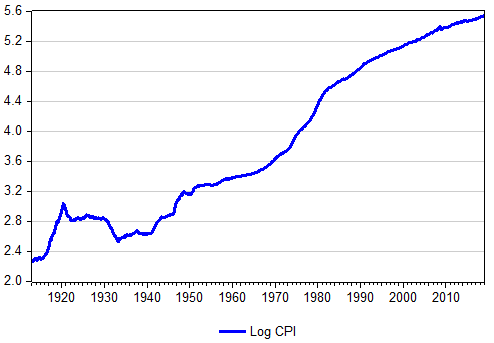
https://inflationdata.com/Inflation/images/charts/Inflation_... Seems to me like breaking the gold standard has lead to quite a bit of inflation. One problem with our view of inflation is that it's compounding... Now, I think the real reason we have compounding and printing of money is that it's a form of taxation (on currency holders) and it makes government debt cheaper and cheaper each year that passes.

That graph is misleading because you're plotting cumulative inflation on a linear graph rather than a logarithmic graph. The basic issue is that you should expect every 20 pixels to have the same weight, but you feel the impact of inflation as later/earlier rather than later-earlier.

For example, compare 1940 to 1950 with 1990 to 2000. Cumulative inflation rises 110% for 1940-1950 and 450% for 1990 to 2000. But, $1 in 1940 will be worth 57¢ in 1950 (145%/255%), and $1 in 1990 will be worth 77¢ in 2000 (1365%/1775%).

There are two ways to fix this: you could plot yearly inflation, but it's difficult to see long-term trends; or you can plot cumulative inflation on a logarithmic scale, but people aren't as used to logarithmic scales.

yearly: https://en.wikipedia.org/wiki/File:US_Historical_Inflation_A...

cumulative: https://uploads-cdn.omnicalculator.com/images/cpi-inflation/...

Re: Hazard pay in focus as essential workers earn less than the jobless

#266

Earlier quoted context omitted.

And the bigger issue is that correcting this is going to be a new political hammer to hit people with.

Respectfully, I believe you have it backwards and the issue needing correcting is this (quoted from article). "Few employers have compensated extra for on-site work amid the health crisis. A recent survey by the Economic Policy Institute found that fewer than a third of people who had to leave their homes to work during the pandemic received additional pay or benefits. As U.S. coronavirus cases persist and some state…

I don't have any issue with hazard pay.

The concern is entirely about people being paid more than their jobs to stay home. In some conversations I've had with people, there's an attitude that staying at home is just a giant vacation that they'd like to go on as long as possible.

It's an understandable position as well for anybody who won't see much of an impact from the economic side effects. When people begin asking to extend the stay-at-home-pay program, there are a lot of people who will support the idea of getting paid excessively to stay home and anyone who tries to correct that fiscally unsustainable situation is going to be made out to be the bad guy.

Hazard pay for essential workers makes complete sense.

It's the excessive unemployment for people to stay home that's the problem. For a bunch of people, it's a giant vacation. For others who are working through all of this, they are strained, stressed out, worried about getting sick and their nerves are shot.

All in for hazard pay, but fix the unemployment problem. It's completely out of balance.

Re: Hazard pay in focus as essential workers earn less than the jobless

#267

Earlier quoted context omitted.

OK, but the definition of "food insecurity" used at that first link includes, at the "low food security level" people whose "quantity of food intake and normal eating patterns were not substantially disturbed". I don't think you're doing any favors to the cause of food security by suggesting that people starving in America is a big issue, or implying that anything like 1 in 9 people are in that situation. I think the…

'"The word "hunger," the panel stated in its final report, "...should refer to a potential consequence of food insecurity that, because of prolonged, involuntary lack of food, results in discomfort, illness, weakness, or pain that goes beyond the usual uneasy sensation."' "One in seven households with children were affected by food insecurity in 2018." "Food insecurity rates are highest for single mother households a…

Are you agreeing with me? Disagreeing with me? When all you do is quote from a report which has no findings w.r.t starvation it's hard to know.

Starvation doesn't mean hunger, it means the process of dying of hunger.

Re: Hazard pay in focus as essential workers earn less than the jobless

#268
post #85

Earlier quoted context omitted.

Whatever happened to doing worthwhile things because they're hard ? Do you know how hard it is to have to quarantine yourself from your family because you've been deemed an essential worker, while getting seemingly nothing in return? Do you know how hard it is to live with the guilt of even possibly infecting others with COVID? Clearly, the current administration puts corporate profits over the lives of Americans. Cl…

I’d love to send that message but the other team seems dedicated to throwing the game. Biden is garbage

There's more than one election. There's also the entire house, a third of the senators and perhaps local elections as well.

Re: Hazard pay in focus as essential workers earn less than the jobless

#269
post #262
post #250

Earlier quoted context omitted.

Has anyone said we needed unbounded stimulus? I don't think so. However, there are certainly economic theories around those ideas though, such as UBI, so I would not say that it's infeasible for a country to continue to run in such a fashion. That said, given our current economy, inflation is not a concern. If you are concerned about real resources, such as human lives, then that is basically what we're exchanging ri…

>Has anyone said we needed unbounded stimulus? Somebody dismissed the very idea of there being limitations to our ability to pay for stimulus, yes, which was why I originally entered the thread to address this excessive dismissal: >>or assuming that our government has enough money lying around to pay everyone this much all of the time >Federal spending doesn't come from money laying around, in the first place, it com…

The original poster wasn't suggesting unlimited stimulus, the opposite actually, and the person replying to them regarding how federal money is doled out is not terribly far from the mark. If they want to spend the money, they find the money, inflation be damned. It seems way too early to handwring over moral hazards and costs/sustainability of stimulus benefits, when TX and FL are closing back down after their failed experiment.

Re: Hazard pay in focus as essential workers earn less than the jobless

#270

In more normal times, it makes sense that unemployment should not be lucrative, and workers should be encouraged to take any job at all rather than be unemployed. But the calculus changes in a pandemic, because you want people to stay home, even if they have nothing productive to do there. Low-wage work is almost never remote, so a person working a non-essential, low-wage job is likely not providing enough value to o…

> because you want people to stay home You want most people to stay at home. You want the ones who can work from home to do so. You want your essential workers to go to work. Imagine you have three workers each earning $30K p/a; that's about the 24th percentile for a household in the U.S. One loses their job as a result of covid-19. One can work from home but loses some hours (incomes reduces to $25K p/a). One has to…

I agree it’s certainly not socially equitable. Laid-off non-essential workers receive an undeserved pay raise for doing no work, and essential workers receive no benefit for continuing to work despite the hazards involved. Mandating hazard pay would be fairer, yes, but has consequences of its own — e.g., some essential employers at the margins of profitability become insolvent, causing less essential work to be done.

I’m only saying that as an emergency measure, where your chief concern is short-term continuation of essential work and discontinuation of non-essential work that incentivizes people to leave home, raising UI benefit helps achieve that. Layoffs act as a useful indicator of whether a given pre-pandemic job is actually essential to preserve, and laid-off workers are more tangibly in need of assistance to avoid cascading problems (tenants failing to pay rent, landlords failing to pay property tax, REITs collapsing, pensioners not getting paid, etc.). Giving a windfall to the unemployed is obviously counterproductive in a normal economy, but in the short-term it does solve some problems. Also airdropping money to low-income essential workers would make things more fair, but these workers are not generally facing eviction.

Your point about hour reductions may be true in some states — I’m not sure — but at least in mine (New York) workers receive unemployment insurance for any reduction that drops their pay by more than 20%, with benefits proportional to the reduction in hours.

Post reply on HN