In the Herbert Dune, civilization collapsed because of smart machines. So after renaissance they are completely banned for the future use.
Collapse OS
261–270 of 323 posts
Re: Collapse OS
#262I don't think just developing a Z80 operating system is enough. The whole ecosystem needs to be preserved. In agriculture, we have the doomsday seed vault [0] just for this purpose. If we anticipate collapse of the current economic system or society, I think we should build a doomsday computer vault, that keeps everything we need to rebuild the computing industry in a underground bunker. It keeps everything we need i…
The embryo of this idea is in Software Heritage [0]. It's a great project, well worth supporting. Of course this doesn't include the requirement to store and maintain hardware, and even though we can store well-written documents detailing how to build these sorts of machines from scratch, it might not be feasible for post-disaster societies to do this.
Re: Collapse OS
#263I don't think just developing a Z80 operating system is enough. The whole ecosystem needs to be preserved. In agriculture, we have the doomsday seed vault [0] just for this purpose. If we anticipate collapse of the current economic system or society, I think we should build a doomsday computer vault, that keeps everything we need to rebuild the computing industry in a underground bunker. It keeps everything we need i…
Yes I agree, a Z80 is not enough.
Especially that the people who will restart from a Z80 will face technological edges when their skills and needs grow. We faced the same in the 80's: going from 8 bit to 16, then 32, having memory addressing problems, being pushed to new and hardly compatible architectures, having programs to rewrite...
Then why not leaving behind us a technology, still simple, but that will save them most of these issues?
I feel an 8-bit data bus and 32-bit address bus would be a good way to make long-live programs, edge-free when extending memories, and still not so complex processors and main boards. The address bus does not need to be fully wired in the first processor versions, so it can scale over time with more complex processors when skills and needs grow.
Besides, it would be smart to leave in a vault a kind of FPGA technology with sources to flash the FPGA components. So no need to create a production line for many different integrated components: only one output, and the components are specialized by flashing them.
Indeed even microprocessors can be flashed on an FPGA.
Well, just ideas...
FPGA: https://en.wikipedia.org/wiki/Field-programmable_gate_array
Low tech CPU to support 32 bit code: https://en.wikipedia.org/wiki/Motorola_68008 (8 lines data bus, 20 lines of address bus, 32 bit programs, 70 000 transistors)
Microprocessor on an FPGA: https://en.wikipedia.org/wiki/Soft_microprocessor
Re: Collapse OS
#264Earlier quoted context omitted.
I think there is a business model for different reasons. As web client tech stabilizes and telecom regulatory rollback continues, there may be an opportunity for localized solutions to be landed for all sorts of different purposes.
I don’t see large opportunities in localized “web tech” (I’ll read as http based) business. The whole reason the web works for business is that you can give something away to millions of people for ad revenue or sell something to very large groups for small amounts of money. Localization reduces your customer base. The price a business has to charge would be higher. This is on top of the adoption problem.
That’s one aspect of the business, but you also have companies like Netsuite or Intuit selling general ledgers and similar solutions, and those lines of business don’t really benefit from the scale.
Re: Collapse OS
#265I don't think just developing a Z80 operating system is enough. The whole ecosystem needs to be preserved. In agriculture, we have the doomsday seed vault [0] just for this purpose. If we anticipate collapse of the current economic system or society, I think we should build a doomsday computer vault, that keeps everything we need to rebuild the computing industry in a underground bunker. It keeps everything we need i…
I'd like to see a log being kept in orbit. Like every 10 years it's rotated (FIFO, oldest comes down, new one is launched) with a large delta so that it might survive our current civilization in case of global / climate craziness.
like graveyard orbit
Re: Collapse OS
#266I don't think just developing a Z80 operating system is enough. The whole ecosystem needs to be preserved. In agriculture, we have the doomsday seed vault [0] just for this purpose. If we anticipate collapse of the current economic system or society, I think we should build a doomsday computer vault, that keeps everything we need to rebuild the computing industry in a underground bunker. It keeps everything we need i…
> The whole ecosystem needs to be preserved.
I disagree. If humanity collapses, and a new fledgling civilisation grows out of the ashes, then maybe we should let them follow their own path, and make their own discoveries and mistakes.
It's massive hubris to assume that future generations can only survive if they have access to our knowledge.
Many civilisations have fallen only to be replaced by newer betters ones, even when they've had no previous records to refer to.
We're just a stepping stone along the path of human evolution, we are no greater or lesser than the stones before us, or the stones that come after us.
Re: Collapse OS
#267Earlier quoted context omitted.
They would see the "© 1982" on a chip and although it would be incredibly futuristic (35+ years in the future!), would at least know it was likely to be created by humans. Whether they could work out how on earth you place such incredibly tiny components onto a sliver of silicon is interesting. If the person taking the computer back in time mentioned the word "photolithography" I suspect they would have been able to…
I don't think there would be many copyright dates on the chips. They might think that Texas ruled the world from the TI logo being on everything, though.
Here's a high res picture of the C64 PCB, where you can see the markings on the chips: https://myoldcomputer.nl/wp-content/uploads/2015/11/board-32...
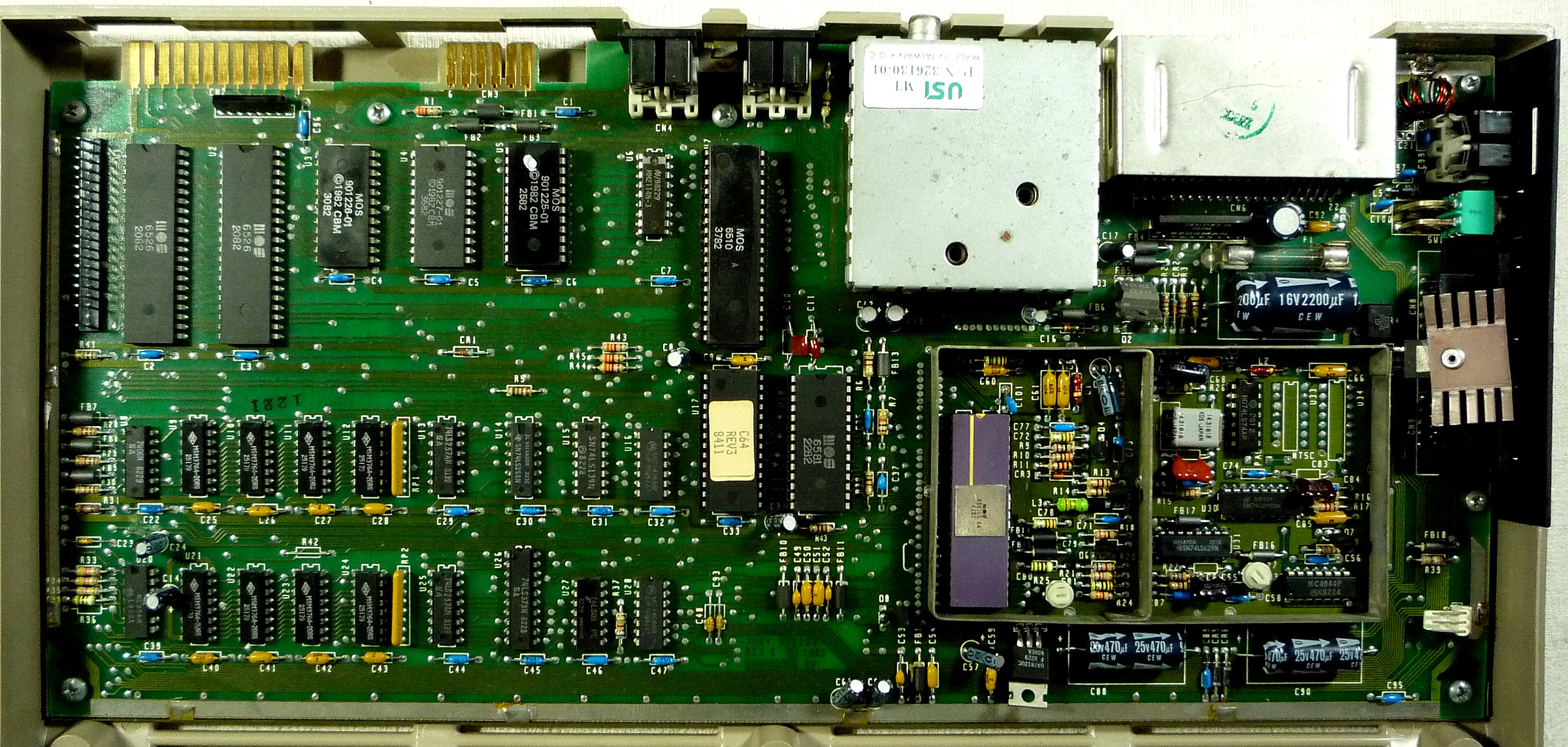
You can see both copyright dates, and plenty of other English text. While in 1940 this would have represented incredible futuristic technology, it's pretty obviously made by humans and not a piece of alien magic. It also has components like resistors and capacitors with markings which would have been immediately obvious to 1940s electronics experts.
Re: Collapse OS
#268Earlier quoted context omitted.
> ...East Germany did it Not sure about the Soviet Union, but East Germany had to "import" complete production lines from Western Germany in order to bootstrap their chip production. Of course the West prohibited exporting such sensible technology to the East, and there's some wild stories around involving the secret service, setting up a proxy chip manufacturing company in Western Germany, shutting this down, and "l…
Are there any good books/podcasts/documentaries about this? Sounds fascinating.
I don't have any really watertight first hand info unfortunately, only bits and pieces I stumbled over in German internet forums when I've been researching stuff for emulator coding.
Some of the stories of how Western machinery was procured is mentioned from time to time in articles like this one:
https://oiger.de/2011/08/26/die-teure-jagd-auf-den-megabit-c...
It seems to have been less "broad sweep style" than I mentioned above though, more like that new products required specialized machines which were only produced by a handful Western manufacturers, and which were under the CoCom embargo. And the "grey-importing" of those machines went through various shadow companies in different countries to cover everything up.
Re: Collapse OS
#269Earlier quoted context omitted.
I said this further up the thread, but I'd rather have a raspberry pi, some screen cribbed from a smartphone, and some flash sticks. Why plan for less than the raspberry pi level?
Or you know, a laptop. I've got like 6 of them piling up dust and all they need is 19V. The oldest from 2008, the batteries on 3 have sadly failed being unused, everything else still works. I've also got 2 desktops from 2003ish (Athlon64 and Pentium III), they probably work, too, although they're stored in a garage (along with some other stuff like VCRs and CRT displays). Not to mention routers old and new, all runni…
> Or you know, a laptop. I've got like 6 of them piling up dust and all they need is 19V
Mechanical parts fail first. The keyboards on those laptops will be gone after a few years of use. The USB ports won't last much longer. How long will the thermal paste and internal fans last?
The point of the z80 is that they're cheap and relatively easy to build from scavenged parts.
Re: Collapse OS
#270If I were to pick an 8-bit processor for a post-apocalyptic future, it'd be the single chip version of the Fairchild F8, not a Z80. It was designed to be extremely simple and reduced in scope to the minimum of what a processor needed. It went into space. Radiation hardened versions were made. The original version had its functionality broken up into multiple chips. That could allow for easier repairs. I don't know ho…
> It was designed to be extremely simple and reduced in scope to the minimum of what a processor needed. It went into space. Radiation hardened versions were made.
But you won't find them in calculators just lying around that you can scavenge. Remember, the narrative driving this is post-economic/supply chain apocalypse.