Live data from Hacker News

To solve affordability crisis, Bay Area housing stock must grow 50% in 20 years

sfexaminer.com

261–270 of 361 posts

Re: To solve affordability crisis, Bay Area housing stock must grow 50% in 20 years

#261
post #248

Earlier quoted context omitted.

No, not at all. But I don't see why wanting things to stay similar to when you bought the house is any more selfish than wanting to barge yourself into an area that may not be able to absorb the additional population.

I think it's a bit obtuse to suggest that someone who had the luck to be born a little earlier and move into an area somehow has some sort of a natural right to keep others out through obstructionist policies, and expecting them to act with compassion is somehow selfish. But I suppose that's par for the course for the US, where individual expression and selfishness is valued over collective good.

Not saying my opinion one way or another, but there is definitely a “natural right” just in the simple sense of physically being present before others.
Re: To solve affordability crisis, Bay Area housing stock must grow 50% in 20 years

#262

- World population goes up - Global amount of wealthy people goes up - Demand for a spot in a city goes up So if you extrapolate this 100 years, you will end up in a situation where even the worst cities of 2018 will be unaffordable for the regular person.

This reminds me of the joke, "If our daughter keeps growing at this rate, she'll be 12 feet tall by age 18"

Re: To solve affordability crisis, Bay Area housing stock must grow 50% in 20 years

#263
post #211

Earlier quoted context omitted.

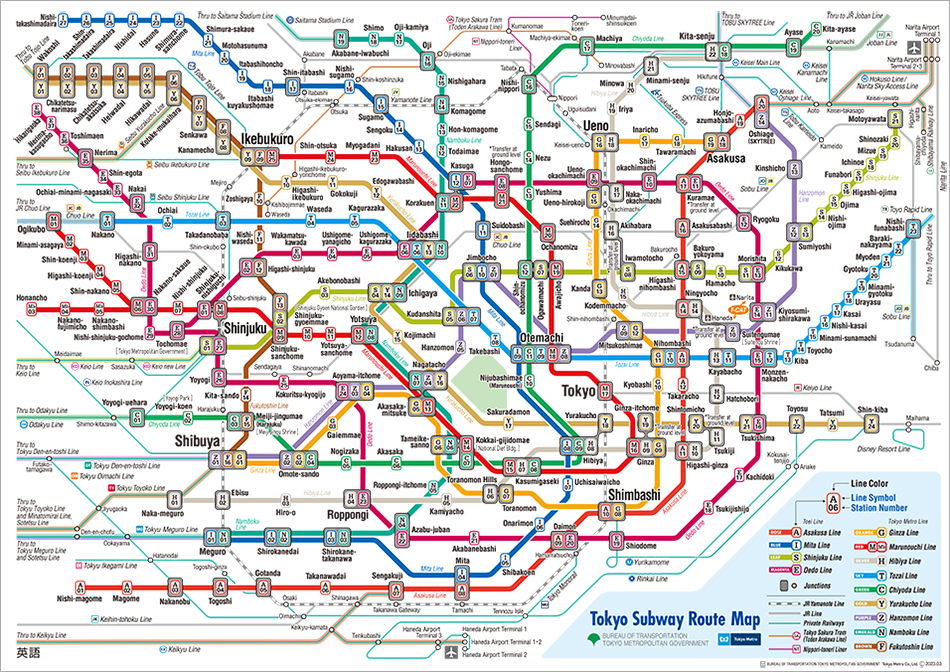
Why can't we do what every other city with an extensive subway system did?

There may be seismic reasons.

https://www.tokyometro.jp/en/subwaymap/img/img_01.png

Re: To solve affordability crisis, Bay Area housing stock must grow 50% in 20 years

#264
post #106

News from 2029: Skylynr, the 'Uber of nanoassembled highrises', last night replaced 44 San Francisco Victorians with apartment buildings. Reached for comment, SF's Planning Department said the overnight construction violates a city moratorium, to study displacement issues, now in its 14th year. The Board of Supervisors plans to address the issue in an emergency session next Tuesday. A Skylynr spokesperson says over 4…

Perhaps you put this in the future to make the overnight construction possible.

But in some parts of the world, the same fait accompli can be achieved the old fashioned way. Just make sure the official enforcing the moratorium has a wife or nephew or someone with a large stake in Skylynr. With such tricks, we will soon house all the world's urban poor. Pity that California is not yet so "advanced".

Re: To solve affordability crisis, Bay Area housing stock must grow 50% in 20 years

#265
post #223
post #208

Earlier quoted context omitted.

Personally I think we should just go for the first one, which is why I didn't mention anything else. Proposition 13 limits should be for owner occupied residences only. This would go a long way to fixing the financialization of real estate problem, which is an often under-discussed contributing factor. You'd get a lot less resistance there. You're not messing with cost of living for owner occupied homes, just second…

One of the reasons Prop 13 happened was to go hand in hand with rent control and help offset the negative costs of rent control. (An advantage for the owner and renter). So I think you'd need to get rid of rent control to get rid of Prop 13 for a large group of people and that would be very hard.

Prop 13 preceded rent control in San Francisco and in most (maybe even all) California cities that have rent control.

Re: To solve affordability crisis, Bay Area housing stock must grow 50% in 20 years

#266
post #221

Earlier quoted context omitted.

That's not the way it works. The reality is that the apartment building goes up and you house is worth nothing unless the government allows an eminent domain for your property or a developer with the bucks to buy out the neighborhood shows up. Until that happens, your house lost a third of its value because there's an apartment next door. If you're unlucky, rates go up and you're stuck.

I don't understand why you're being down voted. Is it really controversial to say that a regular single family house in a single family house neighborhood will go down in value when somebody decides to plant an apartment complex right next to do?

Honestly? I appreciate your willingness to engage in this thread, but I have to say I really don’t care if it does or if it doesn’t.

Making a real estate purchase is a risk. Making a huge one is a huge risk. Right now, the Bay Area is prioritizing rewarding the obscenely wealthy and rewarding massive risk-taking by the moderately wealthy.

If those risks don’t pan out, but people can afford to live here, I’m not that upset.

Re: To solve affordability crisis, Bay Area housing stock must grow 50% in 20 years

#267
post #70
post #30

Earlier quoted context omitted.

If density increases the people who will benefit the most are current landowners. If you have single family home on a big lot, its value will go up many times if you can suddenly build an apartment building on it.

Most current home owners have no interest in selling to a developer or developing ourselves. We just want to continue live in conditions that were present when we bought it: a nice house with a garden on a quiet street. Yes, that is selfish, but I'm not going to apologize for not wanting an apartment complex next door. That said, I'm not going to vote against a state level politician who wants to relax zoning laws to…

> I'm not going to apologize for not wanting an apartment complex next door

That's reasonable.

But what is not reasonable is if you try to enforce that preference on next door. Your house is your house. Your neighbours house isn't.

Re: To solve affordability crisis, Bay Area housing stock must grow 50% in 20 years

#268
post #70
post #30

Earlier quoted context omitted.

If density increases the people who will benefit the most are current landowners. If you have single family home on a big lot, its value will go up many times if you can suddenly build an apartment building on it.

Most current home owners have no interest in selling to a developer or developing ourselves. We just want to continue live in conditions that were present when we bought it: a nice house with a garden on a quiet street. Yes, that is selfish, but I'm not going to apologize for not wanting an apartment complex next door. That said, I'm not going to vote against a state level politician who wants to relax zoning laws to…

As Long as people can buy more than 1 home or you allow foreign investors to buy houses, housing won’t be affordable

Re: To solve affordability crisis, Bay Area housing stock must grow 50% in 20 years

#269
post #257
post #208

Earlier quoted context omitted.

Personally I think we should just go for the first one, which is why I didn't mention anything else. Proposition 13 limits should be for owner occupied residences only. This would go a long way to fixing the financialization of real estate problem, which is an often under-discussed contributing factor. You'd get a lot less resistance there. You're not messing with cost of living for owner occupied homes, just second…

As a renter, that would be very painful for me, as my landlord would simply pass the cost of higher property taxes directly to me. (My building isn't subject to rent control.) For buildings subject to rent control, I would expect this would just cause landlords to spend less on improvements to the properties.

If your landlord gets a property tax cut, would they pass on the savings to you? No.

They are leasing you your place at market rate. The market rate is affected by supply / demand of rental units, not landlord costs. The only way they could pass the extra tax onto you is if you are not market rate and there is a law that allows them to do this, or if increasing property taxes on apartment buildings decreases the supply of rental units - an unlikely scenario.

Re: To solve affordability crisis, Bay Area housing stock must grow 50% in 20 years

#270
post #38

Just a reminder that the growth rates for SF, SV, Seattle, Portland are all pretty puny compared to the growth rates of, e.g. Detroit at its peak. Hell they're not even that crazy compared to growth rates those cities have handled before. People just aren't interested in any perceived threat to their property values so they're strangling growth based on an entitlement mindset. No, sirs and ma'ams, your home's price a…

I think it's also clear that Detroit is not a growth model you'd want to emulate. With the benefit of hindsight, it's clear that Detroit ended up with way too much low-productivity infrastructure that the current residents of the area can't afford to maintain.

Detroit's infrastructure was fine. Detroit's problem is suburbanization. The population of the Detroit metro area is up 1 million people since 1950 and the population of Detroit itself is down 1.2 million people since 1950. Most of the people and nearly all of the people with money left the city and moved to the surrounding suburbs.
Post reply on HN