Live data from Hacker News

Hyperloop One Becomes ‘Virgin Hyperloop One’

techcrunch.com

261–270 of 517 posts

Re: Hyperloop One Becomes ‘Virgin Hyperloop One’

#261
post #127

Earlier quoted context omitted.

He hasn’t done that with rockets. He wants to eventually, but he hasn’t yet. Let’s not let hype cloud facts.

He's getting very close, if one is considering domestic rockets. The standard-bearers were the Delta IV and Atlas V, which price out at around $17,000/kg - $20,000/kg to LEO, respectively. The Falcon 9 comes in at about $2,800/kg to LEO. Comparisons with non-domestic rockets are complicated by state subsidies and differentials in labor costs. But the Falcon 9 is approaching the 10X mark even before reusability has be…

Where are you pulling those numbers from? On ULA's website [1] they say you can launch an Atlas V for less than half the $/kg you listed

[1] I went to rocketbuilder.com and both LEO configurations I tried were around $8,000/kg (and I didn't count the 20% deduction for "ULA added value" since the numbers there are debatable)
Re: Hyperloop One Becomes ‘Virgin Hyperloop One’

#262

Earlier quoted context omitted.

> Some colleagues of mine also did a short feasibility assessment of the original white paper, and came to some similar conclusions Likewise. It sounds like above-surface (on Earth) is probably unfeasible given (a) security and (b) thermal concerns. For security, we just contemplated debris from the track (or a bullet from an errant rifle) puncturing the tube. Hyperloop One is testing an 3.3m diameter and 500m long t…

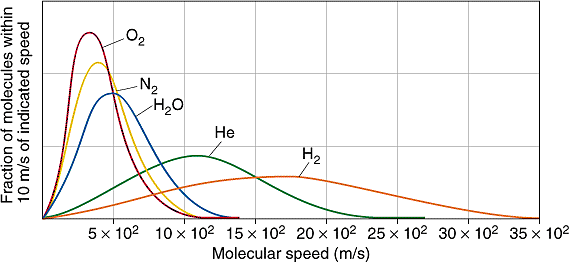
"a wall of air moving at the speed of sound" What? Particles moving in through a hole against vacuum will usually be travelling at a distribution of speeds dependent on ambient temperature, usually a boltzmann distribution. It will not be a wall, but rather a gradient. It's also not so much a maglev as an inductrack, which has only really become possible recently since it's come off-patent.

> What? Particles moving in through a hole against vacuum will usually be travelling at a distribution of speeds dependent on ambient temperature, since T = v_rms

A proper answer merits CFD. Barring that, sure, one can adjust for the velocity distribution [1] and the fact that a vena contracta [2] will reduce initial flow rates.

I used 330 m/s, the speed at 0 °C (which is generous since these tracks will likely be operating in hotter conditions), which one will observe is around the molecular velocity of oxygen or nitrogen.

[1] https://chem.libretexts.org/@api/deki/files/68415/BolzDist-M...

[2] https://en.wikipedia.org/wiki/Vena_contracta

Re: Hyperloop One Becomes ‘Virgin Hyperloop One’

#263

The original Hyperloop paper quotes its design pressure as “about 1/6 the pressure of the atmosphere on Mars” [1]. Martian atmospheric pressure is “about 0.6% of Earth's mean sea level pressure” [2]. So 0.1% of Earth’s surface pressure, or a 1,000:1 pressure change. To put that in perspective, the Boeing 787’s GEnx-2B67, the most powerful GEnx engine variant, generates a 43:1 pressure ratio [3]. To get a sense of the…

The worst thing about the Hyperloop concept is how it takes different smart people with slightly different assumptions about what is being described, how it should work, and how it does work in the fields they are familiar with or experts in and the other fields they are only conversant in, and turns those people into rabid defenders of their own calculations that somehow lose the ability to reassess where mistakes might have been made. I'm not sure how or why this happens, because as far as I know none of this is theoretical science, it's just a matter of applying the principles accurately (which seems to be the sticking point). For example, here's a whole playlist of people arguing over the physics of it, which does devolve into name-calling at points.[1] There appears to be good science involved in the assessments though, but could be said for the most part about both parties. The interesting parts are where people step outside their areas of expertise and their unfamiliarity with the application of the principles causes mistakes.

1: https://www.youtube.com/playlist?list=PLSPi1JFx4_-Gz0Fm0qq2K...

Re: Hyperloop One Becomes ‘Virgin Hyperloop One’

#264

Earlier quoted context omitted.

Assuming your are correct and Branson knows it because he hired good engineering advisers. Why would Branson get involved ? - It is a cool project he wants to be part of and he is willing to pay to see. (I would probably do that) - The benefit is not to reach the goal but all the technology that will be invented trying to reach the goal.

Branson's business model is selling the right to use the Virgin brand to other companies. The article doesn't say he made an investment. It is rather more likely that they paid him.

So basically Trump with more class?

Re: Hyperloop One Becomes ‘Virgin Hyperloop One’

#265

Earlier quoted context omitted.

> Wait, who said that they need to compress the air all the way to Earth pressure? No one. The Hyperloop alpha paper explicitly contradicts this assumption on page 18, where the flow diagram gives the compressor input at 99 Pa and the output at 2.1 kPa (a 21:1 pressure ratio). http://www.spacex.com/sites/spacex/files/hyperloop_alpha-201...

> The Hyperloop alpha paper explicitly contradicts this assumption on page 18, where the flow diagram gives the compressor input at 99 Pa and the output at 2.1 kPa (a 21:1 pressure ratio) One standard atmosphere (atm) is defined at over 100,000 Pa [1]. The 21:1 pressure ratio in Figure 11 on page 18 is for the "passenger plus vehicle capsule" [2]. I'm talking about the tube. Going from 99 to 2.1 isn't hard. Going fro…

Axial compressors aren't the only compressor design. Rotary vane compressors have no problem with those pressures.

The internal pressure was chosen explicitly because it was easy to maintain with simple, single stage mechanical vacuum pumps (see Figure 13 on page 22). Heck, the first result on Amazon for "vacuum pump" goes down to 5 Pa. https://www.amazon.com/dp/B012CFTYX4/

Compare the Hyperloop to true "vacuum train" designs, which need to run at 1/1,000,000th of an atmosphere to mitigate sonic booms (an alternate way to get around the Kantrowitz limit). This requires multi-stage pumping with mechanical roughing, followed by turbomolecular pumps and cryopumping. That 1000x harder vacuum takes 1000x as much pumping power (not because the differential pressure is meaningfully different, but because you expel 1000x less air per stroke).

Re: Hyperloop One Becomes ‘Virgin Hyperloop One’

#266

Earlier quoted context omitted.

> The Hyperloop alpha paper explicitly contradicts this assumption on page 18, where the flow diagram gives the compressor input at 99 Pa and the output at 2.1 kPa (a 21:1 pressure ratio) One standard atmosphere (atm) is defined at over 100,000 Pa [1]. The 21:1 pressure ratio in Figure 11 on page 18 is for the "passenger plus vehicle capsule" [2]. I'm talking about the tube. Going from 99 to 2.1 isn't hard. Going fro…

But that's no challenge at all. You're just describing a usual vacuum pump. And just a single-stage roughing pump (Harbor Freight, anyone?) can get down to less than 1 Pascal, so 100Pa is a piece of cake. That's only needed for slight leaks in the tube, not for the pod itself. Keep in mind that the absolute pressure difference is far less for Hyperloop than for a typical natural gas pipeline, and yet the latter can k…

> You're just describing a usual vacuum pump

Scaling is hard. The largest vacuum chamber we've built is a fraction of the size of the proposed Hyperloop. It was a very, very hard problem [1]. It's expensive, sucks up loads and loads of power and needs lots of thermal management, structural reinforcement and vacuum-off maintenance.

> Keep in mind that the absolute pressure difference is far less for Hyperloop than for a typical natural gas pipeline

Pipes are pressurized from the inside. See my comment from elsewhere in the thread on why vacuums are different [2].

All this said, I generally agree with you. I don't think building a giant vacuum is beyond current technological capability. I do think building one structurally sound and thermal-expansionwise stable enough to carry passengers at high speeds is.

[1] http://teamcorporation.com/images/technical_documents/Space-...

[2] https://news.ycombinator.com/item?id=15459873

Re: Hyperloop One Becomes ‘Virgin Hyperloop One’

#267
post #226
post #219

Earlier quoted context omitted.

"it would be as slow as conventional rail" - citation? Even Reason Foundation (which is as biased as it gets - it's funded by Koch brothers and ideological critic of almost any government investment) claim SF to LA times will be 3:30 to 4:40, which is faster than any train today.

That's barely faster than driving, once you account for the time spent moving between your origin/destination and the train station as well as transferring luggage.

In the near age of driverless cars I think this might be its biggest demise. If cars are automated people wouldn't need a train. It will be cheaper and less confining to a schedule and to a destination.

I think air travel for short to medium flights will fall off. By the time I leave my house and get to someplace that is 8 hours by car it would take 5 hours to check in and check out and you still need to rent a car.

Re: Hyperloop One Becomes ‘Virgin Hyperloop One’

#269

Earlier quoted context omitted.

Weren't there published papers by NASA scientists proving, without a doubt, that it's impossible to construct a booster rocket with the structural stability to return to earth? I'm willing to give this guy the benefit of the doubt considering his track record. It's also instructive to read the comments when the original Hyperloop idea was published. Even the people thinking Musk would fail were in the minority, becau…

> Weren't there published papers by NASA scientists proving, without a doubt, that it's impossible to construct a booster rocket with the structural stability to return to earth? No. Going back to the 1960s, re-usable two-stage configurations were being drafted [1]. [1] http://papers.sae.org/640297/

But I thought this all came to our god king in a dream.

Re: Hyperloop One Becomes ‘Virgin Hyperloop One’

#270
post #189

Earlier quoted context omitted.

When Musk first said that an LA SF Hyperloop could be built for 1/8th the cost of the equivalent HSR, I chuckled and then waited for the punchline, which still hasn’t arrived. It’s a cool idea and I do want to see more prototypes and feasibility studies, but people need to get off the hype train (no pun intended) and be realistic about the cost.

I don't think Musk want hyperloop to be built above the ground. This is just my own personal opinion, not sure if that's how it's going to work, but in one of his interview (TED? I think), he mentioned one of the reasons for his Boring company, was it would be relatively cheaper to build hyperloop - because the atmospheric pressure will be lower underground - and since you don't have to worry about building large inf…

Tunnel boring is orders of magnitude more expensive than railway construction, at typically ~a few hundred million dollars per mile vs ~a few million dollars per mile. I know Musk has plans to magically make tunnel boring significantly cheaper but you need two orders of magnitude cost reduction to make the tunnel digging not cost more than an entire above ground railway.

Cost references: https://tunneltalk.com/TunnelTECH-Apr2015-Arup-large-diamete...

https://www.compassinternational.net/railroad-engineering-co...

Post reply on HN