Live data from Hacker News

Lego's 0.002mm specification and its implications for manufacturing (2025)

thewave.engineer

251–260 of 343 posts

Re: Lego's 0.002mm specification and its implications for manufacturing (2025)

#251
post #16

Earlier quoted context omitted.

Nostalgia... Lego was amazing decades ago so we want it to remain so. It's not anymore though. The whole raison d'etre, namely infinitely recomposable bricks to be creative, was lost the moment they realized they were a LOT more money in custom sets. Sets become collectible, perishable, trends can form, secondary markets exists, etc. It's simply about the baseline, not the principle. Sorry.

These collectible (read: branded) sets are what saved them from bankruptcy, though.

How can you go bankrupt with Lego? That's almost like going bankrupt with Coca Cola. It's probably one of the most if not the most recognizable toy brand there is. I'll have to read up on this, sounds like a fantastic voyage of mismanagement, if true.

Re: Lego's 0.002mm specification and its implications for manufacturing (2025)

#252

Earlier quoted context omitted.

They still do that. I can go to the store right this very moment and get a bin of bricks. There's no problem here: people who want designed sets can get those, and people who want just bricks to use as building material can get those.

I'd be curious to know if those sets include more than just plain bricks.

https://www.bricklink.com/catalogItemInv.asp?S=10698-1 is an example, doesn't include just bricks, but things like windows and wheels

Re: Lego's 0.002mm specification and its implications for manufacturing (2025)

#253
post #12

Lego is one of those companies that is simultaneously amazing and kind of sucks. On one hand the core product is incredible. The tolerances on the bricks are micrometer-level precision and the fact that pieces from the 70s snap perfectly into ones made today is mind blowing. On the other hand, a lot what the company does today just sucks. Set prices are outrageous. Printed bricks get replaced with stickers and many s…

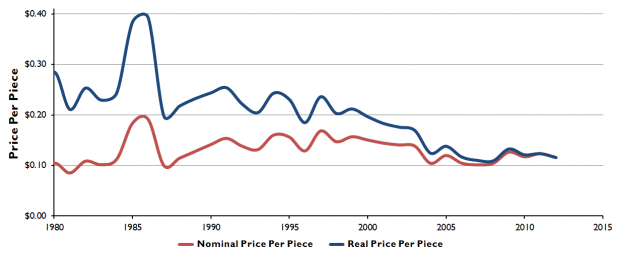
I believe the inflation adjusted price per piece has remained fairly consistent? https://flowingdata.com/wp-content/uploads/2013/02/priceperp...

Perhaps sets of a given physical size have more pieces now compared to before? Not sure.

Re: Lego's 0.002mm specification and its implications for manufacturing (2025)

#254
post #11

> A 2x4 LEGO brick manufactured in 1958 will snap perfectly onto a brick molded this morning in Denmark, China, Hungary, Mexico, or the Czech Republic. In the late 90ies, I regularly played with my uncle's old LEGOs from the late 60ies and early 70ies. They were stored in an unheated attic for 25 years. I remember that some of the old bricks didn't "snap" at all anymore to my newer bricks. They were either extremely…

There were some bricks from the very early days that were not made from ABS, nor did they have the current box and pin style. Those are often loose (or broken).

Re: Lego's 0.002mm specification and its implications for manufacturing (2025)

#255

Earlier quoted context omitted.

These collectible (read: branded) sets are what saved them from bankruptcy, though.

How can you go bankrupt with Lego? That's almost like going bankrupt with Coca Cola. It's probably one of the most if not the most recognizable toy brand there is. I'll have to read up on this, sounds like a fantastic voyage of mismanagement, if true.

https://blog.firestartoys.com/how-the-lego-company-almost-we...

It happened in the early 2000's. They actually posted a loss one year.

Re: Lego's 0.002mm specification and its implications for manufacturing (2025)

#256
>A 2x4 LEGO brick manufactured in 1958 will snap perfectly onto a brick molded this morning..

This is just manifestly NOT TRUE. The outward appearance may be the same. There were intentional improvements to the walls and tubes that make fit less than perfect. Generally, today's brick requires less force to snap and un-snap, because the compression is focused onto fewer points. (I guess this lowers the "hoop strength".)

Older bricks can be either: completely loose, or clutch so hard to each other they are the devil to take apart.

I have many bricks from 1962 onwards. The oldest 2x4s and 2x2s were made of cellulose acetate (CA) (in North America, intermediated by Samsonite.) CA were softer, and either had less clutch power to begin with, or lost it over time. When I got them in the 70s, they fit but wouldn't reliably stick to each other, nor later 70s-80s bricks (all ABS plastic by then.) (CA bricks were mostly red, and they have a pale orange tint.)

70s-80s bricks did not always age well. Aged 1x4 or 1x8 bricks can have the outer wall bowed inward slightly. This is a mold engineering problem anyway. Later, 80s bricks were improved by slightly thinner walls and some reinforcing tabs. The older, aged bricks can stick brutally to each other and to newer bricks.

The 10x10 baseplates didn't age well (these were once box-tops! Tog'l Toys also had the baseplate as a box-lid.) Possibly made of polycarbonate (PC). Other large plates in ABS-- for instance 6x16 (Auto Chassis, red) -- have warped. They were also more brittle to begin with.

So inside Brick geometry has changed over the decades. 60s-70s bricks are closer to plain boxes with tubes inside - as the Kiddicraft prototype of the 50s. In the 80s, the outer walls got thinner and had tiny studs where the studs contacted the wall. And the tubes changed from cylinders to just slightly clover-leaf inside, so that a tube over a single stud now formed 4 points of contact, and came apart with lower shear force. (I believe this also made it easier to pry a plate off of a larger plate.)

I have Fabuland sets from early 80s, whose plain bricks are so stiff, they are positively brutal to snap onto each other or 90s bricks.

The brick geometry of today is much improved. And the ABS is more "plastic", perhaps more "B" (butadiene rubber) or less "S" (styrene): I can drill it more cleanly.

Mid 80s and 90s bricks will interoperate just fine with today's. But bricks from before that period didn't age so well (and their corners, I believe, used to be harder.)
Re: Lego's 0.002mm specification and its implications for manufacturing (2025)

#257
post #43

"that familiar click is the sound of a carefully engineered interference fit designed to hold firm but still be easy for small hands to pull apart." My recent experience calls bs on pulling them apart.

Having grown up playing with LEGOs, I can still distinctly remember the feeling of sore fingers pulling tiny pieces apart after a long session. It wasn't until a few years ago I learned there's an official brick separator tool [1]. Would've changed my life as a kid. [1] https://www.lego.com/en-us/service/help-topics/article/lego-...

There are multiple brick separators, with different strengths and weaknesses.

Re: Lego's 0.002mm specification and its implications for manufacturing (2025)

#258
post #12

Lego is one of those companies that is simultaneously amazing and kind of sucks. On one hand the core product is incredible. The tolerances on the bricks are micrometer-level precision and the fact that pieces from the 70s snap perfectly into ones made today is mind blowing. On the other hand, a lot what the company does today just sucks. Set prices are outrageous. Printed bricks get replaced with stickers and many s…

If you're complaining about the prices, remember how capitalism works. The price is set by buyers, not sellers. That's the invisible hand, the seller will set the price to what buyers show they will pay. If you're unhappy about $500 for a Millennium Falcon or whatever, your beef is not with the company for accepting that when people choose to pay it, it's with those other buyers for paying that much. As the other rep…

>If you're complaining about the prices, remember how capitalism works.

Why get up at all, when gravity always just pulls me back down?

Re: Lego's 0.002mm specification and its implications for manufacturing (2025)

#259
> The 66-year-old brick will have the exact same interference fit, the same clutch power, the same 4.8mm stud diameter.

Pretty sure this is false. Old bricks had way higher clutch power, so high that it was deemed too difficult to separate. Sometime in the 90's the grip strength was reduced.

This false claim is underpins the entire article :(

Re: Lego's 0.002mm specification and its implications for manufacturing (2025)

#260
post #67
post #12

Lego is one of those companies that is simultaneously amazing and kind of sucks. On one hand the core product is incredible. The tolerances on the bricks are micrometer-level precision and the fact that pieces from the 70s snap perfectly into ones made today is mind blowing. On the other hand, a lot what the company does today just sucks. Set prices are outrageous. Printed bricks get replaced with stickers and many s…

> the push towards smartphone-dependent toys feels weird I haven't seen this push? The new Lego Smart stuff is explicitly "screen free play". There is an app but it's just for firmware update and configuration and you can't even connect it unless the brick is on the charger.

Hmm, the comment I was replying to was deleted.

I hate app obsolescence, and licenses that expire on your old hardware (Microsoft Word..) I exhibit 1980s video games. The hardware just continues to work. It's a disgrace what happens to mobile games, they just disappear. (Whattaya do, save all your old phones? I'm hating on you, Atari Classics app on iPad 2; revoked my paid license to use it.)

But to be fair, Lego has gone to great lengths to keep their companion software alive. Still, the nature of mobile: apps require constant updates to stay listed for new OS versions.

For one, Lego Commander existed uselessly on my phone long after it ceased to work... until one iOS it wouldn't install anymore.

Lego giving you a CD with software and instruction was a comfort (challenge: find a CD drive!) but only Mindstorms really.

For desktop apps in the 2010s, Lego relied on Silverlight to get Mac and PC compatibility. So what happens when you rely on a Microsoft framework... still as late as 2015 I was still able to download Mindstorms 2.0 (introduced 2002??) from Lego.

With instructions pdfs, Lego has been ok to let hobbyists reproduce the downloads (last I saw.)

Another thing Lego did was to provide SDKs for Mindstorms (a while after the community reverse-engineered a lot of it...). Opening it up that way was encouraging. (Lego even started distributing HiTechnic's 3rd party sensors, the folks that reverse-engineered the Mindstorms 1.0 RCX.)

I was part of the fan movement from 1998-2001 that hammered on the message for Lego to open things up. What happened is that they hired several of us :)

Post reply on HN