Live data from Hacker News

Girls in Tech closes its doors after 17 years

venturebeat.com

251–260 of 520 posts

Re: Girls in Tech closes its doors after 17 years

#251
post #72

There is an expression which I think is fitting, in a weird way - a successful marriage does not have to last forever. For some reason, we always tend to imagine that, once a company or organization is created, it must last forever. That for it to ‘close its doors’ or ‘wind down’ is somehow a failure. And that’s just not true; a professional athletes career does not last forever, and neither does the lifespan of most…

In fact, we consider a marriage successful if it ends in the death of one of the partners.

Is this still true? If I knew a couple that had a great ten years but then decided that it was time to part ways on friendly terms for whatever reason, maybe continue being great coparents, I'm not sure I'd consider it unsuccessful.
Re: Girls in Tech closes its doors after 17 years

#252

Earlier quoted context omitted.

That would be an improvement over my anecdata of my final project class for my CS degree in 2014 having ~30 men and exactly two women.

Then your class had lower than average women for the time. The overall numbers hasn't changed since then.

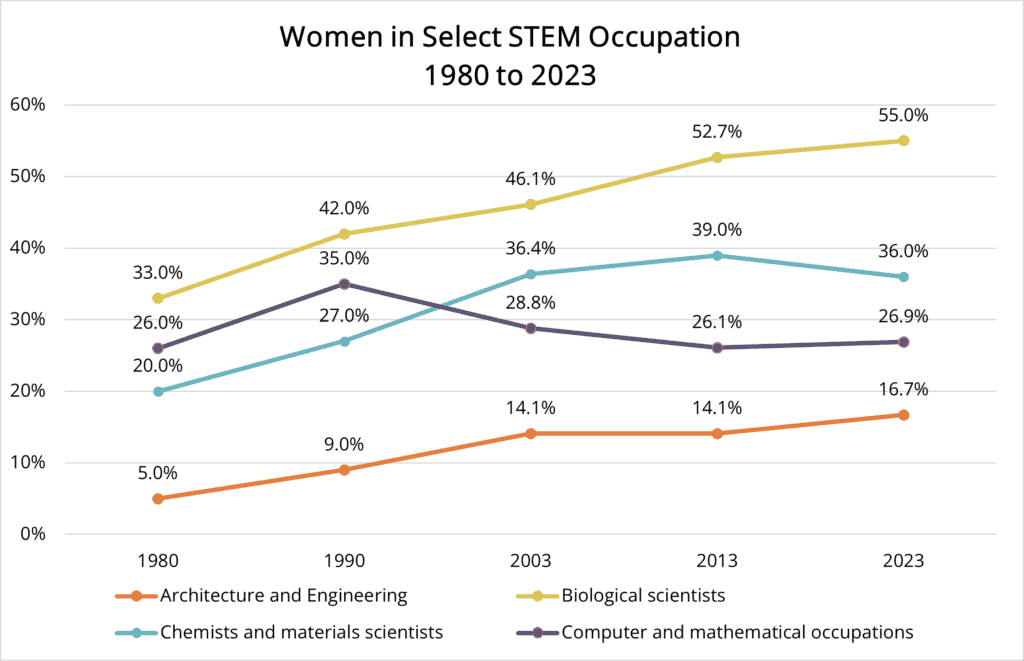
The numbers here are "and mathematical scientists"¹, so it's not (as upthread implies) CS grads, it's CS grads + other studies. I lived with a physics major; she did some code, would she have been counted?², but she was not a SWE in the making³.

My gut would not think other math degrees would necessarily be more women heavy. But like upthread, my class was 2 women in a class of ~160, or Not sure what to say, aside from I cannot reconcile it with experience, and the numbers being used here aren't the ones we need.

(¹as this is how the source for the data, "National Survey of College Graduates", has uselessly lumped them together. The "mathematical" portion includes degrees such as statistics, "Mathematics, general", and other unspecified-by-the-methodology degrees. Even the "computer sciences" portion isn't just CS degrees, they've also lumped, e.g., IT in there.)

(²no, probably not; when I wrote that I was looking at a graph another poster posted, but that graph seems to munch the category names. Likely physics would be under "Physical and related scientists", but also I can't find the methodology of then what a "mathematical science" is…)

(³and in lecture, the in-lecture ratios changed rather dramatically once you got past the point of "other degrees require 2 courses of CS cross-training")

Re: Girls in Tech closes its doors after 17 years

#253

Judging by current distribution of interns, coding is becoming a female dominated field. I think this has more to do with pragmatic mindset of asian parents and less with any DEI efforts. How many other fields: - Are not dangerous or unreasonably physically strenuous - Pay good money - Keep you surrounded by respectable, educated people - Can be mastered in 4-6 years rather than running risk of getting old while stil…

https://swe.org/wp-content/uploads/2023/03/Percent_WomenSTEM...

Re: Girls in Tech closes its doors after 17 years

#254

Earlier quoted context omitted.

Engineers viewing design as a 'less prestigious' role is laughable. The compensation for these tracks is pretty much equal. I would love to hear you spell out why exactly you perceive design as less prestigious.

In general, the compensation is much less than engineers at the same level but the potential for career growth beyond senior is much easier.

I would agree on the junior side of things. There is a higher threshold for the starting line for engineers, but for higher levels, design is by no means seen as a less prestigious role. Not in any sense of the word.

For salaries – see e.g. levels.fyi for quick comparison. Even Google – a company not really known for valuing design that highly: SWE L6 avg. = 520K USD. Product Designer L6 avg. = 515K USD.

Re: Girls in Tech closes its doors after 17 years

#255

Earlier quoted context omitted.

I don't feel the same. The last decade or so has seen an explosion of women show interest in joining the tech community. Ratio's on teams I've been on has greatly increased throughout my career. I've been on several teams now where women have outnumbered men. In my experience, the ratio is now flipped when you look at the team as a whole (XFN, etc). I may be biased though as I've only worked at "premier" large tech c…

It's been a change in the past 10 years but I would say women are still systemically under-compensated, under-levelled, and encouraged to move into less prestigious roles like product, design, etc. The perception that women are better at "soft skills" means that we get pushed out of technical tracks into coordinating work, managing people, and sometimes just straight up babysitting male devs. Those career paths lead…

There is a great book (written by a female engineer, Tanya Riley) called "The Staff Engineer's Path". I've learned a lot from the book, but one part of Tanya's experience that I could not relate to was having mentors who would encourage me and provide "you can do this" kind of pep talks. For a male engineer the usual experience is the opposite: we are expected to be competitive, and if we display any doubts then the only advice we'll get is "are you sure you want this promotion enough?" and "are you cut out for this?"

It appears to be much easier to advance in one's career as a self-doubting woman than a self-doubting man. This is probably because women are expected to have a high degree of self doubt and there is no assumption that they are defective if they admit to it.

And management is absolutely more prestigious and better compensated than IC work, despite what some may claim.

Re: Girls in Tech closes its doors after 17 years

#256
post #51

At the risk of posting a reflexive comment, what should we be doing here? It seems like everything has unintended consequences (not on a cost-benefit basis): - Minority affinity groups pull people from majority groups and decrease integration. - Anti-discrimination/sexism/etc. movements often add social barriers to interactions (e.g. things I do within my identity group would be misperceived if done across) - Affirma…

I have seen data presented multiple times showing the relation between a country’s wealth and/or economic freedom and women’s participation in stem fields. It’s a negative correlation. I often wonder if we should just be focused on maximizing individual freedom and let the chips fall where they may. This will result in some professions with extreme sex imbalance, and we should accept that outcome.

The idea that social sciences can pinpoint a single cause on something as full of confounding factors as this... it's extremely arrogant.

But then, the same applies to the people that immediately explain it as discrimination.

Re: Girls in Tech closes its doors after 17 years

#257
post #169

Earlier quoted context omitted.

You could read it that way, but she said "with sadness and devastation". You are taking some extreme liberties with your interpretation of what she's saying. The sentiment she's sharing is clearly quite negative. I don't think she's happily wrapping up her mission, I think she's going out of business and has no ability to continue her mission as she would like to.

We can still view operating for 17 years to be a success. We can still view helping women in tech for 17 years to have improved the world, even if it cannot continue.

We can consider winning one basketball game a success even when our team is disbanded after one season, but I don't know how that's relevant to whether someone is devastated about closing a group down that was meant to help women, when women still need to be helped.

Re: Girls in Tech closes its doors after 17 years

#258

Earlier quoted context omitted.

Then your class had lower than average women for the time. The overall numbers hasn't changed since then.

The numbers here are "and mathematical scientists"¹, so it's not (as upthread implies) CS grads, it's CS grads + other studies. I lived with a physics major; she did some code, would she have been counted?², but she was not a SWE in the making³. My gut would not think other math degrees would necessarily be more women heavy. But like upthread, my class was 2 women in a class of ~160, or Not sure what to say, aside fr…

This chart isn't lumping them, it has never been close to single digit percent for the past 50 years. Any class with sub 10% women is a big outlier. And as you can see from the graph, things hasn't really improved, classes used to have way more women, the single digit percent examples are low outliers at a time when things had already gotten really bad from where they used to.

https://www.aei.org/wp-content/uploads/2018/12/cs.png?x85095

Re: Girls in Tech closes its doors after 17 years

#259

Earlier quoted context omitted.

When I look around my peers, not a lot has changed in the last 10 years for woman in tech

FWIW remote work has opened the door to many women who would have left the field otherwise, so they might be less visible. It's still not great in my opinion, but I think there's more senior engineers and managers and an overall better situation than a few decades ago.

This is an effect of remote work that isn't discussed nearly often enough: it nearly completely removes any non-work-related "culture fit" filter from the equation for hiring and promotions. Without the happy hours, shared lunch breaks, or even the water cooler conversations "fitting in" isn't nearly as important remote as it was in person.

This benefits everyone who struggles to fit in with the traditional tech bro class: women, but also the neurodivergent, the deaf, the blind, teetotalers, and many more who would otherwise end up subconsciously perceived as less of a team player.

Re: Girls in Tech closes its doors after 17 years

#260
post #28

Earlier quoted context omitted.

The (economic) purpose of Girls in Tech is to create more workers in software so that prices for labor will go down. Given the layoffs of 2022-ongoing, labor costs in tech are dropping enough that interested parties aren't incentivized to increase the supply of labor further.

> interested parties aren't incentivized to increase the supply of labor further It's good when a profit-driven industry decides to stop trying to cut expenses.

Also unlikely.
Post reply on HN