Live data from Hacker News

A house 3D printed from raw earth

itsnicethat.com

251–260 of 261 posts

Re: A house 3D printed from raw earth

#251

Earlier quoted context omitted.

The negativity is no more unwarranted than positivity. Each depends on what problem a person values. In terms of housing the unhoused this doesn’t do anything. In terms of aesthetic possibilities for people with money it provides another option where a wide array of options already exist. In HN terms, this is a “rewritten in Haskell.” It demonstrates someone understands a bit about 3D printing. It demonstrates some i…

> In terms of housing the unhoused this doesn’t do anything. In terms of aesthetic possibilities for people with money it provides another option where a wide array of options already exist. Hey, that's me! I want one! I'm here to know if plumbing is included and if the exterior can look better, but I love this style on the inside. Its a mixture of Pierre Cardin's bubble palace and another aesthetic I've seen where t…

The part that can be done in 200 hours can be done with conventional methods in 200 hours.

Framing the superstructure of a building is always the fastest part. Site preparation beforehand and installing services and finishes afterwards are what takes most of the time.

Keep in mind that 200 hours is the time on site. It doesn't include lead time. If there are ten projects ahead of yours, you're 2000 hours out and because there is a dependency on a particular machine, you just have to wait. While you are waiting for your 200 hours, there will be weather delays on the other projects. Other owners will be like you and decide to add an extra room while the machine is there. Framing crews are largely fungible. Proprietary machines and materials are not.

So now it is finally your turn. Any other trades that need to be onsite haven't been sitting around waiting. They are off on other projects with their own schedules, delays, change orders and problems. Sure you scheduled them for 2200 hours out, but that turned out to be 3200 hours and the plumber will be free at the 3700 hour mark and the electrician at t=4000 hours. Because that's the way construction actually works.

It's why everyone has heard horror stories. It's why 200 hours sounds too good to be true. I mean how long will it take you to find a piece of land with suitable soil? How much time will it take to figure out where to put your strip mine on the property?

Also keep in mind that 200 hours is five forty hour work weeks (and 2000 hours a work year). That 3d printer has to be fed by someone and that someone won’t be working round the clock.
Re: A house 3D printed from raw earth

#252

Earlier quoted context omitted.

Yes, true. Picking winners is a hard game though... so I have sympathy for that part. The part that bothers me is crapping on other fields for things we would tolerate, even respect in our own. If a tech company was messing with 3d printing experimentally, released some esoteric and impractical new database alternative or somesuch... We might criticise, but this reaction to experimental architecture is extreme. I thi…

I see your point (although I am allergic to Architect-speak myself!)

I am too, instinctively... though I consciously try to push through it.

OTOH, I think architect-speak is the actual glue between art philosophy and wider movements. Why is "postmodernism" (or modernism, etc.) an epistemology, political ideology, artistic sense and architectural school? They don't seem obviously related Why did Ayn Rand write about an architect to demonstrate her thoughts?

Logical or not, these "movements" are connected somehow and they to ebb and flow together.

There are a lot of lessons here for tech nerds. You could easily describe "agile vs waterfall" in modernist vs postmodernist terms. Apple & Google's product aesthetic does reflect typically modernist ideas... form from function or whatnot.

A couple of years ago I went deep into talking to literal flat earthers (friends, whom I love). I learned (and still processing) a lot. Anti-intellectualism plays a fundamental role, but the key parts are a level or two deeper to that. You need to realize that psychologists, political "think tankers," dieticians or economists actually do present themselves as equally authoritative to physicists. They're wrong all the time, and many of their loudest talking points turn out to be fads in retrospect. EG Monetarism seems to be dying ATM, despite having been unchallengeable for 40 years. That happens in physics too, but relativity didn't make Newtonian mechanics seem like pseudoscience in retrospect. To a MOP though, there isn't an obviously discernible difference between Newtonian mechanics and the food pyramid. Both are intellectualism, claiming the authority of science. All they see is suits, academic titles, and positions of authority who get to be the authority.

Anyway... because architect/artists speak can be bullshit, is often very clumsy, and we can't discern BS from insight, we assume it's all bullshit or a way to get away with bullshit. Often, its our own ignorance.

I credit PG with bridging these worlds for me.

Re: A house 3D printed from raw earth

#253

Earlier quoted context omitted.

There are better ways to build affordable housing already. You make a factory that builds prefabricated panels then deliver them onsite. With prefab, you don’t need to transport an expensive piece of equipment to remote parts of the world and have onsite experts there to supervise and repair it. You don’t have to deal with tear down and setup of the equipment at every site and installers have predictable channels to…

Not only are there better ways to build affordable housing, there are better ways to do exactly what the article is describing. A buddhist monastery in my area managed to build beautiful structures using bricks made from local raw earth. No fancy giant 3D printers necessary.

Do you have have links for monastery? I have so many questions... how big is it? what does it look like? I love the idea of earth as a building material, and I'd love to see what the state of the art is now. Do we, as a species, possess the skill to build a Guastavino vault as good as a century ago in New York? Or something as pleasing Cuba's National Art Schools?

3d printing a building might be a cursed problem. If it doesn't scale past single-family dwellings, it's useless. Mo sprawl, mo problems. How could this tech scale up to the size of an apartment building? If you have a big crane, prefab panels are certainly cheaper and faster. Maybe if you built in the style of Agadez Mosque, with the scaffold incorporated into the structure, the robots could climb as they build. That seems to rule out toothpaste extrusion as a technique since the cure time would be a bottleneck. (Let's rule out energy intense curing agents.)

A bricklaying robot... supplied with bricks via the scaffold in the structure.... could the engineering to do that possibly be cost effective against skilled humans? Or the big crane? We haven't even considered aesthetics.

Cursed. Problem.

Re: A house 3D printed from raw earth

#254
post #181

Earlier quoted context omitted.

Thank you for finding this wonderful information. In adobe construction, too-high clay content can be as big a problem as too low. All clays are somewhat expansive, and the most plastic clays like bentonite are also the most expansive. If your adobe is too expansive it cracks when it dries and contracts. Including enough sand makes it less expansive and less plastic when it gets moist, and including enough straw† all…

maybe they're just arching the walls more than you would normally dare to do with adobe. I suspect that's a pure compression structure. It's a dome with an oculus, like the Pantheon. It probably took finite element analysis to design an asymmetrical dome. The asymmetry is just showing off.

A pure compression structure is a pool of liquid. If you add some shear strength, so the structure can withstand compression and shear but no tension, you can additionally build a heap of sand or a pyramid with no internal voids. To build a vertical wall, much less an arch or vault or nonuniformly-drying adobe†, your material needs to withstand some tension—a property you only really come to appreciate after attempting to build or plaster with adobe containing too little clay or too little straw‡, then watching the structure crumble as it dries.

It's common to analyze masonry structures as "pure compression structures", but that's a useful simplification permitted by considering the bricks to be atomic units. The tensile stress trying to peel the bottom surface off a brick arch is small, but it's real, and if not resisted by the tensile strength of the brick, the arch collapses from the inside out, like the sand arches that sometimes form above an aperture in a moving-sand-picture desk toy. Fired-clay bricks have enough tensile strength that we don't have to think about this, but adobe is just at the limit where safe and reliable building is possible with enough care. For this reason, traditional adobe walls are very strictly vertical, but their surfaces are not; they are significantly thinner at the top than at the base.

(I'm not an architect or structural engineer, but I spent much of my childhood in adobe structures, I've taken a few adobe-construction classes, and in the process I've built a few adobe structures that are still standing.)

______

† Nonuniformly-drying adobe is not a particular type of adobe. It's the nature of the drying process that, during drying, the surface of the brick or wall is dryer than the core—it's precisely that moisture gradient that causes moisture to diffuse out of the core, thus allowing the core to dry. But that same moisture gradient sets up a tensile stress in the surface, which you can diminish but not eliminate by adjusting the adobe mix. Even portland-cement concrete does this, though to a smaller extent.

‡ Straw or other high-performance, fibre-reinforced stabilising agents, of course.

Re: A house 3D printed from raw earth

#255

Earlier quoted context omitted.

The actual products that make it work: Mapesoil 10.[1] "High-performance, fibre-reinforced powdered stabilising agent for sports sub-base contruction surfaces".The amount of Mapesoil 10 required is 3%-5% of the dirt weight. Comes in 500kg bags, on pallets. Dynamon SR4 [2] "Superplasticizer based on acrylic polymer for concrete with long slump retention". About 1%-2% of the mix. That gets the material through the 3D p…

The 3D building printer people still don't have a good way to do compaction. Something like the Lil' Bubba curb machine.[1] It's a simple little device for making concrete curbs. You put in concrete, and it compacts and rams it into the curb it is making, pushing itself along. Something like that is needed at the output end of the 3D printing arm. [1] https://youtu.be/A06vfELMIK8

I used to wonder about something like Lil Bubba bringing in and compressing dirt to make agriculture borders/fences/windbreaks about 3-4' high. Imagine a grape harvester that straddles rows, bringing in dirt like a zipper. Of course, wouldn't be useful in all cases or maybe any, but running post and wire fencing for hundreds of kilometres in the outback must be brutal.

Re: A house 3D printed from raw earth

#256
The interesting thing with all these alternative construction methods is that they end up having much larger costs in one way or another. I'm a huge fan of "alternative living" (lived in a boat I built myself for years) but even I can't convince myself to build a home with one of these alternative methods (shipping container, 3D printing, compressed earth block, adobe, wattle and daub, concrete block, etc.) First there's the permitting process. Then there's the construction costs. Then there's the safety aspect (many of these homes are a disaster with earthquakes/fire/water issues.)

An underappreciated thing is how easy having straight walls makes construction. Having lived in a boat with curved walls, I would never consider a land home with curved walls. The beauty of the curve does NOT make it worth it, unless you plan to hire someone at great expense to do all the work for you. Yes, it's that bad, your 4 day cabinet project will become 4 weeks in no time. Instead of being able to simply plop in premade components (windows, benches, cabinets, beds, etc etc) you'll now need to custom build absolutely everything. Even the parts that seem simple are not. Laying flooring in a square room is simple enough. In a small curved room, you'll have to cut a ton of pieces with a strange curve. Then you have to lay them to meet up with the curved walls. It's a nightmare. You're also negating part of the eco-friendly aspect, by the way, when you have to discard huge amounts of curvy pieces of material (trust me, you'll cut large pieces wrong more than a few times.) That's one reason why I find this 3D printing clay project quite cool - you can simply 3D print benches, cabinets, walls etc to nestle right up to the curve.

I'd be very curious to hear from anyone here who tried to save money while building a home, but I would suspect that the answer is to go small and minimize labor. Even minimizing labor, you're going to need permits, a foundation, electrical, HVAC, a roof, etc, so it's not going to be nearly as cheap as you think.

If anyone is interested in a good cost breakdown of house construction costs, I like this one: https://www.nahbclassic.org/generic.aspx?sectionID=734&gener...

You'll notice that the sum total of framing + exterior finishes (framing, exterior wall finishes, roof, windows and doors, etc) come out to around 30% of the construction cost of a new home, or around 18.5% of the total cost of a new home. So this machine can save you at maximum 30% of the construction cost. The rest is pretty much fixed: landscaping+deck+driveway = 6.8%, interior finishing = 25.4%, plumbing/electrical/HVAC = 15%, foundation = 12%, permits/sewer/fees = 6%.

Which gets to my last point: the issue with technologies like these is that people compare their best-case projections for one part of the system to the total costs of the existing solution (traditional stick built construction) in the same way people make arguments for Gadgetbahn type projects. You see that the average new single family home costs $485k and suddenly a $50k shipping container home looks really appealing. But that's ignoring two things - one, the costs that are not included in that $50k, and two, that you're comparing a projection to reality. Compare apples to apples, and you'll realize that a stick-built kit for several hundred square feet can be had for $29k: https://allwoodoutlet.com/LARGE-CABIN-KITS/Allwood-Avalon-54...

Re: A house 3D printed from raw earth

#257
post #255

Earlier quoted context omitted.

The 3D building printer people still don't have a good way to do compaction. Something like the Lil' Bubba curb machine.[1] It's a simple little device for making concrete curbs. You put in concrete, and it compacts and rams it into the curb it is making, pushing itself along. Something like that is needed at the output end of the 3D printing arm. [1] https://youtu.be/A06vfELMIK8

I used to wonder about something like Lil Bubba bringing in and compressing dirt to make agriculture borders/fences/windbreaks about 3-4' high. Imagine a grape harvester that straddles rows, bringing in dirt like a zipper. Of course, wouldn't be useful in all cases or maybe any, but running post and wire fencing for hundreds of kilometres in the outback must be brutal.

When you see rock walls around fields, it's often partly to dispose of unwanted rocks in the fields. “This is an awesome amount of manual labor, but it is trivial when compared to the much larger effort of getting stones to the edges of the fields in the first place.”[1]

An extreme case is western Ireland. Tiny plots surrounded by far too many stone walls. Pretty, but too rocky for sustenance farming. Cromwell ordered the Catholics to go "to hell or to Connacht".

[1] https://www.earthmagazine.org/article/history-science-and-po...

Re: A house 3D printed from raw earth

#258

Building a house was never a problem and the huge costs are mostly artificial. The biggest problem is regulation and that you need to have a lot of money to convince local authority to grant a permission to build. It is out of reach for a regular citizen. You can't even build a mud hut without a blessing of a civil servant, and they hate when regular people want to build something as they don't have means to grease t…

That's partially true.

But, if you build a house and it collapses on top of you, who's responsible? Who pays for your medical expenses?

Even worse, if the house collapses and it falls on top of your guests, who's responsible? Who pays for everyone's medical expenses?

That's just one random example, there are many ways a house can fail.

Re: A house 3D printed from raw earth

#259

Earlier quoted context omitted.

Not in the US. Americans prefer living in cardboard boxes. I mean, timber frame and drywall palaces.

You mean affordable structures made out of renewables and built to the latest safety and efficiency standards? I always feel like this sentiment sounds like nostalgia some express about the "sturdy" cars of the 60's. Sure, you can hit them with a hammer without a dent, but the engineering is crap.

> You mean affordable structures made out of renewables

Yeah, last I heard ceramic brick is a super artificial material that doesn't degrade at all over time. It's also very toxic :-p

Re: A house 3D printed from raw earth

#260

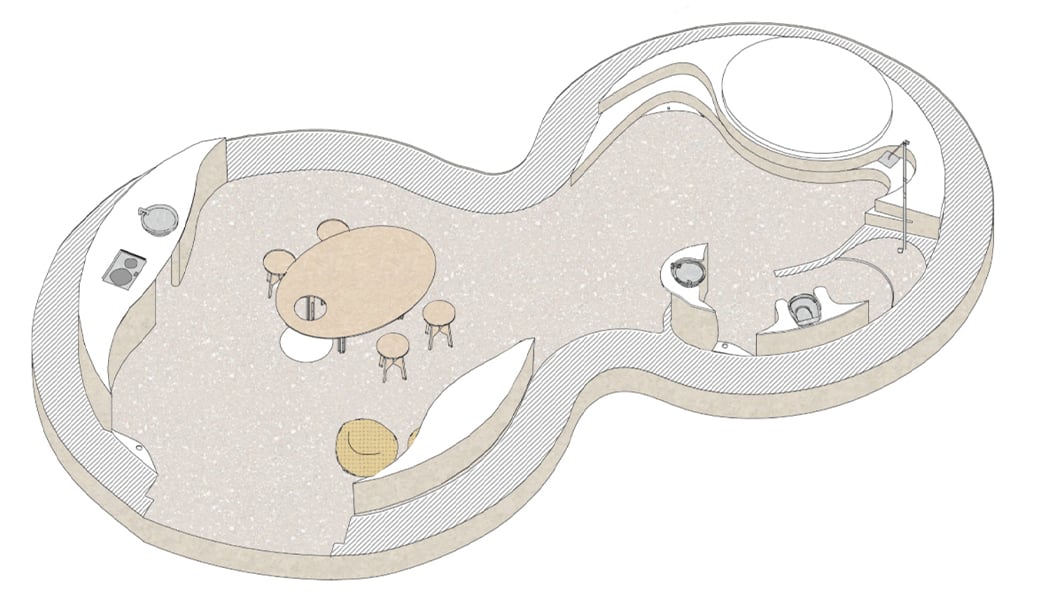
In all of these demos, they never show you the resulting bathroom, shower, or kitchen. It's always "here's a shell we made". I'd like to see the finished house, with fixtures in place and working.

There are a few shots showing the floorplan and utilities.

This illustrates the bath and kitchen areas. Looks as if there's a cooktop but no oven. The bath includes a sink, shower, and WC.

https://www.yankodesign.com/images/design_news/2021/02/a-3d-...

Post reply on HN