Live data from Hacker News

Statement by FTC Regarding Reported Concerns about Facebook Privacy Practices

ftc.gov

251–260 of 285 posts

Re: Statement by FTC Regarding Reported Concerns about Facebook Privacy Practices

#251

Earlier quoted context omitted.

600+ Million records: "Name, Address, Email, Carrier, Line Type, Secondary Phone, Age, Gender, Household Income, Marital Status, Presence of Children, Home Owner Status, Home Market Value, Length of Residence, High Net Worth, Occupation, Education Level, Twitter Handle & Followers, Facebook Profile & Followers, LinkedIn Profile"

Don't forget number of steps per day, resting heartbeat rate...

No, that's not included. Read the link.

I do not speak for Fitbit, but I work for Fitbit, and I do not appreciate my employer being baselessly lumped in with violators of privacy.

Re: Statement by FTC Regarding Reported Concerns about Facebook Privacy Practices

#252

Earlier quoted context omitted.

I don't know. Once you get your photos off of Facebook I think you can leave really easily. You can still message all your important friends through sms or your chosen chat app. Snapchat exists as an alternative for casual photo sharing. Reddit or Twitter for posting news, memes or funny videos. I think people exaggerate the importance of Facebook. Young people can adapt to new technology quickly. I know I was able t…

Young people might be able to adapt to new technology quickly, but they also have some of the strongest social pressures to remain on the technology all their friends are at. The difference between being in the "cool" message group and someone having to message you separately is a much bigger hurdle for them to face than where all your photos go.

> Young people might be able to adapt to new technology quickly, but they also have some of the strongest social pressures to remain on the technology all their friends are at.

Exactly - that's the danger for FB. If the coolest of kids head somewhere else, that strong social pressure works against FB and not for it.

Re: Statement by FTC Regarding Reported Concerns about Facebook Privacy Practices

#253

>Foremost among these tools is enforcement action against companies that fail to honor their privacy promises This is the crux of the issue. The problem is that when Facebook asks for "location information", the consequences of this are not being conveyed to the user. The user might think, "ah they want my location for the weather recommendations and event suggestions in my neighbourhood". They do not realise how som…

http://webcache.googleusercontent.com/search?q=cache:https:/...

http://web.archive.org/web/20180124044328/https://www.ftc.go...

Re: Statement by FTC Regarding Reported Concerns about Facebook Privacy Practices

#254
post #75

Earlier quoted context omitted.

The difference is, if devs don’t support your brower, your browsing experience suffers. Every developer on Earth could leave Facebook and it would not make the experience of using fb any worse. Facebook is not a software platform, it’s an ad platform. If anything fb would get better if we stopped targeting it.

I remember the process, it had nothing to do with the dev support. Actually, it was the other way around - IE had all the dev support and websites broke down on Firefox but people were fanatics. There were extensions that let you render the page in IE if it's not working on Firefox. When the Chrome came along, Firefox already put a dent in IE market share and it already became socially unacceptable for techies to use…

IE11 still has 75% share in the banking industry.

It’s far from dead, although we’re finally seeing Edge and Firefox rise a bit more sharply.

Slow-moving, heavily regulated corps with lots of internal legacy apps simply cannot use Chrome with its frequent feature deprecation, weak management, and constant desire to send telemetry and who knows what else to Google servers.

Re: Statement by FTC Regarding Reported Concerns about Facebook Privacy Practices

#255

>Foremost among these tools is enforcement action against companies that fail to honor their privacy promises This is the crux of the issue. The problem is that when Facebook asks for "location information", the consequences of this are not being conveyed to the user. The user might think, "ah they want my location for the weather recommendations and event suggestions in my neighbourhood". They do not realise how som…

The user does not know that Facebook it going to tip off the insurance provider about the user's unhealthy eating habits or his chronic medical condition. Or maybe tip off his bank that he has substantial wealth elsewhere. Are you aware of any instance in which this has actually happened? AFAIK Facebook has not been selling location data to anyone, and this would be a direct violation of their privacy policy. Further…

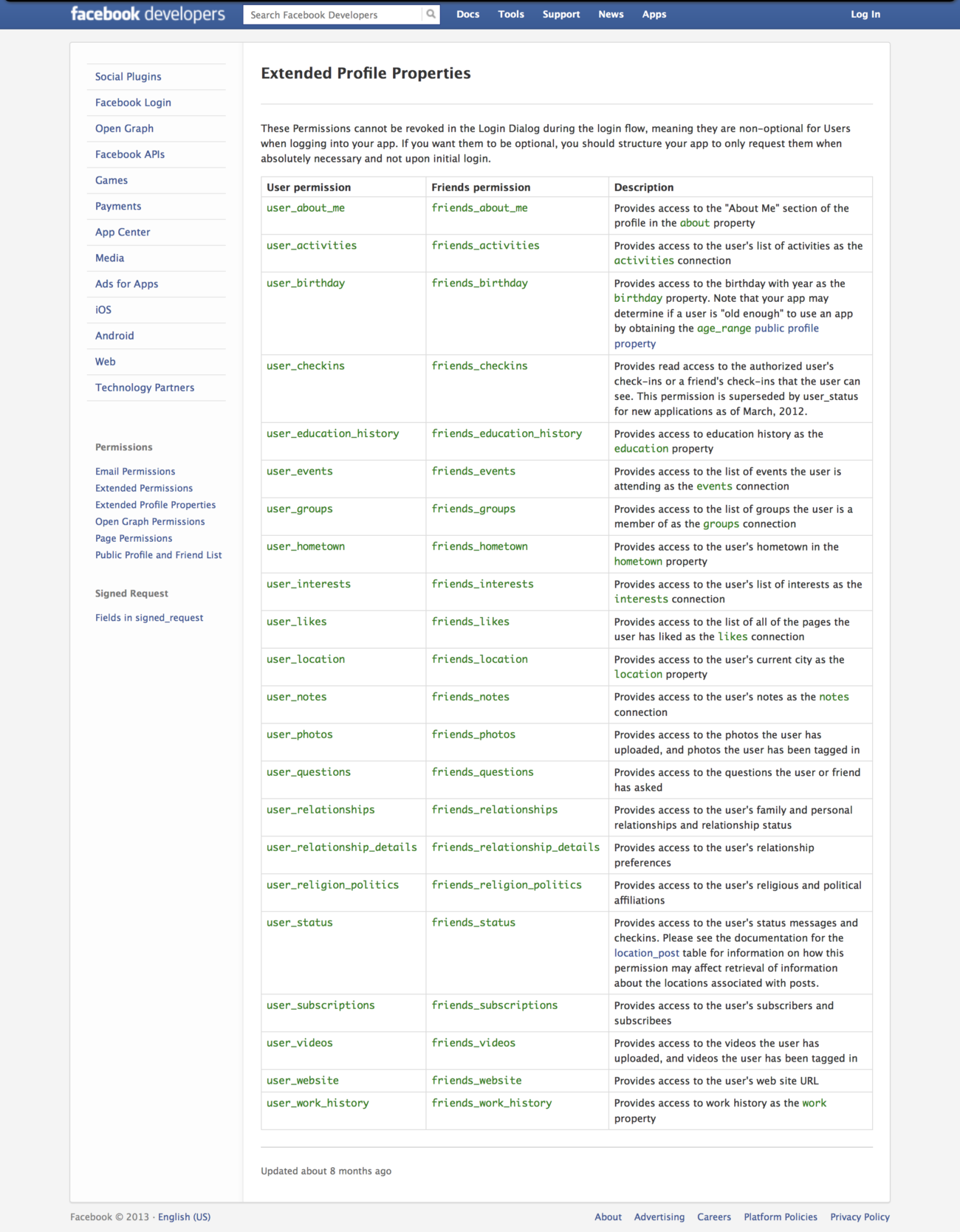
Location data, both user and friends, are part of Extended Profile Properties:

https://stratechery.com/2018/the-facebook-brand/

https://stratechery.com/wp-content/uploads/2018/03/Screen-Sh...

https://web.archive.org/web/20130911191323/https://developer...

Re: Statement by FTC Regarding Reported Concerns about Facebook Privacy Practices

#256

>Foremost among these tools is enforcement action against companies that fail to honor their privacy promises This is the crux of the issue. The problem is that when Facebook asks for "location information", the consequences of this are not being conveyed to the user. The user might think, "ah they want my location for the weather recommendations and event suggestions in my neighbourhood". They do not realise how som…

If I had a nickel for every time someone called me paranoid or a conspiracy theorist for mentioning this before last week, I'd have a ton of nickels. I should feel better now that people of aware of the nefariousness of this type of data collection, but I feel worse. The general public is being fed this as "Russia" and "Trump", and not getting the real, horrifying, surveillance state truth of what's going on. I'm les…

> If I had a nickel for every time someone called me paranoid or a conspiracy theorist for mentioning this before last week, I'd have a ton of nickels.

I just had an existential age-related hiccup realizing that I had a school paper on the subject back in 2002.

Re: Statement by FTC Regarding Reported Concerns about Facebook Privacy Practices

#257
post #198

Earlier quoted context omitted.

And that's much more than the raw materials... A nickel is 75% copper and 25% nickel. There are 2000lbs in a ton. That's 1500lbs of copper and 500lbs of nickel. Scrap pricing is $2.50/lb for copper, $3750. Scrap pricing is $4.83/lb for nickel, $2415. Total = $6165

> A nickel is 75% copper and 25% nickel. Interesting, I thought nickle was the coin and nickel was the metal, but it seems that isn't the case and/or changed. (?)

Coinage has a marked propensity to debase.

"For in every country of the world, I believe, the avarice and injustice of princes and sovereign states, abusing the confidence of their subjects, have by degrees diminished the real quantity of metal, which had been originally contained in their coins."

-- Adam Smith, Wealth of Nations

https://en.wikipedia.org/wiki/Denarius#Debasement_and_evolut...

https://en.wikipedia.org/wiki/Denarius#/media/File%3AFinenes...

Re: Statement by FTC Regarding Reported Concerns about Facebook Privacy Practices

#258

Earlier quoted context omitted.

The user does not know that Facebook it going to tip off the insurance provider about the user's unhealthy eating habits or his chronic medical condition. Or maybe tip off his bank that he has substantial wealth elsewhere. Are you aware of any instance in which this has actually happened? AFAIK Facebook has not been selling location data to anyone, and this would be a direct violation of their privacy policy. Further…

Location data, both user and friends, are part of Extended Profile Properties: https://stratechery.com/2018/the-facebook-brand/ https://stratechery.com/wp-content/uploads/2018/03/Screen-Sh... https://web.archive.org/web/20130911191323/https://developer...

Right, but those are directly authorized. That's not the same as going to Facebook and buying location data, nor does it apply to friends' locations.

Re: Statement by FTC Regarding Reported Concerns about Facebook Privacy Practices

#259

Earlier quoted context omitted.

> The right types of questions to ask are along the lines of whether we're sure competitors have sufficient ground to catch up to massive incumbents and keep them honest (and in this case specifically, whether certain misrepresentations or violations occurred that should be made to materially affect market standing through government intervention). I don't see how there could ever be any viable competition. Facebook…

> I don't see how there could ever be any viable competition. Facebook already has many of the top engineering minds in the world who are pushing the edge of what computers are capable of, not to mention the largest database and neural network of human behavior ever created. How is any of that necessary? I don't give a shit about their bleeding-edge neural network or army of PhDs. I just want to send my mom pictures…

>I would argue that all that technical bloat only made the Facebook experience worse. Facebook itself had humble beginnings. All a competitor needs is a LAMP or MEAN stack, an experience worth migrating to, and enough ethical sense to not treat its userbase like a science experiment.

It also needs the ability to make the transition plausible for consumers. There's really no reason that Facebook should be able to enforce a stringent walled garden and bar specific user agents that aren't negatively impacting the network and aren't exceeding the access of the user they represent.

But Facebook did exactly this in Facebook v. Power Ventures, leaving an entrepreneur with a ruined business and a bill for $3M in damages for creating a system that exfiltrated only one's own personal, copyrighted data from Facebook. It wasn't even taking other peoples' feeds or trying to multiplex data. It was simply trying to make one's own data accessible and portable.

Large tech companies have done this for decades, abusing the CFAA and the Copyright Act to enforce de facto platform monopolies. These companies know that if they can't assert ownership over the data, they'll have to compete on merit in the open marketplace, and who wants to deal with that?

This is also why you don't see new protocols like POP3 or NNTP anymore. Academics trying to build a transparently-syndicated collaboration platform are out. Big companies looking to hoard your data and assert some type of incidental, indirect ownership over it are in, and they want to make sure that you don't really have the option to leave. Lock-in is king.

Once a critical mass outside of the tech-savvy early adopter crowd is obtained, aggressive legal methods like those used against Power allow incumbents to hold onto power in perpetuity. Granny doesn't care about all of that tech mumbo-jumbo. She just knows that she can't see Auntie's pictures anymore because you broke it by switching her to F+. Since they're legally forbidden from multiplexing Facebook's content into a universal "social media reader", Granny's options are to stare at a blank feed or go back to Facebook -- even though Auntie would be perfectly willing to allow Granny to see her content through F+, and it's really more of an accident that Facebook is the platform that received the initial post.

What is Granny gonna do in this situation? Why have we awarded tech companies the right to hold user-generated content hostage like this? Wrap anything in custom HTML and it's suddenly very difficult for a third-party to access it without infringing your copyright on the exterior HTML wrapping, regardless of the status of the content inside. In the US, it's infringement to load copyrighted content into RAM, per the RAM Copy Doctrine.

Good luck convincing a technologically-illiterate judge that your software is no more disruptive than Chrome or Firefox, especially when you have to do so over the objections of Facebook's $X000/hr law firms and previously-referenced army of PhDs.

Such rules have stifled online innovation for decades now, and they're the reason that the internet is becoming a walled garden.

Under the GDPR, which mandates all companies provide a machine-readable export of user data within some fairly short timeframe (less than a week iirc), things may become marginally more fluid for people in EU countries, but I wouldn't count on it.

Disclaimer: not a lawyer
Re: Statement by FTC Regarding Reported Concerns about Facebook Privacy Practices

#260
post #160
post #148

Earlier quoted context omitted.

"It's okay because you weren't personally affected" is so obviously wrong. It's so obviously against the spirit of the law and of society. I find it hard to imagine you're arguing in good faith. But how about this, then, since you're so intent on making this political? How about we fix this so that no future politicians can benefit from this kind of targeted advertising - both liberal and conservative?

> How about we fix this so that no future politicians can benefit from this kind of targeted advertising - both liberal and conservative? I’d be fine with it, but the first step is admitting that yes, Obama benefited from harvested social media data as well. No one wants to do that, this is all a Trump thing as far as the media, and therefore the general public, is concerned.

the big difference being that the obama data was harvested via an app branded by obama campaign with the specific purpose being to help the obama campaign... vs a quiz app unrelated to politics where participants were paid small amounts to use, and thus pull data on their social network

the first is explicitly political; the second is actively hiding their intentions

*edit: also they used the data very differently. obama used it to push people’s hopes and dreams; trump used it to push people’s fears. overall, obamas campaign was FAR more positive than trumps

Post reply on HN