Any one did code through of this? Would love to know some highlights
React Native is now open source
241–250 of 298 posts
Re: React Native is now open source
#242How can we manage the Asynchronous parts like Ajax for example?..
Re: React Native is now open source
#243Earlier quoted context omitted.
(Someone had a post asking a good question about what this means. It got downvoted and deleted, which I think is unfortunate for a community that cares about learning about the world around it, so I'm replying here.) There are two separate kinds of legal protection at issue here, copyright and patent. The only thing that's close to covering ideas is patent law, not copyright law. (I'm assuming US law here, since that…
If you use any of their work then it opens you up to Facebook leveraging this against you. If they feel you violate a patent of theirs and they ask for a royalty or licensing fee - you can't even say it's not a valid patent or you void the right to use React Native, and anything else that has the PATENTS file in it (which is all of their stuff AFAIK) - that's why Google doesn't use it.
I'm not sure that is the case. The linked document says:
"The license granted hereunder will terminate ..."
that could be read to mean both licenses, the copyright one and the patent one, but the most natural reading, particularly as they are in separate files, is that it is referring solely to the patent license.
If that reading is correct, you can still use React Native to the extent that doing so doesn't violate any of Facebook's patents. They could argue it does and you could argue it doesn't. Until and unless a judge ruled that it did, you could continue using the software.
Edit: Geofft that's a good point. I suppose this really is a poison pill for a sufficiently large company.
Re: React Native is now open source
#244Earlier quoted context omitted.
If you use any of their work then it opens you up to Facebook leveraging this against you. If they feel you violate a patent of theirs and they ask for a royalty or licensing fee - you can't even say it's not a valid patent or you void the right to use React Native, and anything else that has the PATENTS file in it (which is all of their stuff AFAIK) - that's why Google doesn't use it.
I'm not sure that is the case. The linked document says: "The license granted hereunder will terminate ..." that could be read to mean both licenses, the copyright one and the patent one, but the most natural reading, particularly as they are in separate files, is that it is referring solely to the patent license. If that reading is correct, you can still use React Native to the extent that doing so doesn't violate a…
Yes, but it also affects you in the case that you argue that some other, unrelated Facebook patent is invalid, even if you're happy to concede that the patents covering React Native are valid.
For Google's use case, it means that if they ever find themselves in court claiming to have prior art on any of Facebook's patents (let's say Facebook sues them over something G+ does, and Google says it was described in the literature well before either of them), they automatically lose the (patent) rights to all of Facebook's OSS, even if they're legally in the right. So they can't build anything they care about on React.
Re: React Native is now open source
#245Re: React Native is now open source
#246Re: React Native is now open source
#247Earlier quoted context omitted.
If you're learning iOS development, stick to learning iOS development. A framework, no matter how cool and neat it is, will not replace pure iOS development for serious apps. Also ask yourself a question, do you really think you can call yourself an iOS developer when the only way you truly know how to create apps is with React?
> for serious apps Like Facebook's Groups app and Ads Manager app, which both use React Native?
No, like GarageBand, OmniFocus, Keynote, or hell even iBooks.
Re: React Native is now open source
#248Earlier quoted context omitted.
No, it doesn't mean that. It means that you lose the additional license to use any of Facebook's patents that may cover React. These may or may not exist.
Then why say "whether or not such claim is related to the Software?" That would imply just the opposite to me.
That clause relates to the patents you own that you're suing Facebook over, not the patents Facebook owns that they're (no longer) granting you a license to.
As an example, say Facebook owns patent 1234567 "Method and system for reacting natively". Google owns 7654321 "High-density computers in a data center". Google builds the new Maps app using React Native. This would infringe 1234567, except that React Native comes with a patent grant, so the Maps app is properly licensed.
Then Google sues Facebook over Open Compute Project, claiming infringement of patent 7654321. This has nothing to do with React Native, but Google has just lost its license to 1234567. So Facebook now gets to sue Google over the Maps app. (More likely, Facebook will threaten to sue in order to force a settlement for the other lawsuit.)
Re: React Native is now open source
#249Earlier quoted context omitted.
Are you nitpicking legal semantics (including something in one agreement or another), or saying it's possible to legally use React-Native while suing Facebook for completely unrelated patent infringement?
The latter. It is absolutely possible to legally use React while going ahead and suing Facebook. You do not lose your license to React by suing Facebook. What you do lose is an explicit grant of additional patent rights - the grant given in the PATENTS file. Note that there is no specification therein regarding what patents might be covered; it's completely possible that none of Facebook's patents have anything to do…
> It is absolutely possible to legally use React while going ahead and suing Facebook.
Only if it's possible to use React without infringing (or licensing) any Facebook patents. "Use" is not just about copyright.
(Which, as you point out, is plausible; there's just no reason to believe it's guaranteed to be true.)
Re: React Native is now open source
#250Please see this image:
http://facebook.github.io/react-native/img/chrome_breakpoint...
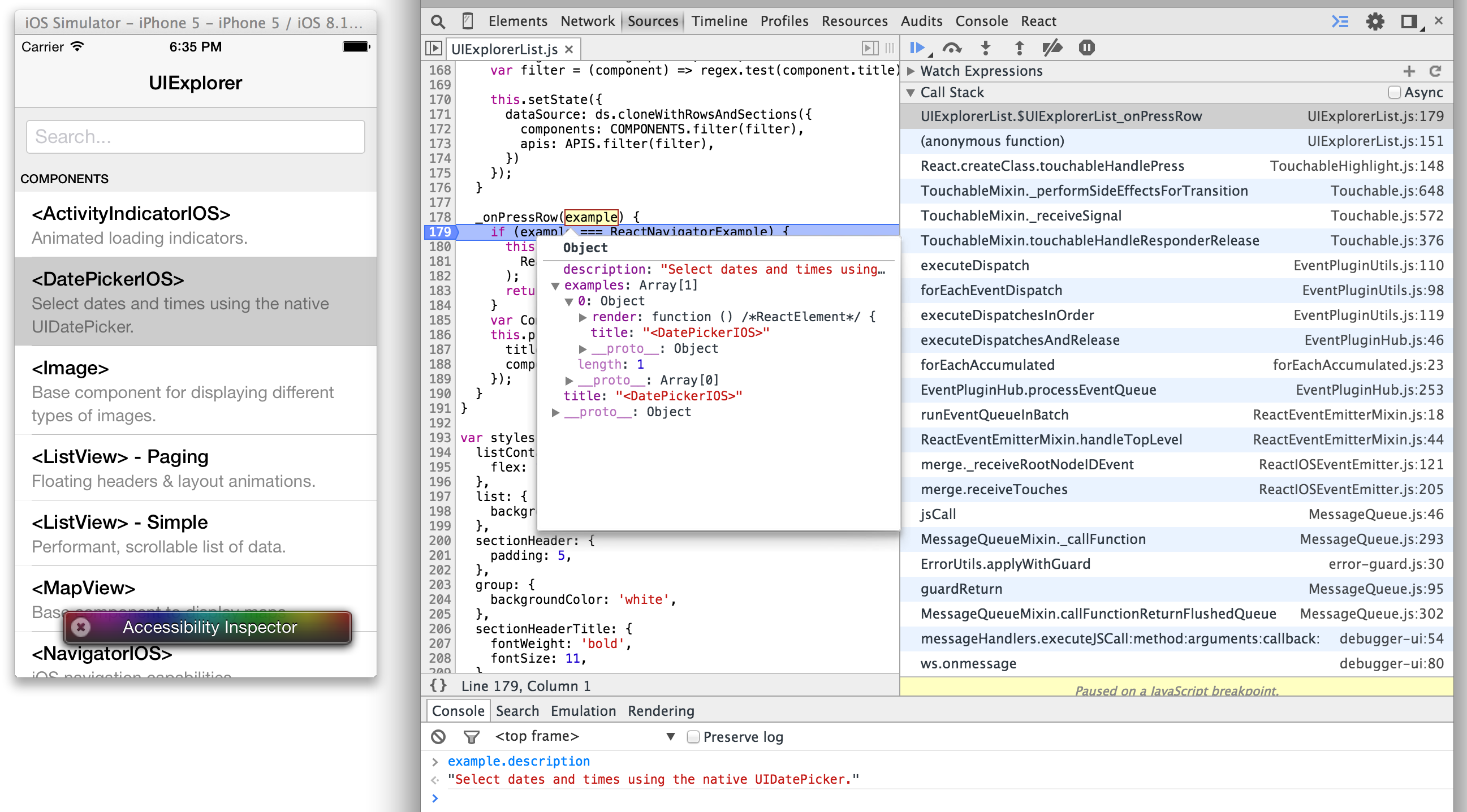
I am really confused. Why is this easier - this looks extremely buggy and complex?