Live data from Hacker News

Kids Rarely Read Whole Books Anymore. Even in English Class

nytimes.com

241–250 of 364 posts

Re: Kids Rarely Read Whole Books Anymore. Even in English Class

#241

I never understand where these anecdotes come from. I live in a rural Red State, a place you'd expect less reading, and my kids, and many of their friends, read full books all the time and have since they were quite young. The curriculum in our public school regularly requires kids to read full books for class, and the kids you'd expect from the homes you'd expect read plenty. So whatever the problem is, if there eve…

> I live in a rural Red State, a place you'd expect less reading, and my kids, and many of their friends, read full books all the time and have since they were quite young. > The curriculum in our public school regularly requires kids to read full books for class, and the kids you'd expect from the homes you'd expect read plenty. Reading the expected books for school is very different from reading a lot privately at…

Yeah, that was totally me.

The only book I ever read for school was by accident. I was already deep into it on my own when the teacher assigned it to us
Re: Kids Rarely Read Whole Books Anymore. Even in English Class

#242

Earlier quoted context omitted.

Let the market solve it. If the market requires educated adults the market will create that environment or something, answer is probably private schools. I assume they’d say something like that.

Slight problem with that if you would like to live in a functioning, thriving democracy: democracy in the sense of "one person, one vote" requires or at least greatly benefits from a broadly educated population. It's not sufficient, but very likely necessary.

See my last sentence

Re: Kids Rarely Read Whole Books Anymore. Even in English Class

#243
post #5

Earlier quoted context omitted.

It’s odd, I read ravenously as a kid/teen, as did my siblings. You need to read what you enjoy, and for it to not be forced. (For example, summer reading at the library gave out prizes kids cared about for reading books.) Plus, we didn’t have access to much digital media like TV/video games (though it was the early 2010s) because my parents were strict, so books were a solid source of entertainment.

I read a lot of books that fit my tastes as a kid, usually adventure/fantasy genre stuff. Never enjoyed the stuff that got assigned in school though. I’d probably like it now.

That was my problem too. Not in the US but in Europe. The stuff we had to read was all by 'highly acclaimed: authors who have carved out this niche of 'literature art ' between them.

However their books were dusty, tough, whiny and horrible to get through. Yuck. I never read fiction in my own language ever again just in spite.

Re: Kids Rarely Read Whole Books Anymore. Even in English Class

#244

Earlier quoted context omitted.

It is interesting how everyone parrots that art is important when the vast majority of the population will never actually engage with it. Opera? Ballet? Literature? Poetry? Classical music? Modern art? Do the numbers it seems most people can do without them and still be functional.

Avengers end game is also art. I engage with this type of art. I don’t consider opera the art of our modern culture. It is unfortunately a niche.

Yes! Art that's taught in school and that is "required" to know if you want to appear intelligent or fancy is just what GP posted.

But art is also:

* electronic music (if you're not aware, it's not just repetitive dum-dum-dum for 8 minutes, although I enjoy that style, as well);

* rap (it's not just guns, drugs and mysoginy);

* all the other music genres, of course, but I gave electronic music and rap as examples because they're usually treated badly by people who're not familiar with them;

* games (I've been emotionally moved by many flash games, let alone new immersive games);

* movies, series - live action or western animation or anime.

Yet, in school we either learned about classical composers, or about regional composers. Only once, around 10th grade, we had a cool music teacher who played other genres for us - Fat Boy Slim, random metal groups, even a few pretty out-there experimental things. Much better than learning about some composer who lived 50 years ago just because he is from the same country as you.

Same for paintings and similar art. What good does it do a 7th grader to look at Picasso? The context matters, but for people who don't care about such art, it's useless. I won't feel better if I can "intelligently" discuss the art scene in $nation in $year. I have, later in life, read interesting articles that actually mix politics and life in general with the art that was "allowed" to flourish. Like art in Soviet Russia. But that context, if it was given at all, didn't mean anything to a 7th grader, especially if they didn't learn about Soviet Russia in history before the art class. In my experience my education was all over the place.

Re: Kids Rarely Read Whole Books Anymore. Even in English Class

#245

Earlier quoted context omitted.

> I convert that to digital time in my head What? They are the same thing.

Not to other people I've talked to. I'm the wrong person to ask this about, since I prefer digital time, so time is just a number to me. But Technology Connections made a video atleast talking about it,[1] so hopefully that get part of the point across. To him and plenty of other analogue-first people, time is a progress bar, or a chart, or something along those lines, and that's the natural way to perceive time, and…

Totally agree. I do the same.

The only reason we have analog clocks is because digital ones were much harder to build. That time is of course over for good. It was a compromise imposed by limited technology.

Re: Kids Rarely Read Whole Books Anymore. Even in English Class

#246

Earlier quoted context omitted.

I think school ruined fiction books for me. I had to read long boring books about stories that didn't interest me, with useless sentences describing what the scene looked like or what someone had for dinner. Most of the stories and themes were outdated and didn't have enough context to make them understandable. Some books even used outdated words and phrases. Maybe if I wasn't forced to read a book in an outdated lan…

Seems like a skill issue on your end.

I read non-fiction all the time. HN and reddit comments, news articles, Wikipedia articles, books, research papers. My ADHD doesn't help, but doesn't prevent me from finishing 300-page books that are actually interesting. I have yet to find a fiction book that's not full of fluff.

I've read a couple of scripts for movies and TV, and they're, by far, much better than fiction books for me. Just more condensed, more to-the-point.

That's not to say that I admit I can't finish (or even start) a fiction book now. They're ruined for me. But I don't care.

Re: Kids Rarely Read Whole Books Anymore. Even in English Class

#247
post #182

Earlier quoted context omitted.

I think you are missing the broader point: why should one read things occurring in an alien context to begin with? It's not as if there is a dearth of more modern works. It seems like the main function of selecting older works is to make it artificially harder for students to read.

> why should one read things occurring in an alien context to begin with? I think there's a trivial answer which is that all things you encounter are fundamentally from an alien context. The degree of alien and intention of the action are the things to consider before proceeding. For example, why would one choose to read the account of a survivor of tragedy? To develop some amount of (emotional or cognitive) empathy?…

I'm using "context" in the sense of GP as to why it is hard to read e.g. Beowulf. Certainly one could find a modern account of a survivor of tragedy that would be more approachable? But in any case, accounts of tragedies of survivors are not the sort of material one finds in an English class, which is what's being criticized here (and indeed reading such accounts would probably be an improvement for the reasons you give).

Re: Kids Rarely Read Whole Books Anymore. Even in English Class

#248

Earlier quoted context omitted.

> I live in a rural Red State, a place you'd expect less reading I would not assume this, given that the states with the highest literacy rates are mostly rural and at least half red (NH, MN, ND, VT, SD, NE).

Break that down further and you'll see it's blue cities in those red states that have the highest illiteracy rates. Same with crime. Kind of goes hand in hand. Education in blue cities needs to be fixed.

oh I am sooo stealing this “blue cities is red states” thing - well done mate wherever you picked this up from, well done!!

Re: Kids Rarely Read Whole Books Anymore. Even in English Class

#249

I never understand where these anecdotes come from. I live in a rural Red State, a place you'd expect less reading, and my kids, and many of their friends, read full books all the time and have since they were quite young. The curriculum in our public school regularly requires kids to read full books for class, and the kids you'd expect from the homes you'd expect read plenty. So whatever the problem is, if there eve…

> I live in a rural Red State, a place you'd expect less reading I would not assume this, given that the states with the highest literacy rates are mostly rural and at least half red (NH, MN, ND, VT, SD, NE).

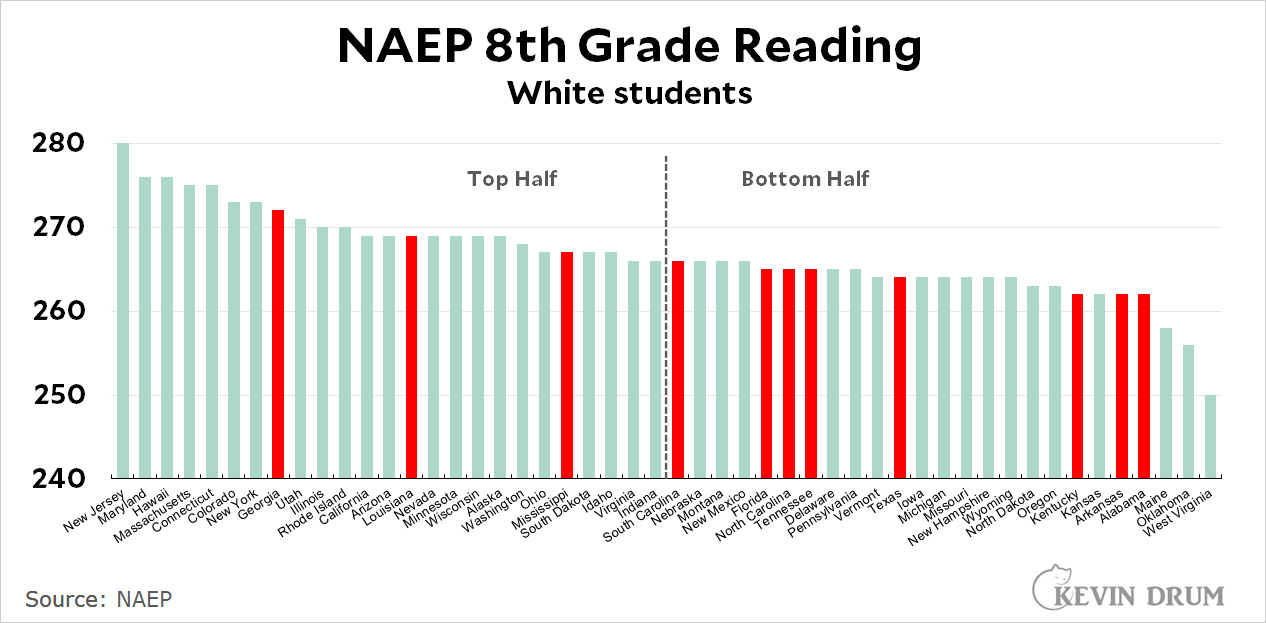
Yeah, reading scores are about how well you teach reading. In terms of NAEP 8th grade reading scores, New York, Georgia, Utah, Illinois, Rhode Island, and California cluster together in the top half, in that order: https://jabberwocking.com/wp-content/uploads/2023/04/blog_na...

Re: Kids Rarely Read Whole Books Anymore. Even in English Class

#250
post #40

Comments here are very strange, “Reading books should go the way of cursive! Education is more like childcare anyways.” It’s bizarre stuff to say. What would you have the education system do? Put iPads in front of kids all day?

Let the market solve it. If the market requires educated adults the market will create that environment or something, answer is probably private schools. I assume they’d say something like that.

>Let the market solve it. If the market requires educated adults the market will create that environment or something, answer is probably private schools. I assume they’d say something like that.

I don't pretend to speak for anyone else, but I am more than my economic inputs and outputs, and while it was in a somewhat different context, Heinlein's prose applies in spades WRT your assertion:

“I had to perform an act of faith. I had to prove to myself that I was a man. Not just a producing-consuming economic animal…but a man.” ― Robert A. Heinlein[0][1]

[0] https://www.goodreads.com/quotes/11588525-i-had-to-perform-a...

[1] From Starship Troopers[2]

[2] https://en.wikipedia.org/wiki/Starship_Troopers

Post reply on HN