Live data from Hacker News

Normal Operating Sounds

tesla.com

241–250 of 273 posts

Re: Normal Operating Sounds

#241
post #126

Earlier quoted context omitted.

This is the kinda good natured fun that I really liked Tesla for before they announced an armored vehicle that's designed in a way to increase the likelihood of accidentally running over your kids playing in the driveway.

Alternately, it’s designed in a way that almost all trucks and SUVs in the US are designed, in a way that is generally expected/preferred by customers who buy those vehicles. I also don’t like it, but it’s not Tesla’s fault that that’s where the market is. I’ve heard from so many foolish people who don’t understand physics that they feel safer driving a big heavy vehicle and being up high. The armor has nothing to do…

> I’ve heard from so many foolish people who don’t understand physics that they feel safer driving a big heavy vehicle and being up high

Can you elaborate on this a little? I only took Physics up to University level so maybe I'm missing something, but - why _wouldn't_ that make you safer in the case of a collision? My naïve assumption is that it would:

a) decrease effective force on the passengers (greater mass of car => less acceleration from a given collision force => less force transferred to passenger)

b) make the car less likely to flip (assuming that the increased mass offsets the extra instability from the height of the vehicle - which, since the chassis is likely heavier on the bottom than the large hollow areas at the top, I think is likely)

c) move the passengers (slightly, but non-negligibly) out of the direct line of impact

"Driving a big heavy vehicle and being up high" might well make you _more likely_ to have a collision, meaning that you total aggregate chance of injury goes up even as "chance of injury, given a collision" goes down - but that's more about misunderstanding statistics than physics, as well as selfishly prioritizing personal safety over societal safety.

Thank you for helping me be less foolish!
Re: Normal Operating Sounds

#242
post #240
post #200

Earlier quoted context omitted.

It's a joke. That clip is supposed to be your passengers.

I still don't understand. Is that a feature of the vehicle or not? Is this an April Fool's joke or is there a setting that cheers on the driver while accelerating? I see some individuals took insult to my question. Some of the sounds are pings and pops and knocks to mimic a combustable engine. What is this sound for?

It's the sound your passengers make, which is a joke.

Re: Normal Operating Sounds

#243
post #201

Earlier quoted context omitted.

This is an aside, but as a native of winter cold: shivering is an excellent strategy to avoid death, but it’s a terrible strategy for actually feeling warm. (Better is moving, relaxing, and massaging the ears/hands/feet to promote blood flow.)

Sort of makes sense to me. From what I understood from the wiki [1], you can compare the temperature regulation (very) roughly to a thermostat: There is a "target" temperature that the body "wants" to reach and a "current" temperature that the body senses it currently has. If "current" is higher than "target", the body invokes several mechanisms to bring the temperature down, such as turning up sweat production and m…

Easy upvote.

I think there’s something else mentioned on that page that is a major contributor to feeling cold: redirecting blood flow away from the skin and in to the muscles (/organs)

Re: Normal Operating Sounds

#244

Earlier quoted context omitted.

Modern turbo designs (most anything in the last 25 years, at least) use water cooled turbos and convection keeps the water flowing after the engine is turned off. This is why we don't use turbo timers any more.

And also even back then it affected almost no one, there were loads of tests done on this by automotive magazines of the era and found out that usually the last 1-2 minutes of gentle driving to your driveway/garage is more than enough to cool down the turbo properly, the only people affected were those who due to either aggressive driving or circumstances of their location would drive at high rpm, stop, then immediat…

Towing something heavy uphill, then stopping to get some gas and a sandwich. The SAAB killer move.

Re: Normal Operating Sounds

#245
post #241
post #126

Earlier quoted context omitted.

Alternately, it’s designed in a way that almost all trucks and SUVs in the US are designed, in a way that is generally expected/preferred by customers who buy those vehicles. I also don’t like it, but it’s not Tesla’s fault that that’s where the market is. I’ve heard from so many foolish people who don’t understand physics that they feel safer driving a big heavy vehicle and being up high. The armor has nothing to do…

> I’ve heard from so many foolish people who don’t understand physics that they feel safer driving a big heavy vehicle and being up high Can you elaborate on this a little? I only took Physics up to University level so maybe I'm missing something, but - why _wouldn't_ that make you safer in the case of a collision? My naïve assumption is that it would: a) decrease effective force on the passengers (greater mass of ca…

It doesn’t make the car less likely to flip except when the mass is extremely concentrated at the bottom (such as in a Tesla where there is a huge dense battery pack in the bottom). The COG is much higher on SUVs and trucks than it is on passenger cars. It has improved, but it is still bad.

Being out of the “line of impact” is mostly irrelevant when you are going 80mph and the vehicle hits something. That kinetic energy is going somewhere.

Large/heavy vehicles are less maneuverable and take longer to stop because of their increased kinetic energy at cruise. In collisions the massive added weight means they have much more energy that needs to go somewhere at time of impact.

The passenger safety of a car in a collision is not determined by which vehicle is still more car-shaped after the wreck, otherwise the bigger and heavier your vehicle, the better off you’d be.

Additionally, pushing around the big and heavy chassis uses way more energy unnecessarily, which is not crash safety related, but is still very unsafe due to the fact that burning petrochemicals is currently in the process of literally destroying our civilization. You might not crash, but you will burn.

Re: Normal Operating Sounds

#246

Earlier quoted context omitted.

Also turbo charged engines can greatly benefit from running idle for a minute. I learned the hard way. (Had to replace the turbo.)

There have existed "turbo timers" that keep the engine running for a short time after the key is off to help avoid this. Not sure if that works with modern cars as easily.

I have a 2021 twin turbo car (Audi RS 5). It runs the radiator and pumps adaptively on engine shut off to bring things down.

Re: Normal Operating Sounds

#247
post #49

My previous car, a 2014 Model S, had my favorite acceleration sound of any car: a guttural whine in a perfect third, ascending as speed increased, and louder as load increased. It's the only thing I miss after upgrading to a Model 3. Well, that and the ability to do burnouts. Confused quite a few people doing that.

Reminds me of my old civic, pre-cvt, once you get to about 70kph, it would shift into a high gear and then engine noise would become a satisfyingly low hum. My current car with CVT hasn't got an operating regime I enjoy like that.

Re: Normal Operating Sounds

#248
After listening to a few dozen chimes and confusing some of them I can't help but wonder why we accept technology to communicate to us in this crude way. Why not make it talk to us, "too fast", "too close", "hand brake active", etc.?

Might want to keep chimes for emergency warnings where speech would be too slow, although there's an argument to be made that speech would still be better, since jarring chimes might scare you so much that you take just as much if not more time until you've identified the emergency.

Re: Normal Operating Sounds

#249

Earlier quoted context omitted.

Do 0w-30 not Xw-20. The number on the left is cold temperature performance, where cold temperature =not at operating temperature. The number on the right is in the manual and you only change it when you go to the track. Atm you're running a lighter oil than your car is designed to use and it's very likely to be a bad idea. In the video you linked the only oils you can compare in the way he is comparing them are the 0…

This. The latter is also useful to check for impending headgasket doom (or cracks) before it is otherwise visible.

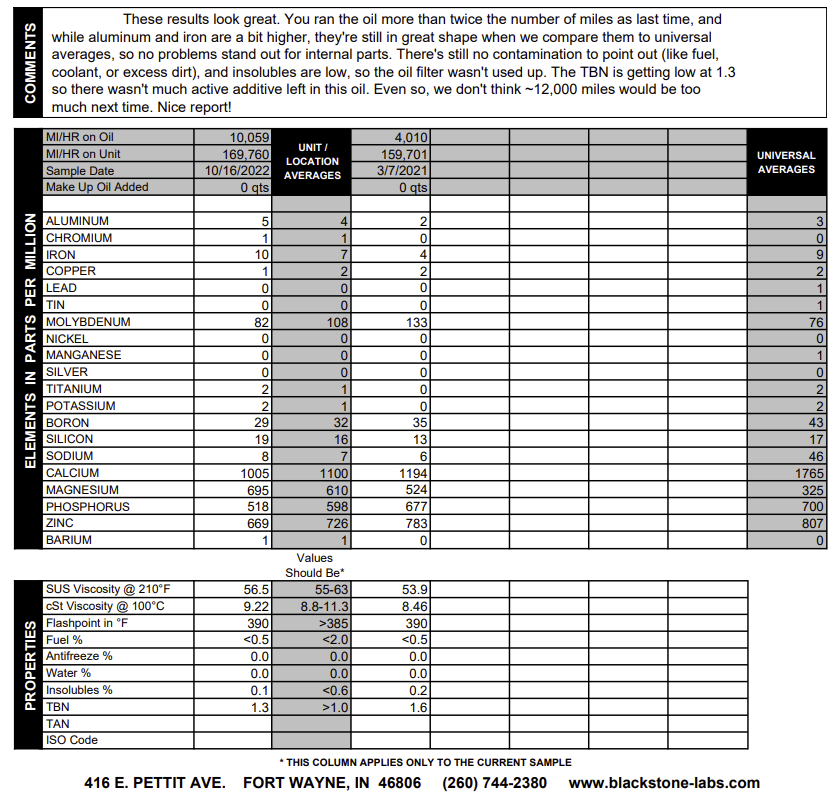
Here's the oil analysis from my most recent change: https://bbot.org/etc/oct2022change.png

The cold starts aren't great for driver comfort, but don't seem to have a big effect on engine internals.

Re: Normal Operating Sounds

#250
post #7

This one is pretty cool and definitely surprised me. > Motor Humming or Whirring when Navigating to a Supercharger … > In some circumstances (such as cold weather), it is normal for the motor(s) and components to make noise, such as humming or whirring as it generates heat to warm the Battery. Super cool that the motors can be used for things other than moving the vehicle. It reminds me of how ESCs for RC vehicles us…

> Super cool that the motors can be used for things other than moving the vehicle. It reminds me of how ESCs for RC vehicles use the motors to generate audible chirp tones to indicate status.

> Motors are multi-purpose devices!

In WALL-E, one of the robots following the title character, lacking any audio output, spins its motors at different rates to play the tune from Hello, Dolly! that it had learned from WALL-E.

See also the Floppotron: https://www.youtube.com/watch?v=oGfkPCZYfFw

Post reply on HN