Live data from Hacker News

How the Windows Subsystem for Linux Redirects Syscalls

blogs.msdn.microsoft.com

231–240 of 274 posts

Re: How the Windows Subsystem for Linux Redirects Syscalls

#231
post #207

Earlier quoted context omitted.

> I'll just point you to the fact that the internet infrastructure and most of the servers on it, along with every Apple desktop and pretty much every mobile device, run Unix. I wonder how much of the internet infrastructure would run Unix if free (as in beer) clones like *BSD and GNU/Linux did not exist in first place. How much internet infrastructure would run actually Unix if ISPs had to choose between Aix, HP-UX,…

Are you too young to remember "the network is the computer"? And of course this worked in reverse, when Netscape released their commercial webserver Microsoft rushed to give away IIS.

I started coding in the 80's and I remember how the UNIX market was afraid of Windows NT workstations, before they actually started losing market share to the free (beer) UNIX versions in form of BSD and GNU/Linux.

Re: How the Windows Subsystem for Linux Redirects Syscalls

#232
post #75

Interesting, I wonder how much overhead is added to syscalls to look up the process type. Does NT still do this check when no WSL processes are running?

Pretty sure these are different entry points, so you wouldn't need to do anything different for normal Windows processes whether WSL is running or not.

Re: How the Windows Subsystem for Linux Redirects Syscalls

#233
post #172

Earlier quoted context omitted.

They're called threads. Overlapped I/O on Windows is based on a thread pool, which is why you can't cancel and destroy your handle whenever you want--a thread from the pool might be performing the _blocking_ I/O operation, and in that critical section there's no way to wake it up to tell it to cancel. Just... like... on... Unix. The difference between Windows Overlapped I/O and POSIX AIO is that on Windows it's a bla…

The difference between Windows Overlapped I/O and POSIX AIO is that on Windows it's a black box, so people can pretend it's magical. No. The difference is that in Windows you can check for completion and set up an overlapped I/O operation in one system call. Requiring multiple system calls to do the same thing means more unnecessary context switches, and the possibility of race conditions especially in multithreaded…

Application developer is not the only perspective in the world however.

Re: How the Windows Subsystem for Linux Redirects Syscalls

#234

Earlier quoted context omitted.

I wrote the windows bits for libuv (node.js' async i/o library), so I have extensive experience with asynchronous I/O on Windows, and my experience doesn't back up parent's statement. Yes, it's true that many APIs would theoretically allow kernel-level asynchronous I/O, but in practice the story is not so rosy. * Asynchronous disk I/O is in practice often not actually asynchronous. Some of these cases are documented…

You're completely missing how the NT I/O subsystem works, and how to use it optimally. > * Asynchronous disk I/O is in practice often not actually asynchronous. Some of these cases are documented ( https://support.microsoft.com/en-us/kb/156932 ), but asychronous I/O also actually blocks in cases that are not listed in that article (unless the disk cache is disabled). This is the reason that node.js always uses thread…

> Write a kernel driver on Linux and NT and you'll see how much more superior the NT I/O subsystem is.

I wrote Windows drivers and file systems for about 10 years, and Unix drivers and file systems also for about 10 years.

I'd rather practice substance agriculture for the rest of my life than deal with Windows drivers again.

Re: How the Windows Subsystem for Linux Redirects Syscalls

#235
post #30

.

"As Brother Francis readily admitted, his mastery of pre-Deluge English was far from masterful yet. The way nouns could sometimes modify other nouns in that tongue had always been one of his weak points. In Latin, as in most simple dialects of the region, a construction like servus puer meant about the same thing as puer servus , and even in English slave boy meant boy slave . But there the similarity ended. He had f…

What is this from ?

Re: How the Windows Subsystem for Linux Redirects Syscalls

#236
post #221

Earlier quoted context omitted.

Which design faults do you think epoll specifically has? I know there are lots of file descriptors not usable with epoll or rather async i/o in general and that sucks (e.g. regular files). For networking, I find epoll/sockets nicer to work with than Windows' IOCP, because with IOCP you need to keep your buffers around until the kernel deems your operation complete. I think you have 3 options: 1) Design the whole appl…

The cool thing is that by gifting buffers to the kernel as policy, the gets to make that choice. In Linux, you don't, and userspace and kernelspace both end up doing unnecessary copying, and it means with shared buffers, something might poll and not-block, but actually block by the time you get around to using the buffer. This is annoying, and it generally means you need more than two system calls on average for ever…

> something might poll and not-block, but actually block by the time you get around to using the buffer

On Linux if a socket is set to non-blocking it will not block. I don't really understand your point with shared buffers. You wouldn't typically share a TCP socket since that would result in unpredictable splitting/joining of data.

> In Linux, you don't, and userspace and kernelspace both end up doing unnecessary copying

I'm not so sure the Linux design where copies are done in syscalls must be inherently less efficient. I'm pretty sure with either design, you generally need at least one memcpy - for RX, from the in-kernel RX buffers to the user memory, and for TX, from user memory to the in-kernel TX buffers. I think getting rid of either copy is extremely hard and would need extremely smart hardware, especially the RX copy (because the Ethernet hardware would need to analyze the packet and figure out where the final destination of the data is!). Getting rid of TX copy might be easier but still hard because it'd need complex DMA support on the Ethernet card that could access potentially unaligned memory addresses. On the other hand, I also don't think you need more than one copy, if you design the network stack with that in mind.

> you need more than two system calls on average for every IO operation in performance servers.

True but it's not obvious that this is a performance bottleneck. Consider that a single epoll wait can return many ready sockets. I think theoretically it would hurt latency rather than throughput.

> As a rule, you can generally detect "design faults" by the number of competing and overlapping designs.

On Linux, I think for sockets, there are only: blocking, select, poll, epoll. And the latter three are just different ways to do the same thing. On Windows, it's much more complicated - see this list of different methods to use sockets (my own answer): http://stackoverflow.com/questions/11830839/when-using-iocp-...

> One specific fault of epoll (compared to near-relatives) is that the epoll_data_t is very small.

Pretty much universally when you're dealing with a socket, you have some nontrivial amount of data associated with it that you will need to access when it's ready for I/O, typically a struct which at least holds the fd number. Naturally you put a pointer to such a struct into the epoll_data_t. I don't see how one could do it more efficiently outside of very specialized cases.

Re: How the Windows Subsystem for Linux Redirects Syscalls

#237
post #172

Earlier quoted context omitted.

They're called threads. Overlapped I/O on Windows is based on a thread pool, which is why you can't cancel and destroy your handle whenever you want--a thread from the pool might be performing the _blocking_ I/O operation, and in that critical section there's no way to wake it up to tell it to cancel. Just... like... on... Unix. The difference between Windows Overlapped I/O and POSIX AIO is that on Windows it's a bla…

The difference between Windows Overlapped I/O and POSIX AIO is that on Windows it's a black box, so people can pretend it's magical. No. The difference is that in Windows you can check for completion and set up an overlapped I/O operation in one system call. Requiring multiple system calls to do the same thing means more unnecessary context switches, and the possibility of race conditions especially in multithreaded…

It's only the right way to do it from an application developer's perspective if the behaviour of the official OS-approved interface matches what their application needs, which is unlikely to be the case here. For example, according to https://support.microsoft.com/en-us/kb/156932 there's a fixed-sized pool of threads used to fetch data into cache to fill async I/O requests. If you try to have too many async I/O requests for the number of threads (which can be as small as 3) the excess are automatically converted into synchronous, blocking requests. This renders the API useless for something like an event-driven web server, because any file I/O call could block the main thread until it completes.

(Also, curiously when the data's in the cache that page shows a performance penalty for async reads that complete synchronously from the cache compared to sync reads. Wonder why.)

Re: How the Windows Subsystem for Linux Redirects Syscalls

#238
post #221

Earlier quoted context omitted.

The cool thing is that by gifting buffers to the kernel as policy, the gets to make that choice. In Linux, you don't, and userspace and kernelspace both end up doing unnecessary copying, and it means with shared buffers, something might poll and not-block, but actually block by the time you get around to using the buffer. This is annoying, and it generally means you need more than two system calls on average for ever…

> something might poll and not-block, but actually block by the time you get around to using the buffer On Linux if a socket is set to non-blocking it will not block. I don't really understand your point with shared buffers. You wouldn't typically share a TCP socket since that would result in unpredictable splitting/joining of data. > In Linux, you don't, and userspace and kernelspace both end up doing unnecessary co…

> I'm not so sure the Linux design where copies are done in syscalls must be inherently less efficient.

Windows overlapped IO can map the user buffer directly to the network hardware, which means that in some situations there will be zero copies on outbound traffic.

> especially the RX copy I also don't think you need more than one copy, if you design the network stack with that in mind.

When the interrupt occurs, the network driver is notified that the DMA hardware has written bytes into memory. On Windows, it can map those pages directly onto the virtual addresses where the user is expecting it. This is zero copies, and just involves updating the page tables.

This works because on Windows, the user space said when data comes in, fill this buffer, but on Linux the user space is still waiting on epoll/kevent/poll/select() -- it has only told the kernel what files it is interested in activity on, and hasn't yet told the kernel where to deposit the next chunk of data. That means the network driver has to copy that data onto some other place, or the DMA hardware will rewrite it on the next interrupt!

If you want to see what this looks like, I note that FreeBSD went to a lot of trouble to implement this trick using the UNIX file API[0]

> On Linux, I think for sockets, there are only: blocking, select, poll, epoll. And the latter three are just different ways to do the same thing.

Linux also supports SIGIO[1], and there are a number of aio[2] implementations for Linux.

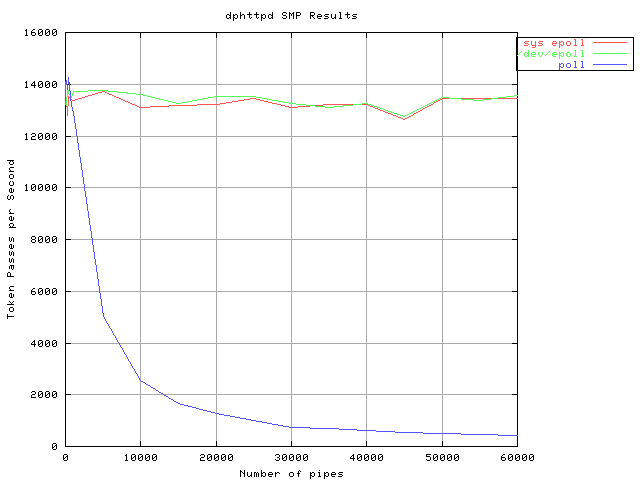
epoll is not the same as poll: Copying data in and out of the kernel costs a lot, as can be seen by any comparison of the two, e.g. [3]

Also worth noting: Felix observes[4] SIGIO is as fast as epoll.

> I don't see how one could do it more efficiently

Dereferencing the pointer causes the CPU to stall right after the kernel has transferred control back into user space, while the memory hardware fetches the data at the pointer. This is a silly waste of time and of precious resources, considering the process is going to need the file descriptor and it's user data in order to schedule the IO operation on the file descriptor.

In fact, on Linux I get more than a full percent improvement out of putting the file descriptor there, instead of the pointer, and using a static array of objects aligned for cache sharing.

For more on this subject, you should see "what every programmer should know about memory"[4].

[0]: http://people.freebsd.org/~ken/zero_copy/

[1]: http://davmac.org/davpage/linux/async-io.html#sigio

[2]: http://lse.sourceforge.net/io/aio.html

[3]: http://lse.sourceforge.net/epoll/dph-smp.png

[4]: http://bulk.fefe.de/scalability/

[5]: https://www.akkadia.org/drepper/cpumemory.pdf
Re: How the Windows Subsystem for Linux Redirects Syscalls

#239
post #51

Earlier quoted context omitted.

>the NT kernel is much more sophisticated and powerful than Linux Source? It's not sophisticated enough or powerful enough to be the most used kernel on super computers (and in the world). Windows pretty much only dominates the desktop market. Servers, super computers, mainframes, etc, mostly use Linux. A few years ago there was even a bug in Windows that caused degradation in network performance during multimedia pl…

They got audio setups right. The reason the network degradation happened is that video and audio playback were given realtime priority so background processes couldn't cause pops, stutters, etc. At the time Vista was released, most home users didn't have a gigabit network, so the performance degradation would only happen on a small number of users, and most would rather prefer good audio and video performance to a sl…

The reason the network degradation happened is that Microsoft couldn't figure out how to stop heavy network activity causing audio glitches on some systems even after giving audio realtime priority, so they hacked around it by adding a fixed 10,000 packets-per-second cap on network activity regardless of system speed or CPU usage (less if you had multiple network adapters). See https://blogs.technet.microsoft.com/markrussinovich/2007/08/... This was just as much of an issue on multicore systems because the cap was unaffected by the system speed and chosen based on a slow single-core machine.

Re: How the Windows Subsystem for Linux Redirects Syscalls

#240
post #237

Earlier quoted context omitted.

The difference between Windows Overlapped I/O and POSIX AIO is that on Windows it's a black box, so people can pretend it's magical. No. The difference is that in Windows you can check for completion and set up an overlapped I/O operation in one system call. Requiring multiple system calls to do the same thing means more unnecessary context switches, and the possibility of race conditions especially in multithreaded…

It's only the right way to do it from an application developer's perspective if the behaviour of the official OS-approved interface matches what their application needs, which is unlikely to be the case here. For example, according to https://support.microsoft.com/en-us/kb/156932 there's a fixed-sized pool of threads used to fetch data into cache to fill async I/O requests. If you try to have too many async I/O reque…

I comment on the advice given on that page here: https://news.ycombinator.com/item?id=11867375

I've never had a single issue with "async things suddenly becoming synchronous which blocks the main thread" -- if you architect things properly that just never happens, blocking operations are off the hot path, and when you absolutely must block, IOCP's concurrency self-awareness kicks in and another thread is scheduled to run on the core, ensuring that each core has one (and only one) runnable thread.

Post reply on HN