Live data from Hacker News

Why is the sky blue?

explainers.blog

221–230 of 279 posts

Re: Why is the sky blue?

#221
post #65

Earlier quoted context omitted.

I have always wondered about this. The verb for the first person is to 'see'. To a third person you 'show' For the first person there is 'listen' (or 'hear'). Does English not have a corresponding word for the third person ? What about Germanaic or Nordic languages ? Do they have a third person analogue of 'listen' ?

Interesting. This is indeed a funny gap in the language. "Show" work for any sort of visual thing you might want to present to someone. It's a bitransitive verb: it takes both a direct and indirect object in addition to the subject: "Bill showed Marsha her new car." ^^^^ ^^^^^^ ^^^^^^^^^^^ Subject D.Obj Indirect Obj. For an auditory thing, our common words seem to subdivide it based on the sound source: "tell" for pr…

Languages are so interesting, although I have zero talent in acquiring them. I don't care much for speaking them, pronouncing them right, but I do wish I could read some of the literature in their original language.
Re: Why is the sky blue?

#222
post #200
post #65

Earlier quoted context omitted.

I have always wondered about this. The verb for the first person is to 'see'. To a third person you 'show' For the first person there is 'listen' (or 'hear'). Does English not have a corresponding word for the third person ? What about Germanaic or Nordic languages ? Do they have a third person analogue of 'listen' ?

In Finnish you might use "kuunteluttaa" . You start with "kuunnella" , "to listen" and inflect it in the way that turn a verb into "make someone verb ". This particular example is a little unusual, but the same thing is commonly used with e.g. "taste". It works with all kinds of verbs, so it comes handy when you want your car serviced or your house painted.

Thanks for showing :)

Re: Why is the sky blue?

#224

In The Cuckoo's Egg Cliff Stoll recounts an episode from the oral defense of his astrophysics PhD thesis. A bunch of people ask questions but one prof holds back until... """ “I’ve got just one question, Cliff,” he says, carving his way through the Eberhard-Faber. “Why is the sky blue?” My mind is absolutely, profoundly blank. I have no idea. I look out the window at the sky with the primitive, uncomprehending wonder…

What I love is that the question is child-simple but bottomless

Re: Why is the sky blue?

#225

I think we can simplify the answer to this question for most audience and say "the air is blue". If they say, the air appears to be clear when I stare at something other than sky, the answer is you need more of air to be able to see its blue-ness, in much the same way that a small amount of murky water in your palm appears clear, but a lot of it does not. If they ask, why don't I see that blue-ness at dawn or dusk, t…

"Air is blue" works surprisingly well as a first approximation, in the same way "the ocean is blue" works until someone asks why

Re: Why is the sky blue?

#226

Earlier quoted context omitted.

Well, no; what's coming into the cloud is sunlight, filtered through the atmosphere. It scatters that light and so it has that color. The same like a heap of powdered salt in the palm of your hand, held up to the sun. Clouds illuminated by the setting sun aren't white.

> Well, no; what's coming into the cloud is sunlight, filtered through the atmosphere. It scatters that light and so it has that color. The model the article describes is: 1. The sun puts out a bunch of light. 2. Light that is lower-energy than blue light fails to be effectively scattered by the atmosphere, and follows a path from the sun to you. 3. Light at the levels of blue and up is effectively scattered by the a…

Here's a different presentation:

1. Imagine a conceptual sunbeam originating from the sun and passing through the sky high over your head.

2. This sunbeams low-frequency components ("reds") continue on in their straight path, making them invisible to you.

3. The high-frequency components ("blues") are scattered by the atmosphere, going in random directions. When you look at the sunbeam, you can see these scattered blues, making the sky blue.

4. A cloud floating up in the atmosphere is illuminated by some direct sunbeams, which are "red".

5. It's also illuminated by the scatter from the atmosphere, which is "blue".

6. Do those two sources balance out exactly such that the light exiting the cloud has the same profile as light exiting the sun?

Re: Why is the sky blue?

#227

It's also not just why the setting or rising sun is red, but why it's yellow when high in the sky. The sun doesn't look yellow when viewed from outside the atmospheric veil.

From space the Sun is basically white, but once you're under the atmosphere you've already lost a chunk of the blue end of the spectrum to scattering

Re: Why is the sky blue?

#230

I think we can simplify the answer to this question for most audience and say "the air is blue". If they say, the air appears to be clear when I stare at something other than sky, the answer is you need more of air to be able to see its blue-ness, in much the same way that a small amount of murky water in your palm appears clear, but a lot of it does not. If they ask, why don't I see that blue-ness at dawn or dusk, t…

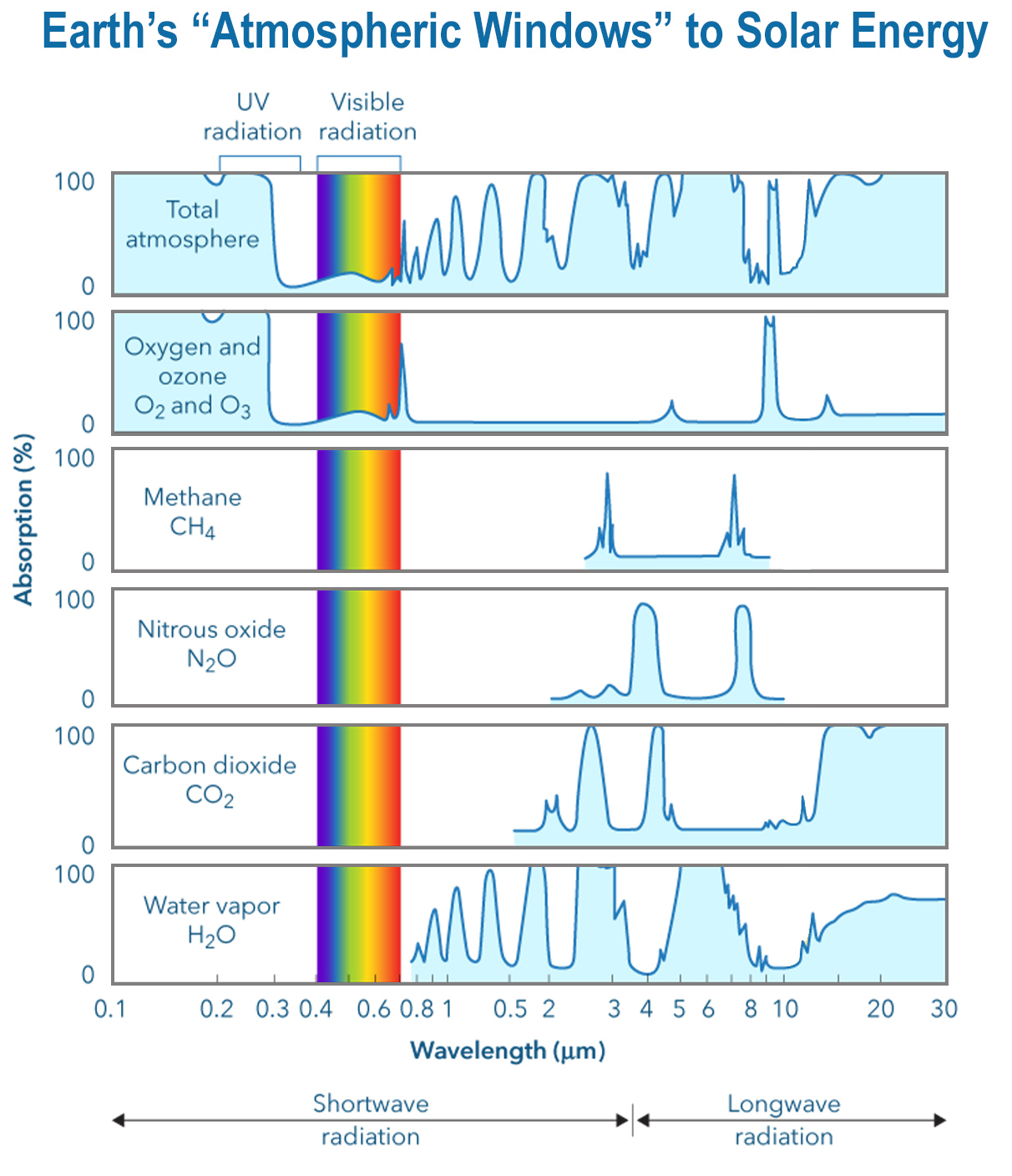
The air is most definitely not blue. It is a shade of orange. https://pace.oceansciences.org/images/EarthAbsorptionEMSpect...
Post reply on HN