Live data from Hacker News

Will we ever get fusion power?

construction-physics.com

221–230 of 309 posts

Re: Will we ever get fusion power?

#221
post #192
post #129

Earlier quoted context omitted.

> 2 weeks of clouds or 2 weeks of no wind AND not OR. To actually need 2 weeks of storage you would need both 0 output in solar for 2 weeks and 0 wind for two weeks and 0 output from hydro. That doesn’t happen. You still get solar power on cloudy days, it just takes more panels to generate some specific level of power. The goal is to minimize X$ for generation + Y$ for storage while guaranteeing sufficient supply. An…

> You still get solar power on cloudy days, it just takes more panels to generate some specific level of power. That is wrong. On cloudy winter days the inverters often just stop. Source: have 20kW of panels on a house in the south of France.

Theres something wrong with your setup. I get about 10-15w of production in the dead of night with a full moon. Source: 5.5kW of panels on a house in South Africa.
Re: Will we ever get fusion power?

#222
post #40

Earlier quoted context omitted.

> all the power to everything from small remote weather stations through houses to large islands Not without very large capacity gas/etc. plants available on standby (unless you’re fine with will below 99% availability)

Or batteries. Batteries have huge potential, simply due to the fact that they're so broadly defined - must store energy, output it as electricity on demand, and be cheap. There's a high chance that we find some way to make grid-scale batteries extremely cheaply, in the future. In the mean time, getting to 90% will basically stop climate change in its tracks, giving us time to research dirt-cheap batteries.

It doesn't even have to always be electricity on demand, sometimes we also need heat. I wonder if heat storage will be a thing we'll have in the households (or maybe it's enough to have it in district heating facilities?).

Re: Will we ever get fusion power?

#223
post #62

Earlier quoted context omitted.

Given how rapidly the price of batteries and solar are falling, it seems absurd to think it will make any economic sense to spend tens of billions of dollars on a monster fusion plant. China are churning out regular old fission plants, and have 27 under construction right now . Even still, the average build time is 7 years. So even if we get some breakthrough and figure out how to build a commercial fusion plant, it'…

> Given how rapidly the price of batteries and solar are falling Battery prices are pretty stable, which is huge problem for wind and solar energy.

That's just so bizarrely wrong I don't even know where it came from.

The price of batteries has declined by 97% in the last three decades: https://ourworldindata.org/battery-price-decline

Re: Will we ever get fusion power?

#224
post #177

Earlier quoted context omitted.

Transmission loses are 3% per 1000km so moving electricity from morroco to the UK would result in ~6% loss in electricity. Saying > There will be times when the wind doesn't blow and the sun doesn't shine Is just FUD. The wind is blowing and the sun is shining in many places within 2000km no matter where you live

I find that fact that the UK would depend on another country for power generation in a serious way really really dumb. There is no other way of putting it. If we did that we might as well sell off our armed forces and declare global peace unilaterally, that is how naive that option is. It would make the UK, or any country that did that, incredibly vulnerable. We cannot ever lose power.

The UK imports 5 Twh of electricity from France as it is so I guess you should start up the auctions.

After failing to successfully launch a Trident missile for 8 years it probably wouldn't change much.

You've only managed to send to Ukraine what the US spends on parks.

Honestly at some point you all need to accept that you really aren't a meaningful player in geopolitics anymore and focus on getting GDP per capital higher than that of Americas poorest state.

Seriously you can't afford to not dump feces in your waterways, what other option do you have.

Uncle Sam and the Polish will keep you safe. The only threat you need to worry about is the machete gangs you keep importing to keep your Pret delivery under 3 quid.

Re: Will we ever get fusion power?

#225
post #43
post #30

Earlier quoted context omitted.

Just by buying an electric vehicle I already have more than enough batteries to solve these problems for my household. The transition to EVs - which is a hard necessity to solve climate change, and well on the way - implies battery production that’s already within an order of magnitude of storing enough solar to supply power year round. As long as you’re not too close to the poles, but most people don’t live there an…

> Just by buying an electric vehicle I already have more than enough batteries to solve these problems for my household. Not if you live in Northern Europe. Solar is basically worthless there during winter. I’m not even talking about polar nights, just places like Denmark where the difference in production between January and June is 20x. No batteries (that we know of) would solve that.

Denmark gets 67% of its electricity from renewables, mainly wind.

Re: Will we ever get fusion power?

#226

Earlier quoted context omitted.

> Given how rapidly the price of batteries and solar are falling Battery prices are pretty stable, which is huge problem for wind and solar energy.

That's just so bizarrely wrong I don't even know where it came from. The price of batteries has declined by 97% in the last three decades: https://ourworldindata.org/battery-price-decline

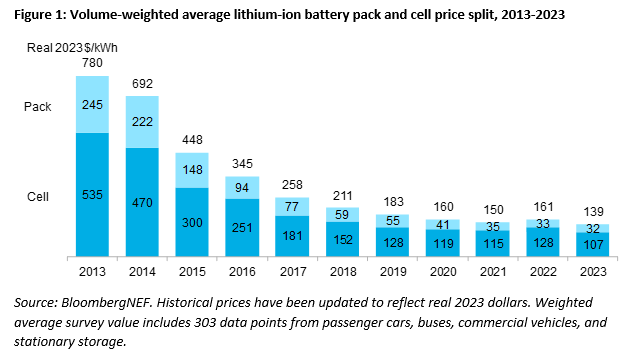
This article is outdated. The price has been relatively stable in the last ~4 years: https://assets.bbhub.io/professional/sites/24/fig1battery.pn...

Prices are decreasing much slower now. At this pace, large scale energy storage for replacing stable energy sources like coal and fission power plants is far out of reach.

Re: Will we ever get fusion power?

#227
post #177

Earlier quoted context omitted.

I find that fact that the UK would depend on another country for power generation in a serious way really really dumb. There is no other way of putting it. If we did that we might as well sell off our armed forces and declare global peace unilaterally, that is how naive that option is. It would make the UK, or any country that did that, incredibly vulnerable. We cannot ever lose power.

The UK imports 5 Twh of electricity from France as it is so I guess you should start up the auctions. After failing to successfully launch a Trident missile for 8 years it probably wouldn't change much. You've only managed to send to Ukraine what the US spends on parks. Honestly at some point you all need to accept that you really aren't a meaningful player in geopolitics anymore and focus on getting GDP per capital…

Harsh, but fair.

Re: Will we ever get fusion power?

#228

Earlier quoted context omitted.

That's just so bizarrely wrong I don't even know where it came from. The price of batteries has declined by 97% in the last three decades: https://ourworldindata.org/battery-price-decline

This article is outdated. The price has been relatively stable in the last ~4 years: https://assets.bbhub.io/professional/sites/24/fig1battery.pn... Prices are decreasing much slower now. At this pace, large scale energy storage for replacing stable energy sources like coal and fission power plants is far out of reach.

> The price has been relatively stable in the last ~4 years

Your linked source shows the price in the last 4 years going from

cell: $128->$107

Pack: $55->$32

Real: $183->$139

So the price has dropped 25% in the last 4 years. That is NOT relatively stable by any definition.

Re: Will we ever get fusion power?

#229
post #150

From 2 years ago. Large region of Australia running fully on solar/wind/storage for 10+ days. Seems like the focus has to be on storage and continued improvement of grid-scale and rooftop solar and wind. South Australia has just chalked up what is undoubtedly a world first – a run of more than 10 consecutive days over which the average production of wind and solar accounted for 100 per cent of local demand. No other…

Those sounds interesting and is likely a nice achievement, but averages really hide the critical information here. What was the min and max, and how did they deal with periods of low supply?

Denmark is a nice example why this matter. During optimal weather their wind power produce around twice their local demand. However, in terms of actually consumption each year they need to import about 50% of their total amount of energy. This despite the fact that they export more energy than they import. The only way that would make mathematically sense is if export and import occur during different periods over the year.

This has multiple issues. The biggest being that they are heavily dependent on nearby countries fossil fueled power plants. A secondary problem is that prices they get for exports are low, since optimal weather conditions means a general surplus of energy in EU, while periods of bad weather results low supply and very high import costs. Their exports do not pay for their imports, despite exporting more than importing (in terms of energy, not money).

One can not remove the word averages and conclude that they ran fully on solar/wind/storage for 10+ days. It would be the same as saying that Denmark is running fully on wind a decade+.

Re: Will we ever get fusion power?

#230

Earlier quoted context omitted.

Base load was a useful concept when steady output power plants with high capital cost produced energy at the lowest cost. It then made sense to use them as much as possible -- to handle the "base load" -- and cover the rest with more expensive to operate but lower capital cost sources. But that's no longer the world we live in. The lowest cost energy is now from intermittent sources, and the optimal grid design will…

Right. Primary power sources will be solar, wind, and batteries. What we need now are peaking plants with low capital cost and high output. High operating cost when running is acceptable because they won't be running much. They're backup generators. Currently, gas turbines can do that, but not much else does. Nuclear, fission or fusion, is the opposite. It's all fixed cost. A higher fixed cost than solar or wind.

Gas turbines can not do that if we include the cost of pollution. Currently we do not have anything that has low capital cost, high operating cost, overall cheap, and carbon free.

Natural gas just trade pollution, a problem for the future, in return for cheaper energy price today.

Post reply on HN