Live data from Hacker News

Global minimum corporate tax: 130 nations to support U.S. proposal

cnbc.com

221–230 of 362 posts

Re: Global minimum corporate tax: 130 nations to support U.S. proposal

#221

Earlier quoted context omitted.

> Politically, it sounds great to say, "Make the corporations pay their share!", but who exactly are we targeting with these taxes? Is it the rich executives? Why not just raise taxes on the rich directly? Pretty basic megarich person accounting: You realize zero income, you just hold a lot of valuable assets, and you pay no taxes. "But surely they must have some income to live on!" you argue. Nope, you get a $10 mil…

Except that doesn't happen? Bezos paid 973 Million in taxes [1], note that article conflates income and wealth in a truly economic illiterate way. https://www.seattletimes.com/business/irs-records-show-wealt...

Bezos is playing it pretty straight, but then again 973 million is basically pocket change for him, also let's not forget about the year he paid zero taxes and got a refund:

> Bezos filed a tax return in 2011 reporting he lost money because of bad investments, allowing him to claim and receive a $4,000 tax credit for his children, according to ProPublica.

Anway Bezos is far from the only mega-rich person, for example from that article you cite:

> Another wealthy person whose tax data ProPublica obtained was Carl Icahn, the activist investor who built his wealth through corporate takeovers. He paid zero income taxes in 2016 and 2017, partly because he was able to deduct interest expenses on loans from his “adjusted gross income,” ProPublica said.
Re: Global minimum corporate tax: 130 nations to support U.S. proposal

#222

Honest question: what is the reason for there to be a corporate tax at all? When corporations distribute profit to their owners/shareholders, those people must pay income tax on it. Why not have the government get its share from income tax? Corporate tax seems like double taxation, and its existence seemingly means that all companies have a lower margin than they would otherwise, meaning that they need to charge high…

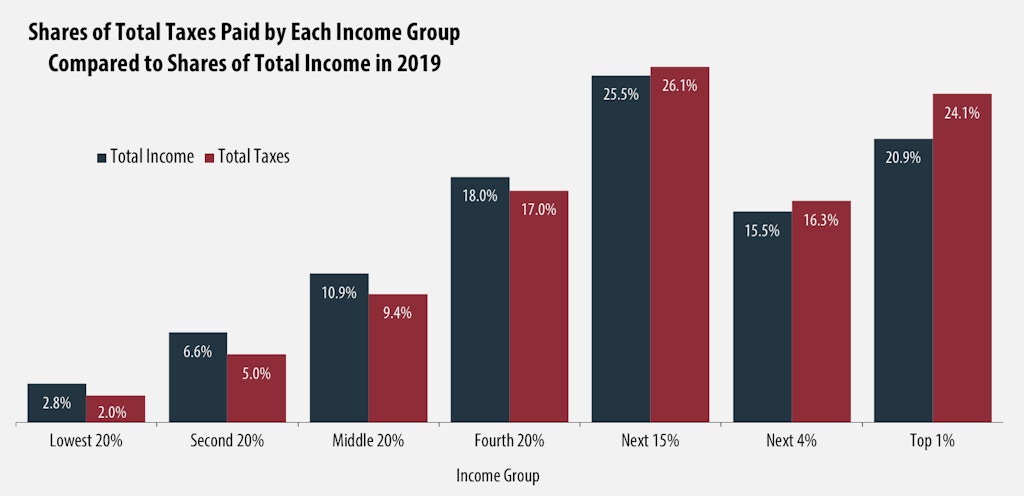
> The top 1% of people by income already pay 40% of all taxes.

I believe that this famous misleading statistic is only true if you specifically limit it to federal income tax, not "all taxes".[0]

Less misleading is to compare total taxes against total income, which is shown in a chart[1] included in the linked article. It shows that the top 1% earn 21% of the income, and pay 24% of all taxes.

The real question is, why are the top 1% only paying 24% of the taxes when they own 39% of the wealth?[2]

[0] https://theintercept.com/2019/04/13/tax-day-taxes-statistics...

[1] https://theintercept.imgix.net/wp-uploads/sites/1/2019/04/ch...

[2] https://jacobinmag.com/2017/10/wealth-inequality-united-stat...

Re: Global minimum corporate tax: 130 nations to support U.S. proposal

#223
post #22

Earlier quoted context omitted.

https://www.oecd.org/tax/beps/oecd-g20-inclusive-framework-m...

Notably absent from the list: Ireland.

Low corpate tax countries not on the list: Ireland 12.5%, Kuwait 0%, Hungary 9%, Kosovo 10%, kyrgystan 10%, Lichtenstein 12.5%, Moldova12%, Sark 0%(UK related but only had 1 active bank so perhaps they did not need it on the list )

I am surprised that they managed to get most of the typical island states on the list to convert. And it will be super interesting if Kuwait and Sark can stay strong or if new companies will take the opportunity to address this market.

https://en.m.wikipedia.org/wiki/List_of_countries_by_tax_rat...

Re: Global minimum corporate tax: 130 nations to support U.S. proposal

#224

Earlier quoted context omitted.

An agreed upon international base tax rate is the wrong solution. This becomes a minimum wage for nations and removes the incentive to compete to be the home of corporate headquarters. Border adjustment tax removes the tax shelter loophole and strengthens the incentive to be a good place to headquarter a corporation.

Nations can still compete. Stability, rule of law, infrastructure investment, etc. Everything except letting companies use the country as a pirate's cave

>Nations can still compete. Stability, rule of law, infrastructure investment, etc.

don't forget tax incentives. Sure, every country has to charge 15% tax, but if you domicile your country here we'll give you tax credits!

Re: Global minimum corporate tax: 130 nations to support U.S. proposal

#225

Earlier quoted context omitted.

Why would a corporation want a country? If you don’t control the planet you’re just waiting for your competitors to crush you.

Corporate motives can usually be reduced to one of three things: cheap (ideally free/forced) labor, cheap resources, and limits on liability.

Monopolize markets.

Re: Global minimum corporate tax: 130 nations to support U.S. proposal

#226
post #90

Earlier quoted context omitted.

Gee, it's almost like taxing corporate profits twice has caused massive distortions everywhere: biggest stock price bubble, tax residency shopping, etc Tax the wealthy. Don't let them take "charitable" deductions or use tax-exempt IRAs. 100% inheritance tax above $4 million.

> Tax the wealthy. Please don't tax the wealthy. I have a couple friends who are in top 0.1%. They have enough money for the rest of their lives. If you start taking money from them, they will simply stop working and start spending more time with friends and family. The correct goal is not to take money from the rich (which can be achieved by taxing them; this is what Bolsheviks did and it resulted in millions of dea…

> If you start taking money from them, they will simply stop working and start spending more time with friends and family.

This model of the world assumes that "rich person" means someone with high income and "raise taxes on the rich" means raising the top marginal income tax rate. I don't think either is true and I struggle to imagine how you could be familiar with the financial details of the .1% and think otherwise. This model cannot survive much contact with actual rich people.

People rich enough to be included in "tax the rich" mostly get their money from capital gains, and I don't believe that any rich person anywhere would ever decide not to invest their capital because the capital gains rate is too high. Even if capital gains were taxed at 90%, what else would you do with capital? Dollars sitting in a checking account cannot "spend more time with friends and family".

Re: Global minimum corporate tax: 130 nations to support U.S. proposal

#227

Earlier quoted context omitted.

Low Corporate tax rates invite corporations into your country. This benefits poor countries more.

How does turning the poorest people in a country into wage slaves "benefit" those poor countries? Those poor people would be better off just being self sufficient farmers at that point. Workers at foxconn were literally killing themselves because of how bad the conditions were. When do we as a society decide that industrialization makes life worse for a huge percentage of the population? These multinationals go into…

Would the workers at Foxconn be better off if we took away their option to work at Foxconn? In general, if they thought that was their best option, it's hard for me to accept at that step an argument that providing them that option is making their life worse [than it would otherwise be]. Maybe there are a few more steps in the argument that make that position stronger?

Re: Global minimum corporate tax: 130 nations to support U.S. proposal

#228

Earlier quoted context omitted.

> In a globalized economy we need lower taxes. Zero would be an even better number. Isn’t that point precisely addressed by the Biden administrations of setting a global minimum tax rate? If every country, or at least every country without signify the trade barriers (who cares what happens in North Korea) has the same tax rate than there’s no incentive for companies to move their profits - or the entire company - abr…

If you think China and others will abide by this nonsense you might need to review how business is supported by government in China. Did you know they can export products at cost and still make up to 15% on their international sales? The world is not a level playing field. Did you know it costs them darn near zero dollars to ship products within the US, while US companies have to pay full fare? The ONLY way the US an…

It seems to me China would generally be in favour of this. They're a large country with large internal consumption, and they would rather some of this money goes into their coffers than somewhere else. Generally, fiscal paradise are small countries which have little to lose by lowering taxes (to local business), and a lot to gain by attracting revenues from bigger countries.

China's corporate taxes are much higher than 15%, so it's not like they would be directly affected by this. They might oppose the plan (I have no idea), but it's unlikely to be on an economical aspect of that's the case.

Re: Global minimum corporate tax: 130 nations to support U.S. proposal

#229
post #29

When the benefits of creating a new country outweigh the costs (to shareholders), does it fall within the fiduciary duty of corporate leaders to form a new country?

I thought part of the plan is that non-complying countries get sanctions/tarrifs applied so your plan wouldn't be viable?

Re: Global minimum corporate tax: 130 nations to support U.S. proposal

#230

Apparently it's also possible to address the issue of shifting corporate profits to tax-havens even without a large scale international agreement. Basically, corporations have one place money comes in and two places it comes out, like so: sales = expenses + profits If you tax the sales, then deduct the expenses, that leaves the incidence of the tax on the profits. But importantly, unlike profits, it's usually clear t…

> But importantly, unlike profits, it's usually clear to which country a sale belongs to.

Is it? If I order something from another country, does the sale belong to the sending country or the receiving country?

Post reply on HN