Earlier quoted context omitted.
But we do all have shared values. In fact, I think we all agree on most of everything. Imagine there was a button you could press where each and every person would suddenly receive at least a nice house, a bit of land to call their own, and a pleasant good paying job. There's not a single person, regardless of ideology, that wouldn't press this button. Another button to get rid of all crime? Yip, gonna be pushed. Ano…
> There's not a single person, regardless of ideology, that wouldn't press this button. You have vastly more faith in humanity than I do. There is an entire class of people who define their success based on how much more they have than everyone else. It isn't enough for these people to be successful, healthy, and financially stable; it is necessary, for their happiness, that other people not have these things. Many o…
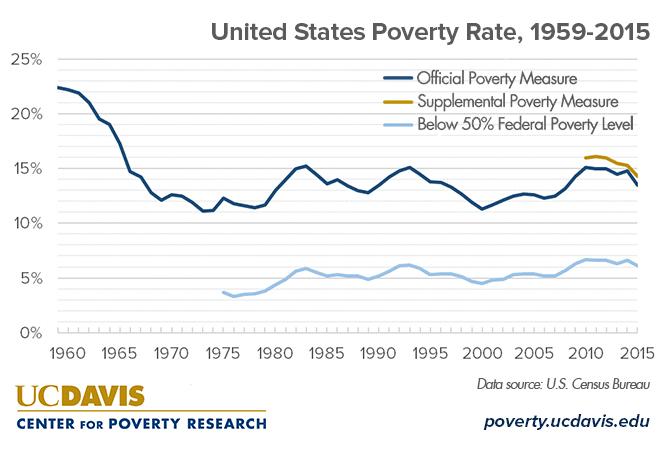
Should the purpose of welfare be to solve poverty or to sustain it? This is another one of those questions that I think we'd all agree on. Nobody wants poverty and so welfare, as one of our primary means of combating it, should do exactly that. It should combat it. Is it succeeding? This is something we can look for objective information on. This [1] is a graph of the US poverty rate. It's clear that welfare is not effectively reducing poverty. One of the oldest proverbs, that's generally appeared throughout the world in completely independent cultures 'is give a man a fish and you feed him for a day; teach a man to fish and you feed him for a lifetime.'
Our capitalist society is fundamentally unfair in one way. The best way to make money is to have money. Start as a billionaire and unless you're a complete idiot (or alternatively voluntarily engaging in extremely high risk enterprise) you're going to die a billionaire. And this goes all the way down. It's much easier to earn $15,000 when starting with $5,000 than it is to earn $10,000 when starting with $0 - even though it's the exact same increase in capital.
If a person is so poor they cannot reasonably afford to even feed themselves, is it a wise investment of what little capital they have to buy a luxury electronic device? Or a new vehicle? Is this the sort of behavior that's going to help them get out of poverty? I think people see these behaviors as a failing of the welfare system. Instead of getting people out of poverty, it's simply sustaining it.
And there are major corporate interests that are invested in sustained poverty. For instance WalMart in their SEC filings actually lists food stamps as one of their major profit conditionals [2]. About 20% of all food stamp outlays end up being spent at WalMart - around $13 billion in recent times. Quite an interesting system we've created. Welfare subsidizes low wages at WalMart, and then caps it off by directing massive amounts of money back to the company. Kraft Foods is another big advocate for welfare and its expansion. About 1/6th of their entire revenue coming from food stamp purchases.
And their are also political gains to be had from sustained poverty. Today around 40,000,000 people are dependent on food stamps. Politicians who promise to expand these sort of programs are likely to disproportionately receive their vote. This creates an incentive to simultaneously service these people, but also keep them dependent. See LBJ's quotes on how he viewed the Civil Rights Act (which he passed), or what he referred to it as privately, for an example of this issue. I will not repeat his language here.
This is really just scratching the surface, but this post is already unreasonable long so I'll cut it here. But I hope I've framed at least the start of a case for showing that when people are not necessarily the biggest fans of programs such as welfare, there are reasons beyond disdainful views of those receiving it, or a desire for them to stay impoverished.
[1] - http://poverty.ucdavis.edu/sites/main/files/imagecache/mediu...
[2] - https://en.wikipedia.org/wiki/Supplemental_Nutrition_Assista...