Sorry Elon, you can't get away from Trump this way.. Now if you could get to Mars :-)
Elon Musk is boring a tunnel to skirt gridlock
221–230 of 278 posts
Re: Elon Musk is boring a tunnel to skirt gridlock
#222Ok, so one thing I've noticed reading the 120 comments in this thread and the article is that literally nobody knows anything about boring, or tunnels. Musk knows nothing, he put someone in charge who knows nothing, the reporter knows nothing, and the commenters here even admit they are completely guessing and know nothing about boring/tunnels. I definitely don't know anything about tunnels. It's a joke that came to…
I can speak somewhat for the UK, but I assume the same can be said for most of Continental Europe, Japan and China where (deep) underground tunnels for have been around for a long time. The deeper tunnels of the London Underground are "bored", that is a full circular profile is cut for the tunnel path. This is contrasted with the "cut and cover" method, which just digs a pit, builds a support structure, and covers it…
> I'd be interested to know if any US cities have deeper tunnels
The downtown portions of Chicago's Blue Line[1] and Red Line[2] were primarily dug using tunnel boring machines in the 1940s. Here's a better view of the tunnels being not square[3].
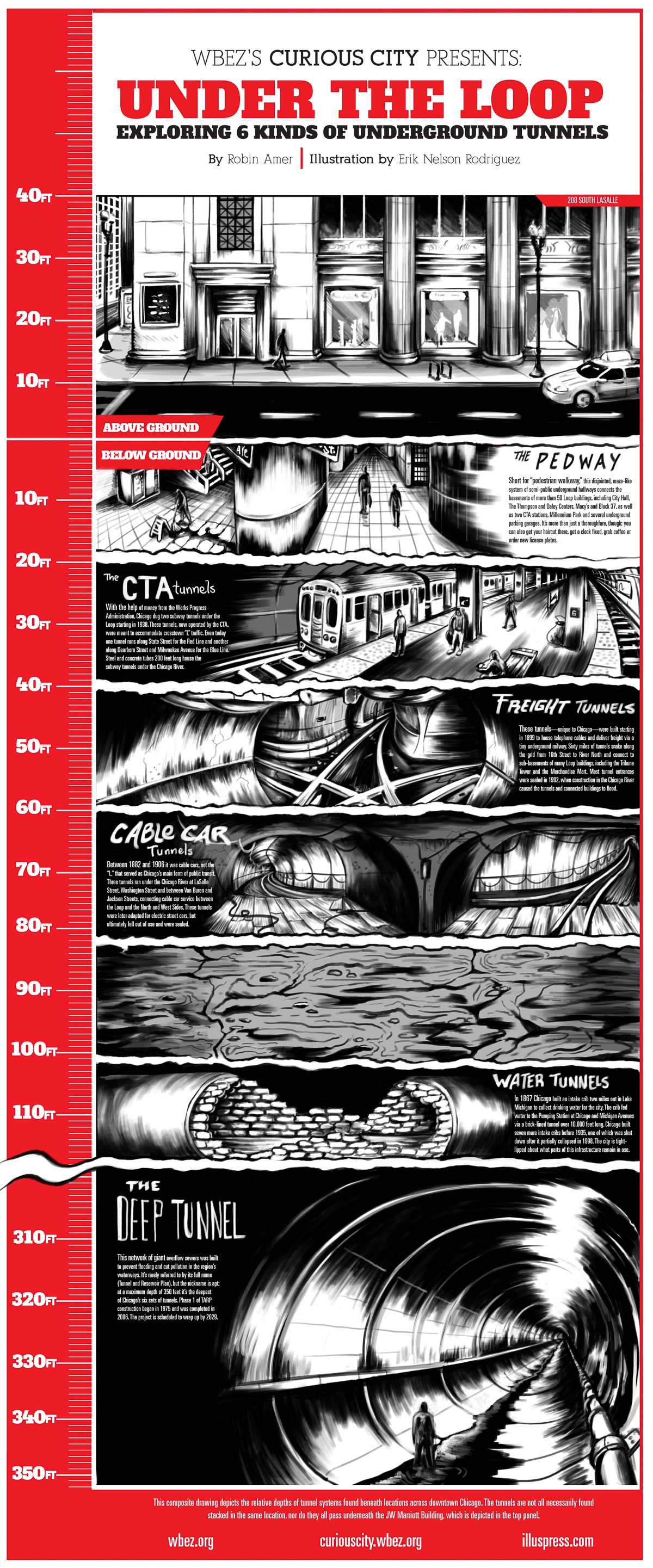
Edit: infographic of various tunnels under Chicago, many of which are even deeper than these bored ones[4]
1: http://www.chicago-l.org/operations/lines/dearborn_subway.ht...
2: http://www.chicago-l.org/operations/lines/state_subway.html
3: http://www.railworks.com/track-project/cta-red-line-tunnel
4: https://uploads.disquscdn.com/images/32697b82560fbd40ec95ec1...
Re: Elon Musk is boring a tunnel to skirt gridlock
#223My laymen's understanding (from various documentaries & articles) is that the expensive part of tunnel construction is managing the transitions between different materials. Boring through hard rock might be slow, but hitting pockets of mud, loose rock and other things (especially when unexpected) can seriously mess up the works, and cause massive delays due to machine damage or reassessment and reinforcement/collapse…
Often the TBM is just left behind in a spur tunnel after finishing the main excavation. It would be too expensive to disassemble and remove.
This is not correct. Most TBMs are advanced into a receiving pit or shaft, disassembled, and moved. Leaving tons of steel in the ground is not cost effective unless schedule is your main driver.
Re: Elon Musk is boring a tunnel to skirt gridlock
#224I thought the current thinking was that building more roads means that there will be more roads to use, and therefore more cars on the road. https://en.wikipedia.org/wiki/Induced_demand
If Musk had talked with any expert in transportation at all he'd know that building a tunnel highway won't solve traffic problems in the long term. Either: A) He hasn't talked with any experts at all. B) He doesn't believe the experts. or C) He doesn't think inducing demand is a problem because he owns a car company. None of these possibilities are very good looks.
> C) He doesn't think inducing demand is a problem because he owns a car company.
Just think how bad the smog would be on a car tunnel. Unless they limit it to zero emission vehicles....
Re: Elon Musk is boring a tunnel to skirt gridlock
#225Earlier quoted context omitted.
Do you happen to have any examples of where induced demand has not happened? My understanding is that it is pretty much guaranteed, especially in larger cities. I think New York's bridges and tunnels are the canonical examples of this. I say pretty much because I assume there must be cases where it didn't happen, but I am unaware of them.
> My understanding is that it is pretty much guaranteed, especially in larger cities. Induced demand can only happen when there is a non-trivial amount of people who have and use some other option. (NYC, for example, where there is a large subway network. A new freeway might convince some subway-users to switch, inducing demand) For a city with no alternatives (like no meaningful public transit), it's impossible to i…
> For a city with no alternatives (like no meaningful public transit), it's impossible to induce traffic demand, because demand is already at 100%. Traffic still grows as population grows, but a person can only physically drive one car at a time, it's currently impossible to induce any higher demand than that.
This is not true. An example is Houston building a 26 lane highway only to lead to ~40 increased commute times [1]. Initially commute times decreased, but then the population felt they could move farther out into the suburbs, get a more affordable house, and still have the same commute time. Once enough people did this traffic times got worse.
So, demand increased.
[1] http://www.citylab.com/commute/2016/01/highway-boondoggle-us...
Re: Elon Musk is boring a tunnel to skirt gridlock
#226Earlier quoted context omitted.
Do you happen to have any examples of where induced demand has not happened? My understanding is that it is pretty much guaranteed, especially in larger cities. I think New York's bridges and tunnels are the canonical examples of this. I say pretty much because I assume there must be cases where it didn't happen, but I am unaware of them.
Maybe induced demand has always happened, in the sense of demand increasing when the product is more available. But it's plenty common for the amount that demand increases to be less than the amount of extra capacity available. Furthermore, is induced demand that bad? If you double the capacity and it again gets filled to the point of gridlock, well then at least twice as many people are now able to be in gridlock, w…
> Furthermore, is induced demand that bad?
It's good in cases where you can eventually meet that demand. Say induced demand for broadband leading to more fiber optic cables being laid down.
However there isn't enough space in cities to ever meet demand. What needs to happen is a shift away from the single-car culture in America and towards mass transit.
Re: Elon Musk is boring a tunnel to skirt gridlock
#227Earlier quoted context omitted.
Do you happen to have any examples of where induced demand has not happened? My understanding is that it is pretty much guaranteed, especially in larger cities. I think New York's bridges and tunnels are the canonical examples of this. I say pretty much because I assume there must be cases where it didn't happen, but I am unaware of them.
> My understanding is that it is pretty much guaranteed, especially in larger cities. Induced demand can only happen when there is a non-trivial amount of people who have and use some other option. (NYC, for example, where there is a large subway network. A new freeway might convince some subway-users to switch, inducing demand) For a city with no alternatives (like no meaningful public transit), it's impossible to i…
There's no such thing as demand being at 100%, certainly not in this context. Demand is a curve. If the cost of driving decreases--i.e. less congestion, easer traveling--people will drive further and more often. It won't happen instantaneously, of course, but demand will adjust even if the population stays the same.
That doesn't mean the new road will fill up completely. There may be other constraining factors. But if a route was highly congested before expansion, you can bet demand will go up after expansion.
> "A year after the freeway opened, traffic volumes along parallel roads like 44th, 56th and 68th streets dropped 40–50%"
Re: Elon Musk is boring a tunnel to skirt gridlock
#228Earlier quoted context omitted.
> My understanding is that it is pretty much guaranteed, especially in larger cities. Induced demand can only happen when there is a non-trivial amount of people who have and use some other option. (NYC, for example, where there is a large subway network. A new freeway might convince some subway-users to switch, inducing demand) For a city with no alternatives (like no meaningful public transit), it's impossible to i…
> For a city with no alternatives (like no meaningful public transit), it's impossible to induce traffic demand, because demand is already at 100%. Traffic still grows as population grows, but a person can only physically drive one car at a time, it's currently impossible to induce any higher demand than that. This is not true. An example is Houston building a 26 lane highway only to lead to ~40 increased commute tim…
It'd seem in that case it's not that demand increased but that people moved further way from their final destination so their commute time was increased.
It may very well be that the same people are still driving or wanting to drive, but simply by living further away the commute times have gone up.
Re: Elon Musk is boring a tunnel to skirt gridlock
#229Earlier quoted context omitted.
I design both boring machines and tunnels and am a regular reader on HN. I have worked on tunnels ranging from the smallest to the largest, rock to soil, and all forms of construction. I have stopped commenting on any tunnel related Elon topic due to people refusing to believe my experience and expertise when it does not align with what Elon Musk and his team of "experts" have said or published in their desk studies.
Awesome! I've got a question that I have not been able to answer. Seattle's "Big Bertha" is surplus once they finish the Alaska Viaduct project in a few months. What process could I use to establish whether or not one could use that machine locally? Assume I can get an inventory of all parts used in the machine. And a related question, is there a way to estimate the cost to retarget a used machine to a new mission?
I doubt Bertha will be purchasable given the litigation on the SR 99 job. I don't know what you would be able or want to use it for - it's 58.5 ft in diameter. It is unlikely that you will get an inventory of all the parts in the machine.
If you really want a machine then you would just call the contractor and ask them their price. You would likely have to pay for delivery.
The process to establish whether or not one could use that machine locally is just whether or not you have a job that needs a 58.5 ft diameter TBM set up the way theirs is. In other words, the process to establish whether or not one could use the machine again locally is basically to go through the design process for the tunnel (preliminary design, geotechnical exploration, laboratory testing, final design, etc.).
Re: Elon Musk is boring a tunnel to skirt gridlock
#230Earlier quoted context omitted.
Do you happen to have any examples of where induced demand has not happened? My understanding is that it is pretty much guaranteed, especially in larger cities. I think New York's bridges and tunnels are the canonical examples of this. I say pretty much because I assume there must be cases where it didn't happen, but I am unaware of them.
Maybe induced demand has always happened, in the sense of demand increasing when the product is more available. But it's plenty common for the amount that demand increases to be less than the amount of extra capacity available. Furthermore, is induced demand that bad? If you double the capacity and it again gets filled to the point of gridlock, well then at least twice as many people are now able to be in gridlock, w…
To be fair, for traffic, it's not necessarily the number of cars that's increasing. If everyone doubles the number of miles they drive, that will have a roughly equivalent effect. Car-miles is really the metric to watch here.