Earlier quoted context omitted.
Seems like what "CPS would do" is the same logic described in the article itself, but instead of the perceived (but not statistical) risk to the children it's the perceived (but not statistical) risk to the parents of those children. I doubt (don't have real data) that reporting actually happens often at all, but it's so easy to imagine and potentially embarrassing and scary for a parent that they avoid it. So even i…
That's a fairly good argument. I would like to see some actual statistics the frequency of CPS overreacting in an unreasonable fashion. I certainly read many news stories about it, but that is misleading in exactly the same way as the stories we hear about child abductions. I do however have some level of knowledge here. I have spoken with people involved in child protection about questions like this. I have been tol…
Why Do We Judge Parents for Putting Kids at Perceived But Unreal Risk?
221–230 of 280 posts
Re: Why Do We Judge Parents for Putting Kids at Perceived But Unreal Risk?
#222Earlier quoted context omitted.
A couple of very slightly uncomfortable conversations seems like a small price to pay for raising your kids in the manner you deem appropriate.
http://reason.com/blog/2015/06/11/11-year-old-boy-played-in-... > One afternoon this past April, a Florida mom and dad I'll call Cindy and Fred could not get home in time to let their 11-year-old son into the house. The boy didn't have a key, so he played basketball in the yard. He was alone for 90 minutes. A neighbor called the cops, and when the parents arrived—having been delayed by traffic and rain—they were arre…
> The suspect then held the boy as the mom took a phone call, according to investigators. The suspect then walked out of the mall cradling the boy in her arms, police said.
If you ever answer your phone, it seems like a very real risk somebody will snatch up your baby.
Re: Why Do We Judge Parents for Putting Kids at Perceived But Unreal Risk?
#223Earlier quoted context omitted.
Your experience doesn't matter here, because we're really talking about a physics problem . There is no known physical process by which parent's intent for leaving the child at home could alter the risk profile of that action. Now that the people really answered a different question that they were actually asked is another thing. Not uncommon with humans in psychological studies.
Yes, but the parent's intent is indicative of their general lifestyle and choices. The point I'm trying to make is that our moral judgements of that intent, while likely being well overinflated, does give us reason to believe that that person's child is at a higher risk when left alone in the environment the parents have given them as compared to the general statistic of perceived risk given to the average child.
Re: Why Do We Judge Parents for Putting Kids at Perceived But Unreal Risk?
#224Are there places in America where things are not this extreme? I am looking for a career in IT, so coming to the Valley might be something I am going to do in my career. But I would want my kids to grow up in a different, more independent way. Like I did in my home country. (If I was in America now and thinking about getting children, this article would be a 100% reason to go back to my home country, it totally gave…
Re: Why Do We Judge Parents for Putting Kids at Perceived But Unreal Risk?
#225Are perceived risks lower in smaller countries? The article mentions Norway, which has a population of 5M. Even if the rate of child abduction is the same as the USA, there will be far fewer scary stories. 1) How many foreign cases does the Norwegian media report? 2) Are Norwegians worried about them? I'd think "oh, America" and move on, but I'd guess that if I lived in Idaho and the case was in Michigan I wouldn't b…
Re: Why Do We Judge Parents for Putting Kids at Perceived But Unreal Risk?
#226It's the result of a bizarre American Protestant religious tenet that gradually evolved into existence over the 20th century, namely: People deserve health and happiness in life in inverse relationship to their degree of cynicism; Children are born in a perfect state, without cynicism, therefore any effort by a cynical (by definition) adult that could protect a child from anything that could possibly affect their hea…
Re: Why Do We Judge Parents for Putting Kids at Perceived But Unreal Risk?
#227Earlier quoted context omitted.
The best thing to do here is to accept the fact that some parents will take more risk and some kids will die every year because of that. We cant do a zilch about it besides charging the parents after the incident has happened.
I'm not convinced. I was under the impression that child-safe pool fences (legal requirement in Australia) have reduced the number of children drowning in the family pool. I was also under the impression that the various ad champagnes over the decades about not leaving children unattended in the bath have also reduced the number of kids drowning in the bath. I was also under the impression that requiring all new home…
In case of government regulation, each regulation ends up imposing significant cost on the entire society to prevent handful of deaths which is a massive waste of resources. I am pretty sure destruction wealth also results in some human misery.
Consider USA:
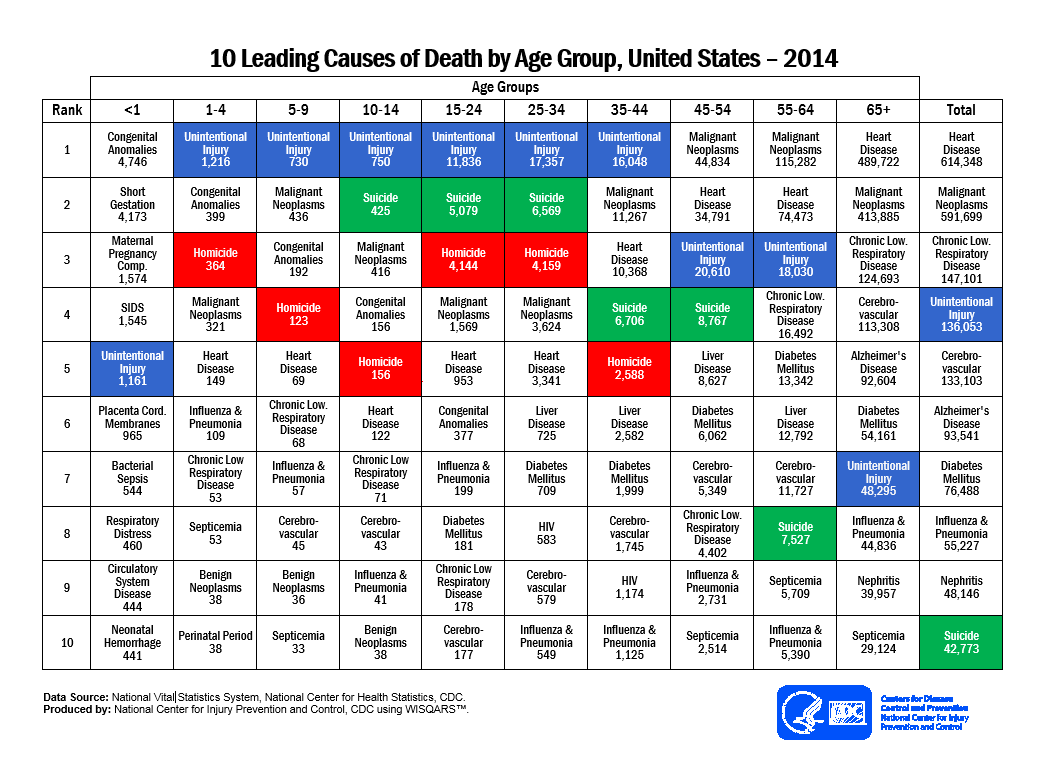
Total deaths caused by unintentional injury in 2014 for children below 14 is 3857 [1]. For a population of 300M it is pretty insignificant. Even if we just look at population below the age of 14 (30M) it is merely 0.00012856666. This is just pure noise.
Sure you can come up with a regulation that imposes a very heavy cost on entire society to eliminate one cause of unintentional injury but I really wonder if it has any impact on the overall number at all.
Unfortunately I don't have more data to backup this claim but if I had to put my money on whether these rules will bring down child mortality I would bet it wont make a difference.
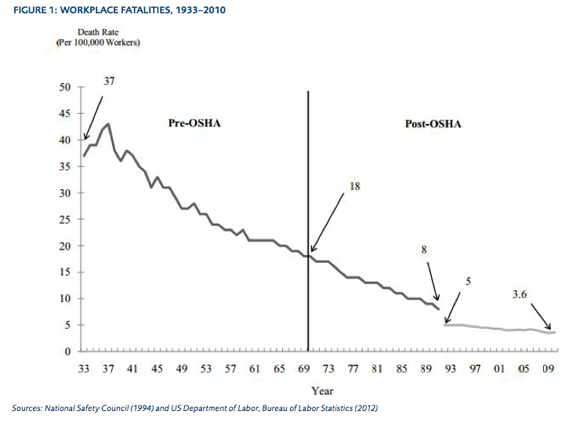
I also think that child mortality will go down over time even if we don't pass a lot of laws and people themselves will figure out solutions to avoid these deaths. A good data point to verify is this OSHA's impact on worksplace safety in USA.
I turns out that workplace safety was getting better even before OSHA and the giant regulation made absolutely no difference what so ever to the decline in worksplace deaths but put a significant cost on businesses. [2]
[1] http://www.cdc.gov/injury/images/lc-charts/leading_causes_of... [2] http://mercatus.org/sites/default/files/workplacefatalities5...
Re: Why Do We Judge Parents for Putting Kids at Perceived But Unreal Risk?
#228The participants know their own ignorance of the exact circumstances of each situation, and so they use their judgement of the parent's character to fill in the gaps.
For example, when the parent leaves for an "immoral" reason, it reflects badly on their character, so the participant would have less reason to believe that they've thought about the child's safety.
On the other hand, when a parent whom the participant has judged to be of good character leaves the child, they assume that the parent them-self has thought through the safety implications and has judged it to be safe. Since the parent would have more information than the participant, the participant is trusting their judgement, and is able to determine that the situation is safer.
In essence, the stories told to the participants actually do have different amounts of information in about the child's safety.
Re: Why Do We Judge Parents for Putting Kids at Perceived But Unreal Risk?
#229Even since I was 10 or so I would often come back to school on my own. Then let myself into our apartment. Eat some lunch, do homework, play until my parents came home in the evening. I was effectively often alone for about 4 or so hours. I wouldn't let my kid do it here in US. Not because I wouldn't trust them or think it is dangerous. But because I am afraid what neighbors, school, CPS would do. My co-worker let hi…
One hears of this kind of thing happening in the US all the time (obviously it is a big place.) I always wonder what proportion of it is due to genuine misplaced concern for the children, and how much of it is strife of the "they don't like the color of your house" variety. One thinks of Homeowner Associations and the way they place fines and pseudo-legal orders on people, a concept which is utterly anathema to the e…
Re: Why Do We Judge Parents for Putting Kids at Perceived But Unreal Risk?
#230Even since I was 10 or so I would often come back to school on my own. Then let myself into our apartment. Eat some lunch, do homework, play until my parents came home in the evening. I was effectively often alone for about 4 or so hours. I wouldn't let my kid do it here in US. Not because I wouldn't trust them or think it is dangerous. But because I am afraid what neighbors, school, CPS would do. My co-worker let hi…
The society is sick. It has the moral equivalent of cancer, or some auto-immune disease, eating it from inside.