Live data from Hacker News

GMP damaging Zen 5 CPUs?

gmplib.org

211–220 of 240 posts

Re: GMP damaging Zen 5 CPUs?

#211

Earlier quoted context omitted.

When I see the term TDP, I remember what I have read in the "Thermal Design Document" of Intel Core2Quad Q6600 and the family it belongs: > The thermal solution bundled with the CPUs is not designed to handle the thermal output when all the cores are utilized 100%. For that kind of load, a different thermal solution is strongly recommended (paraphrased). I never used the stock cooler bundled with the processor, but w…

Man that was a beast of a CPU back in the day. The Conroe Intel era was amazing for the time.

Buying parts for that particular desktop was quite fun:

    - Me: Can I get a Q6600?
    - Seller: But, that's... Quad core?
    - Me: Yes, I'll have it.
    - Seller: OK. RAM?
    - Me: I'll get OCZ Flex-XLC Hybrids. 1GB.
    - Seller: *Gives one*
    - Me: I'll get four.
    - Seller: ?
    - Me: Yes, four please.
Motherboard was an MSI P35 Platinum. Fun times.

Re: GMP damaging Zen 5 CPUs?

#212
post #35

Enthusiast-oriented motherboards often default enable Precision Boost Overdrive, causing higher power and temperature limits for longer periods. To run the CPU at “stock” you need to go in and disable that. Their default Load Line Calibration might be aggressive as well.

Which motherboards enable PBO out of the box? That’s crazy! I know that motherboard manufacturers set some sketchy default turbo durations for Intel CPUs back when Intel was cagey about the spec and let them get away with it, but I thought that AMD was stricter about such things.

Re: GMP damaging Zen 5 CPUs?

#213
post #124

Earlier quoted context omitted.

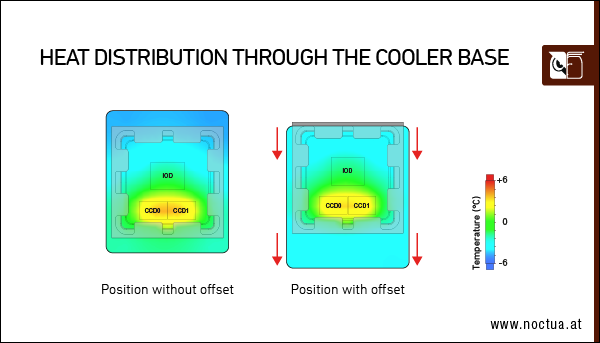
This is per design. On AM5 processors, there's a hotspot on the lower half of the processor where the dies that contain the CPU cores are located. Noctua recommends that AM5 users mount their coolers shifted towards the lower side of the processor for optimal cooling performance, see https://noctua.at/en/offset-am5-mounting-technical-backgroun... . You may have missed the paragraph in the article that explicitly poin…

Noctua recommends mounting their cooler so that the center is shifted toward the lower part of the CPU. From your picture with the thermal paste, it’s clear that your cooler is only making contact with about two-thirds of the CPU, meaning you mounted it incorrectly. The cooler’s contact area must always cover the entire CPU; otherwise, you reduce heat transfer capacity. On top of that, you’re already using an undersi…

Welcome to Hacker News! I'm glad my comment encouraged you to join the site.

I didn't write the article, I was just commenting because other users seemed to miss information that was written in it.

The picture with the thermal paste shows that paste was squeezed out from the entire perimeter of the CPU, so the cooler is making contact with the whole CPU. The paste is squeezed thinner near the lower side of the CPU because that's where the mounting pins are located, meaning that's where the mounting pressure is the strongest. The impression left by the thermal paste matches the diagram on Noctua's site ( https://noctua.at/pub/media/wysiwyg/offset/heat_cooler_base_... ).

Noctua lists the NH-U9S cooler as being compatible with the 9950X, and claims it has "medium turbo/overclocking headroom", see https://ncc.noctua.at/cpus/model/AMD-Ryzen-9-9950X-1831 . I'm not sure how they come up with their compatibility ratings, but I generally trust Noctua knows what they're doing when it comes to CPU cooling.

It's also important to note that the author only tried the offset mount after they had a CPU die when the cooler was mounted centered on the CPU.

Overall, I think it's unlikely that these failures can be blamed on poor cooling.

Re: GMP damaging Zen 5 CPUs?

#214
post #207

Earlier quoted context omitted.

The small coolers used by them are not recommended by Noctua for 9950X. Noctua recommends only bigger coolers for 9950X, which dissipates 200 W permanently on a workload like theirs (which is much less than the over 250 W dissipated in similar conditions by the competing Intel CPUs). Despite this, the overtemperature protection of the CPUs should have protected the CPUs and prevent any kind of damage like this. Besid…

> The small coolers used by them are not recommended by Noctua for 9950X Noctua's CPU compatibility page lists the NH-U9s as "medium turbo/overclocking headroom" for the 9950X [0]. I don't think it's fair to suggest their cooler choice is the problem here. [0] https://ncc.noctua.at/cpus/model/AMD-Ryzen-9-9950X-1831

That means pretty much "not recommended".

On the same page linked by you, Noctua explains that the green check mark means that with that cooler the CPU can run all-core intensive tasks, exactly like those used by the gmplib developers, only at the base clock, which is 4.3 GHz for 9950X, with turbo disabled in BIOS.

Only then the CPU might dissipate its nominal TDP of 170 W, instead of the 200 W that it dissipates with turbo enabled.

With "best turbo headroom", you can be certain that the CPU can run all-core intensive tasks with turbo enabled. Even if you do no overclocking, but you run all-core intensive tasks with turbo enabled, this is the kind of cooler that you need.

Noctua does not define what "medium headroom" means, but presumably it means that you can run with turbo enabled all-core tasks that have medium intensity, not maximum intensity.

There is no doubt that it is a mistake to choose such a cooler when you intend to run intensive multi-threaded computations. A better cooler, but not much bigger, like NH-U12A, has an almost double cooling capacity.

That said, there is also no doubt that AMD is guilty of at least having some bugs in their firmware or in failing to provide adequate documentation for the motherboard manufacturers that adapt the AMD firmware for their MBs.

Re: GMP damaging Zen 5 CPUs?

#215
AMD's desktop CPU TDP numbers have been misleading for over a decade.

I have no idea why they do it this way. Everything they list must be multiplied by about 1.35.

For example, a 170W TDP CPU requires 230W of dissipation. Not 170W.

AMD fans don't give a damn about that though. "It's just fine" (tm).

Re: GMP damaging Zen 5 CPUs?

#216

Earlier quoted context omitted.

> Couldn't this count as false/misleading advertizing though? For what, exactly? TDP stands for "thermal design power" - nothing in that means peak power or most power. It stopped being meaningful when CPUs learned to vary clock speeds and turbo boost - what is the thermal design target at that point, exactly? Sustained power virus load?

> For what, exactly? TDP stands for "thermal design power" The chip is not designed for this rate of power dissipation; and it is not the rate of power dissipation that you can expect to get from the chip.

> The chip is not designed for this rate of power dissipation

Says who? AMD advertises the chip as having a base clock of 4.3 GHz over all cores. The 9950X pulls somewhere around 220W at 5ghz all cores and with how power scales, 170W at the advertised 4.3 GHz seems more than plausible. Seems perfectly within reason that the advertised frequency and the advertised TDP are aligned.

I wish Anandtech was still around as iirc they did have charts for all this, which nobody else seems to do :/

> and it is not the rate of power dissipation that you can expect to get from the chip.

Again, says who? Who's expectations? This is a consumer chip, and the expectations of a consumer chip is not that it spends 100% of its time running prime95 or a similar "power virus" workload. I expect that if I buy this chip while I would have intervals of >170W, I'd also have long periods of much less than 170W. If I have a cooler designed to sustain 170W of cooling, that's going to work out on average just fine as there's thermal mass in the system.

Re: GMP damaging Zen 5 CPUs?

#217
post #192

Earlier quoted context omitted.

Isn't TDP supposed to be an upper bound of how much power budget there is for a chip when it's running under maximum IPC (which implies AVX512 workload spread across all cores with all the test data in all the L1 caches)? I guess that power budget can vary due to process imperfections and/or CPU bugs but saying that it doesn't approximate anything is hard to believe. How about the PSU then, e.g. is 800W PSU a made-up…

No, TDP is only supposed to be a marketing number. It would be nice if it were a real number that meant something, but CPU manufacturers don’t want to include really complicated information in their marketing. When they want to emphasize that a processor is powerful, they increase the TDP number! When they want you to buy an efficient laptop, they just lower the number! Same cpu, same number of transistors, same numb…

https://www.usenix.org/system/files/conference/cooldc16/cool... uses 84W TDP-rated Haswell-architecture Intel i7-4770, and authors constructed the synthetic microbenchmark with 1.67 IPC FPU and 3.86 IPC integer workloads. Then they use RAPL (Running Average Power Limit), something I learned that exists as of today, to measure the power usage on the level of the whole chip package. Reported numbers are ~22W.

Considering that the microbenchmark is utilizing only one core, and considering that this chip has 4 cores in total, could it really be that they would measure ~84-88W if they had designed the microbenchmark so that it utilizes all of the cores? This would then match the declared TDP.

Re: GMP damaging Zen 5 CPUs?

#218
post #97

A quick search on the NH-U9S shows it's a compact cooler for small systems, rated for up to 140 W (see e.g. [1]). The 9950X's TDP (Thermal Design Power) is 170 W, its default socket power is 200 W [2], and with PBO (Precision Boost Overdrive) enabled it's been reported to hit 235 W [3]. [1] https://www.overclockersclub.com/reviews/noctua_nh_u9s_cpu_c... [2] https://hwbusters.com/cpu/amd-ryzen-9-9950x-cpu-review-perfo…

Noctua does not use TDP for their heatsinks and instead have CPU compatibility charts. They say it's fine, with "medium turbo/overclocking headroom". https://ncc.noctua.at/cpus/model/AMD-Ryzen-9-9950X-1831

> Noctua does not use TDP for their heatsinks and instead have CPU compatibility charts.

Reviewers and sellers do, though. Here are a few more: [1][2][3][4]

The highest rating is from [1], which says

You cannot access the TDP guide from here, but we will tell you that it displays 140W TDP; however, it also says you can overclock that to closer to 160W or 180W TDP overall.

AVADirect advertises it as good for 115W [4].

It also beggars belief that a single 92mm fan would suffice to cool a 9950X, when the best 120 and 140 mm air coolers just barely reach 240W [5]. The only Noctua in that review, the 140mm NH-D15S, gets to 233W.

> They say it's fine, with "medium turbo/overclocking headroom"

Hopefully just an innocent mistake...

[1] https://www.tweaktown.com/reviews/7038/noctua-nh-u9s-cpu-coo...

[2] https://www.hardwareslave.com/reviews/cooling/noctua-nh-u9s-...

[3] https://www.frostytech.com/articles/2781/index.html

[4] https://www.avadirect.com/NH-U9S-chromax-black-125mm-Height-...

[5] https://www.tomshardware.com/pc-components/air-cooling/therm...

Re: GMP damaging Zen 5 CPUs?

#219

Earlier quoted context omitted.

They don't say what temperature the CPU was reporting which seems like an odd omission. Whatever the specs of your cooler etc check the temperature it's actually running at. Go by what the CPU is saying! I've got the older 3950x, and the first one died after a few months (still in warranty) with a cooler in spec, but it would go into the 90s at full load just doing big builds. I replaced the heatsink with a basic wat…

Zen 2 is supposed to be able to work up to 95 C so that shouldn't have caused your CPU to fail. And it should clock down before it fails anyway, way below the specified "minimum" frequency if needed - got to experience that with a failing AIO. A better cooler should only be required to make full use of your CPU not to protect it.

I kind of agree with you and Symmetry; but having had a fried CPU I'm more careful. No electronics like running very hot - so even if you're just inside spec on something for the heat it's likely to live a shorter life than if you kept it more comfortable - and it'll let it clock faster if you keep it cool! And really my points are: * the standard spec coolers just don't manage that on these hot CPUs, even if they claim to. * If you're building a machine and you know you're pushing it hard, just check the temperatures to check that cooling you bought is working.

Re: GMP damaging Zen 5 CPUs?

#220
post #152

Earlier quoted context omitted.

https://www.youtube.com/watch?v=ZyWelvEP_CQ

Given that Gamers Nexus needs the ad revenue wouldn't linking to a re-upload that wouldn't give them any of that be sort of bad?

buy a mug from them to support them!
Post reply on HN