Earlier quoted context omitted.
Part 1 is the most "useless" - it's basically required reading to be able to read the rest of the book. There are a few sections in data structures that I read to actually apply (I can't remember the exact parts, but I remember pouring over the book), but mostly it's enjoyable if you like programming for programmings sake. If you think of programming as a practical means for achieving some end (job or creative pursui…
Part 1 has some cool material. The mathematical preliminaries, polynomial arithmetic to motivate linked lists, and symbolic differentiation to motivate trees. The MIX simulator written in MIX too!
Knuth's Art of Computer Programming, V 4B, has gone into print
211–220 of 357 posts
Re: Knuth's Art of Computer Programming, V 4B, has gone into print
#212Earlier quoted context omitted.
I use it more like a dictionary. I don't read it from start to finish, but if I need an algorithm for something, I look it up in Knuth.
This is the function my copy of TAOCP serves. I'm not anywhere near knowledgeable enough to digest all of it, but when I need something and I want to understand the ground theory behind it then to Knuth I go.
Re: Knuth's Art of Computer Programming, V 4B, has gone into print
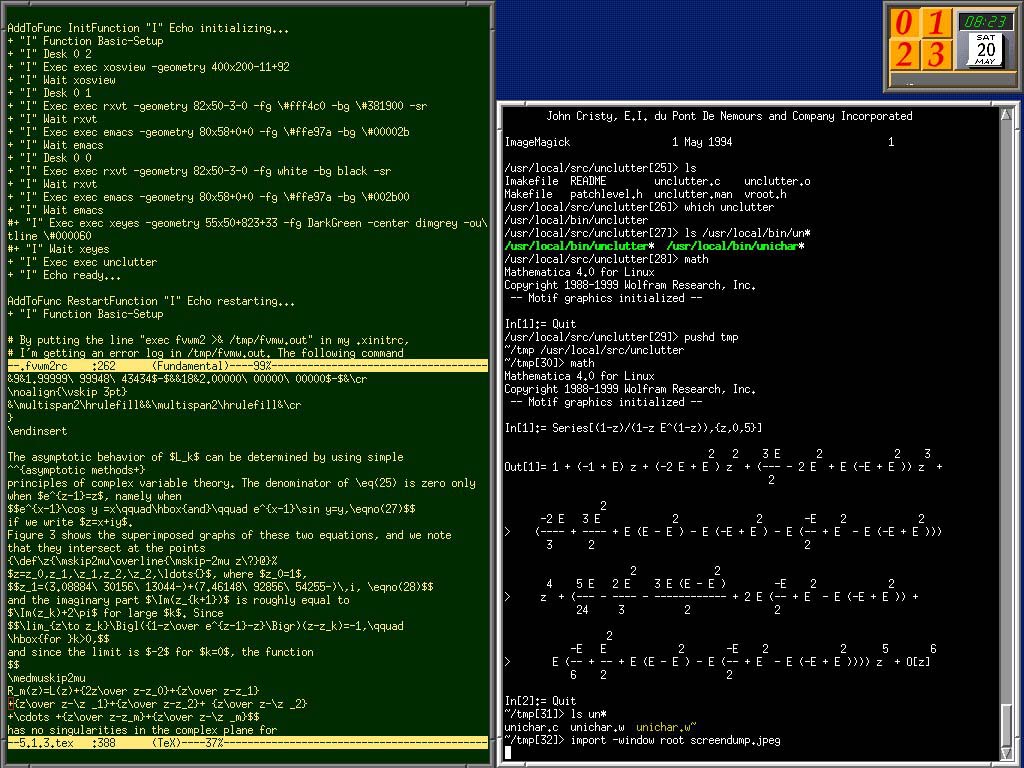
#213A few years ago I had the pleasure of meeting Knuth in his home, my wife was doing some photography for him. He took me to his room and showed me his setup, he was researching Soduku algorithms at the time. His hands were blisteringly quick, moving between EMacs panes, triggering evaluations and printing of results, as fast as any 20 year old. In his 80s , he hasn’t seemed to suffer any mental decline. I started talk…
I also noticed smart people type really fast (if they can touch type) and can switch between multiple windows/tabs fast too. It's not because their fingers move faster than normal people, but because their mind moves smoothly so they can produce a long string of command with stopping to think. > as fast as any 20 year old. I I certainly hope so. Though I think it's more likely that Knuth can be as fast as other 20-ye…
Re: Knuth's Art of Computer Programming, V 4B, has gone into print
#214Re: Knuth's Art of Computer Programming, V 4B, has gone into print
#215A few years ago I had the pleasure of meeting Knuth in his home, my wife was doing some photography for him. He took me to his room and showed me his setup, he was researching Soduku algorithms at the time. His hands were blisteringly quick, moving between EMacs panes, triggering evaluations and printing of results, as fast as any 20 year old. In his 80s , he hasn’t seemed to suffer any mental decline. I started talk…
may we all age so gracefully. perhaps part of the secret is to work like Don.
Re: Knuth's Art of Computer Programming, V 4B, has gone into print
#216Earlier quoted context omitted.
These are the photos my wife took at his home. https://www.quantamagazine.org/computer-scientist-donald-knu... Like the 5th picture down you can see him standing (he uses a standing desk!) and if you blow up the screen, you can see part of an emacs window on the left hand side. I believe he also was using emacs shell windows as well, but not 100% sure. Direct Link: https://d2r55xnwy6nx47.cloudfront.net/uploads/2020/0…
Hard to tell at this resolution, but it looks like he's using a fairly bare X setup with a tiling window manager and only one Emacs frame on the left. The colours and layout on Emacs look like org-mode. Does he write with org-mode? I would have expected him to write bare TeX, of course. Maybe he's doing something else with org-mode. He's got Xeyes on the right, and the shell windows could conceivably be Emacs too, bu…
the only mistake you won't be able to correct from observing screenshot is the "look like org-mode" thing. it's https://www-cs-faculty.stanford.edu/~knuth/programs/color-mo... minor mode which lets you highlight arbitrary lines in a buffer.
Re: Knuth's Art of Computer Programming, V 4B, has gone into print
#217Earlier quoted context omitted.
I also noticed smart people type really fast (if they can touch type) and can switch between multiple windows/tabs fast too. It's not because their fingers move faster than normal people, but because their mind moves smoothly so they can produce a long string of command with stopping to think. > as fast as any 20 year old. I I certainly hope so. Though I think it's more likely that Knuth can be as fast as other 20-ye…
Interesting - I do this but I learned the skill from sight reading music scores - you have to be playing several bars behind what you’re reading so the skill is in going into autopilot with your fingers as you read. No small coincidence then that Knuth is an organist
Also great on the harpsichord and piano.
Re: Knuth's Art of Computer Programming, V 4B, has gone into print
#218I don't mind the mathematical rigour at all, I have benefited from it, but the way the books are structured is all over the shop.
Re: Knuth's Art of Computer Programming, V 4B, has gone into print
#219Earlier quoted context omitted.
[flagged]
For the Christian, reading the Bible is internally transformative.
OK, even though the bible doesn't interest me, we once went through the score of the Fantasia Apocalyptica together and it was useful that I knew enough of the bible to discuss some references. There are also musical "puzzles" or clues in the score a few of which I was lucky enough to catch so I didn't come off as a complete dufus.
Re: Knuth's Art of Computer Programming, V 4B, has gone into print
#220Earlier quoted context omitted.
Honestly, despite everyone's claims of how "beautiful" the books are, I think they are rather terribly formatted. For example, the first volume consists of 2 "chapters". Each chapter spans about 250 pages on its own. So actually not a chapter, but a section, or maybe even a book in its own right. Then, each chapter is broken into sections and subsections that flow one into the next. There's a fundamental lack of whit…
Writing style is subjective and I find Knuth's delightful: almost every paper of his that I've read has been fun. Even in his technical papers he writes at the level an undergraduate student with decent mathematical background (or a strong high-schooler) could mostly understand, which suits me just fine, especially compared to some other academics who write only for their peers / graduate-level and higher. And in any…
cba/to frustrated to re-redo it right now.