Cows eat grass. Humans use more calories digesting grass than they gain from eating grass, so cows are infinitely more efficient than humans at gaining calories from grass. And there are places in the world where growing human food would destroy the land. Semi-deserts like Texas and Montana. Grazing cattle there is a good idea. Bison would be even better because the native prairie there is adapted to bison, but cattl…
40% of lost calories globally are from beef, needing 33 cal of feed per 1 cal
201–210 of 360 posts
Re: 40% of lost calories globally are from beef, needing 33 cal of feed per 1 cal
#202Not trying to be overly flippant... who cares? The paper opens with "to feed a growing population" without asking is that what we need? want? where we are actually heading to? Is feeding the world a real problem? I've yet to see compelling evidence that it really is except as a secondary effect of logistics, energy supply, and war. edit: I understand the environmental impacts. I think we should solve our energy probl…
Congratulations on being overly flippant without trying. Evidently a lot of people care, and environmental impacts and energy problems are closely related.
Re: 40% of lost calories globally are from beef, needing 33 cal of feed per 1 cal
#203Earlier quoted context omitted.
> Is feeding the world a real problem? Yes, but it is not a production capacity problem. The constraints on food are mostly in the logistics chain, often having to do with corruption or distribution targets (food goes where the money is), or regulation (did you know that cherry growers in the Upper Midwest are required --_by Federal law_-- to destroy unsold crops?). A huge amount of food goes to waste simply because…
Tart cherries are supply-controlled because they are processed into other goods, like pie filling, and can be stored for long duration (multiple seasons). The supply-control regulation is designed to prevent a surplus crop from depressing the market to the point where it's no longer viable to grow tart cherries - reducing future supply, ie. the regulation is designed to provide a consistent, stable supply. Surplus ta…
One thing people often don't figure or realize is food takes time to grow. It requires long term thinking to make sure supplies are sufficient. Left to their own devices, farmers will often chase after last season's cash crop. That is bad. It's far better for farmers to stick to more predictable growing and for more dedicated incentives to be issued.
Re: 40% of lost calories globally are from beef, needing 33 cal of feed per 1 cal
#204Not trying to be overly flippant... who cares? The paper opens with "to feed a growing population" without asking is that what we need? want? where we are actually heading to? Is feeding the world a real problem? I've yet to see compelling evidence that it really is except as a secondary effect of logistics, energy supply, and war. edit: I understand the environmental impacts. I think we should solve our energy probl…
meat uses up enormous quantities of water. potatoes for instance use about 75 gallons to produce 2000 calories compared to say 1500 to 2500 gallons for 2000 calories of beef.
We drain the land in Iowa otherwise the north half of it would be a swamp. Complaining about water usage for all but the western edge of Iowa is much the same as complaining about how solar panels use up the sunlight.
Re: 40% of lost calories globally are from beef, needing 33 cal of feed per 1 cal
#205Earlier quoted context omitted.
We have 8 billion people. We have enough people to solve both the energy problem and the food efficiency problem. That said, it's very, very funny that you responded to an article about energy inefficiency (calorie -> calorie) and said we should solve our energy problems. Beef is an energy problem! We're putting 30x the energy into the product against the energy we get out! Thats wasted energy!
Eh. Grow beef mostly grazed on marginal land that can't support other agriculture. This is how a LOT of beef is produced and how most of it SHOULD BE. They're not "lost calories" if they're produced on large swaths of semi-arid land that don't support any other kind of agriculture. And on the opposite side... a LOT of those "lost calories" are corn. Corn is substantially more productive than other crops and people do…
Re: 40% of lost calories globally are from beef, needing 33 cal of feed per 1 cal
#206Not trying to be overly flippant... who cares? The paper opens with "to feed a growing population" without asking is that what we need? want? where we are actually heading to? Is feeding the world a real problem? I've yet to see compelling evidence that it really is except as a secondary effect of logistics, energy supply, and war. edit: I understand the environmental impacts. I think we should solve our energy probl…
> Is feeding the world a real problem? Yes. > I've yet to see compelling evidence that it really is except as a secondary effect of logistics, energy supply, and war. I don't know how to respond to this. It's like saying you don't think breathing underwater is difficult, except for the secondary effects of water. War is a problem. Energy supply is a problem. Logistics is a problem. All these problems lead to starvati…
None of these are logistics, energy supply, or war. The paper is specifically talking about increasing efficiency in food production, the originally commenter is saying that efficiency of production is not the main driver for undernourishment and your comment doesn't address that.
Re: 40% of lost calories globally are from beef, needing 33 cal of feed per 1 cal
#207Earlier quoted context omitted.
Even if food shortages aren't an issue, reducing the amount of land dedicated to food production is a win for ecosystems. Not saying people have to go vegetarian, but reducing meat consumption or using more efficiently produced meats (in terms of land use) would overall make the world a nicer and more interesting place. And, really, with the whole neu5gc thing, it might be that humans would be better off focusing on…
Yes, we could concreting this land and build housings and streets.
Re: 40% of lost calories globally are from beef, needing 33 cal of feed per 1 cal
#208Actual title: Only half of the calories produced on croplands are available as food for human consumption
This is a really big shocker to most people, especially in America. We see these big huge farmlands with rows and rows of corn. We hear the propaganda that farmers are the backbone of this nation and we can't live without them. Songs sing in our heads, "amber waves of grain, from sea to shining sea". People get a warm and fuzzy feeling. Country music psyop perpetuates this. Meanwhile a substantial portion (as noted h…
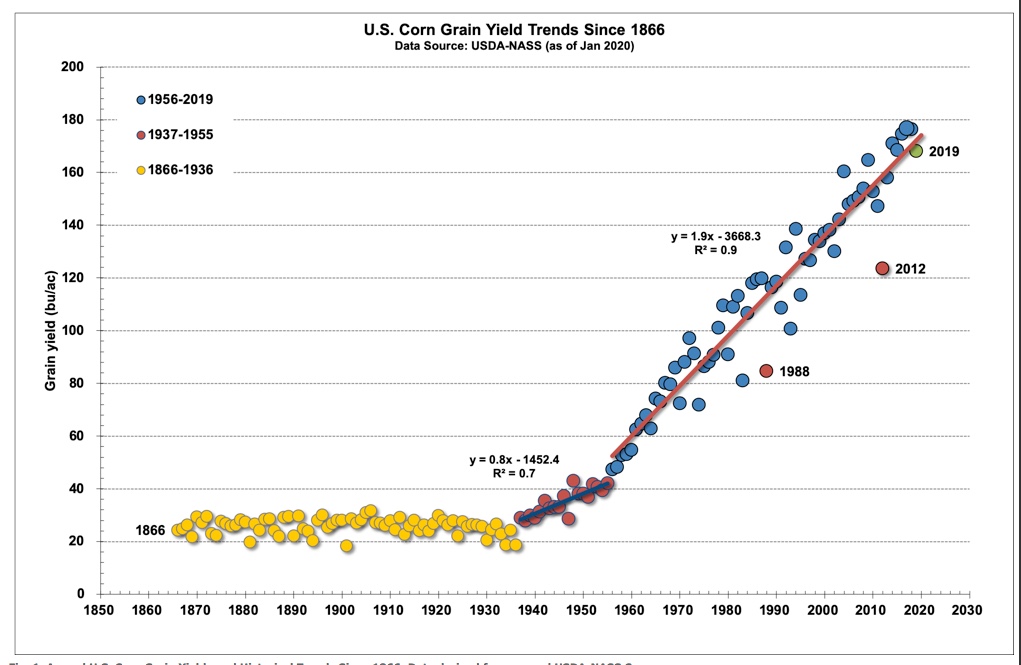
Look at this figure of corn yields per acre (1). Yellow is the "old age" where yields were stagnant. Red is when fertilizer began to be used. Now the huge slope change, has been in exploiting genetic hybrids. GMO allows protection of desirable hybrid traits that might be lost in breeding, introduction of traits to to other strains. Traits of interest are primarily around lessening usage of fertilizer, lessening usage of insecticides, as these are all input costs the farmer would rather not pay especially if they can get the same yield without paying. Thank you GMOs for keeping this linear change in yield even over the last 15 years! Could you believe we improved our corn yields substantially over these 15 years? Remarkable the work biologists do in the quiet of their field.
But of course, lay people just think it is a big conspiracy. They don't understand any of this. They think GMOs are copyright but that belies a lack of education of the last century of agriculture development, since that doesn't make sense as farmers have been using hybrids and ordering new seed some 70 years now in certain crops. It is the nations who have to resort to reusing seed and these inferior strains that are suffering poor yields and food insecurity. Over here, we feed far more with far less land under the plow every year. Their yields are still stagnant at historical levels. And climate change is coming for them, while we are understanding the very genetic basis of our yield improvement. They will be using seeds we engineer for them to be high yield in their changing environment to survive widespread famine in the coming decades. GMO is the greatest human invention, more important than even computers.
1. https://extension.entm.purdue.edu/newsletters/pestandcrop/wp...
Re: 40% of lost calories globally are from beef, needing 33 cal of feed per 1 cal
#209Not trying to be overly flippant... who cares? The paper opens with "to feed a growing population" without asking is that what we need? want? where we are actually heading to? Is feeding the world a real problem? I've yet to see compelling evidence that it really is except as a secondary effect of logistics, energy supply, and war. edit: I understand the environmental impacts. I think we should solve our energy probl…
meat uses up enormous quantities of water. potatoes for instance use about 75 gallons to produce 2000 calories compared to say 1500 to 2500 gallons for 2000 calories of beef.
Re: 40% of lost calories globally are from beef, needing 33 cal of feed per 1 cal
#210Not trying to be overly flippant... who cares? The paper opens with "to feed a growing population" without asking is that what we need? want? where we are actually heading to? Is feeding the world a real problem? I've yet to see compelling evidence that it really is except as a secondary effect of logistics, energy supply, and war. edit: I understand the environmental impacts. I think we should solve our energy probl…
Agreed. The market should decide if beef consumption is viable. Ultimately energy is the basis all food production. Cheap and plentiful energy solves the food production and distribution problem, then its just matter of preferences.