Live data from Hacker News

Economics of Orbital vs. Terrestrial Data Centers

andrewmccalip.com

201–210 of 282 posts

Re: Economics of Orbital vs. Terrestrial Data Centers

#201
post #70

Earlier quoted context omitted.

Cooling isn't anymore difficult than power generation. For example, on the ISS solar panels generate up to 75 W/m², while the EATCS radiators can dissipate about 150 W/m². Solar panels have improved more than cooling technology since ISS was deployed, but the two are still on the same order of magnitude.

So just 13.3 million sq. meters of solar panels, and 6.67 million sq. meters of cooling panels for 1 GW. Or a 3.651 km squared and 2.581 km squared butterfly sattelite. I don't think your cooling area measures account for the complications introduced by scale. Heat dissipation isn't going to efficiently work its way across surfaces at that scale passively. Dissipation will scale very sub-linearly, so we need much mor…

Lets not forget that you have to launch that liquid up as well. Liquids are heavy, compared to their volume. Not to mention your entire 'datacenter' goes poof if one of these loops gets frozen, explodes from catching some sunlight, or whatever. This is pretty normal stuff, but not at this scale that would be required.
Re: Economics of Orbital vs. Terrestrial Data Centers

#202
post #70

Earlier quoted context omitted.

Cooling isn't anymore difficult than power generation. For example, on the ISS solar panels generate up to 75 W/m², while the EATCS radiators can dissipate about 150 W/m². Solar panels have improved more than cooling technology since ISS was deployed, but the two are still on the same order of magnitude.

So just 13.3 million sq. meters of solar panels, and 6.67 million sq. meters of cooling panels for 1 GW. Or a 3.651 km squared and 2.581 km squared butterfly sattelite. I don't think your cooling area measures account for the complications introduced by scale. Heat dissipation isn't going to efficiently work its way across surfaces at that scale passively. Dissipation will scale very sub-linearly, so we need much mor…

> active fluid exchangers operating at speed spanning kilometers of real estate, to get dissipation/area anywhere back near linear/area again

Could the compute be distributed instead? Instead of gathering all the power into a central location to power the GPUs there, stick the GPUs on the back of the solar panels as modules? That way even if you need active fluid exchanger it doesn’t have to span kilometers just meters.

I guess that would increase the cost of networking between the modules. Not sure if that would be prohibitive or not.

Re: Economics of Orbital vs. Terrestrial Data Centers

#204
post #191
post #81

Earlier quoted context omitted.

Yeah, you need 50m^2 of solar panels and 50m^2 of radiators. I don't see why one is that much more difficult than the other.

You need 50sqm of solar panels just for a tiny 8RU server. You also forgot any overhead for networking, control etc. but let's even ignore those. Next at the 400km orbit you spend 40% of the time in shade, so you need an insulated battery to provide 5kWh. This would add 100-200kg of weight to a server weighing 130kg on its own. Then you need to dissipate all that heat and yes, 50sqm of radiators should deal with the…

Don't forget to budget power to run the coolant heaters and prevent them from freezing in the shade.

Re: Economics of Orbital vs. Terrestrial Data Centers

#205
post #70

Earlier quoted context omitted.

Cooling isn't anymore difficult than power generation. For example, on the ISS solar panels generate up to 75 W/m², while the EATCS radiators can dissipate about 150 W/m². Solar panels have improved more than cooling technology since ISS was deployed, but the two are still on the same order of magnitude.

So just 13.3 million sq. meters of solar panels, and 6.67 million sq. meters of cooling panels for 1 GW. Or a 3.651 km squared and 2.581 km squared butterfly sattelite. I don't think your cooling area measures account for the complications introduced by scale. Heat dissipation isn't going to efficiently work its way across surfaces at that scale passively. Dissipation will scale very sub-linearly, so we need much mor…

Well, divide et impera. Fairly straightforward for AI inference (not training): The existing Starlink constellation:

3491 V1 sats × 22.68 m² = 79176 m²

5856 V2-mini sats × 104.96 m² = 614 646 m²

Total: 0.7 km² of PERC Mono cells with 23% efficiency.

At around 313W/m² we get 217MW. But half the orbit it's in shade, so only ~100MW.

The planned Starship-launched V2 constellation (40k V3 sats, 256.94 m²) comes out at 10 km², ~1.5GW.

So it's not like these ideas are "out there".

Re: Economics of Orbital vs. Terrestrial Data Centers

#206
post #192

Earlier quoted context omitted.

It's actually only about 3x. As you intimated, the radiated heat Energy output of an object is described by the Stefan-Boltzmann Law, which is E = [Object Temp ]^4 * [Stefan-Boltzmann Constant] However, Temp must be in units of an absolute temperature scale, typically Kelvin. So the relative heat output of a 90C vs 20C objects will be (translating to K): 383^4 / 293^4 = 2.919x Plugging in the constant (5.67 * 10^-8 W…

You use arbitrary temps to prove at some temps it’s not as efficient. Ok? What about at the actual temps it will be operating in? We’re talking about space here. Why use 20 degC as the temperature for space?

He didn't use 20C as the temperature of space. He used the OP's example of comparing the radiative cooling effectiveness of a heat SOURCE at 90C (chosen to characterize a data center environment) and 20C (chosen to characterize the ISS/human habitable space craft).

Re: Economics of Orbital vs. Terrestrial Data Centers

#207
post #87

Earlier quoted context omitted.

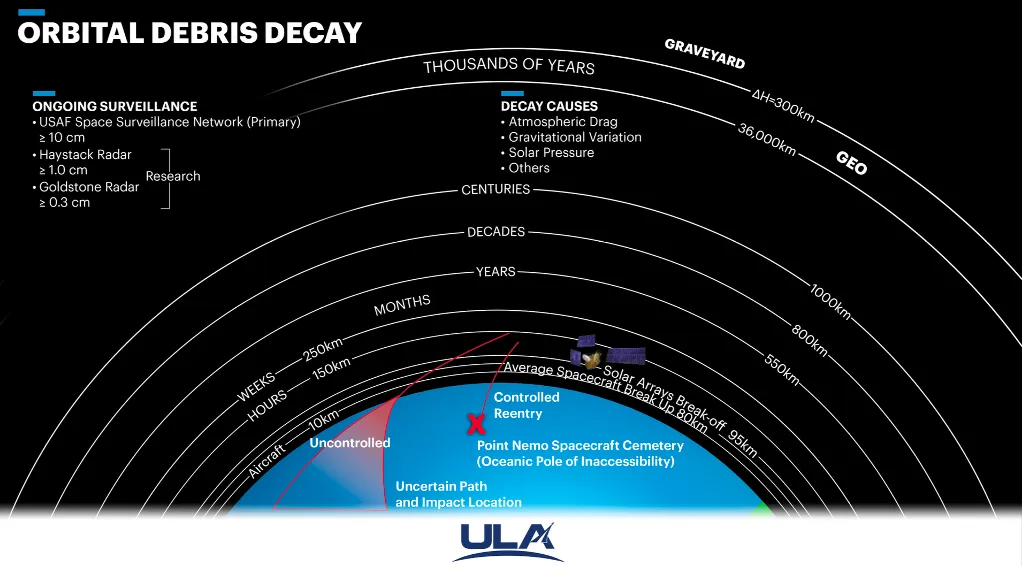
I think they last 2-3 years after they run out of argon fuel , so more like 7-8 years total. It looks like some Starlinks from Nov 2019 are still operational.

My understanding was that anything at ~500km needed readjustments every few months in order to not come down. Much less than 2-3 years. I'd be interested to know what the average lifespan or failure rate of Starlink has been. That's good that some are still up there 6+ years later, but I know many aren't. I'm not sure how many of those ran out of fuel, had hardware failures, or were simply obsolete, but an AFR would…

Quite helpful infographics from ULA: https://blog.ulalaunch.com/hubfs/orbital%20debris.jpeg

Re: Economics of Orbital vs. Terrestrial Data Centers

#208

Earlier quoted context omitted.

Of course you can build these things if you really want to. But there is no universe in which it's possible to build them economically. Not even close. The numbers are simply ridiculous . And that's not even accounting for the fact that getting even one of these things into orbit is an absolutely huge R&D project that will take years - by which time technology and requirements will have moved on.

Lift costs dropping geometrically. Cost and weight of solar decreasing similarly. The trend makes space-based centers nearly inevitable. Reminds me of "Those darn cars! Everybody knows that trains and horses are the way to travel."

Lift costs are not quite dropping like that lately. Starship is not yet production ready (and you need to fully pack it with payloads, to achieve those numbers). What we saw is cutting off most of the artificial margins of the old launches and arriving to some economic equilibrium with sane margins. Regardless of the launch price the space based stuff will be much more expensive than planet based, the only question if it will be optimistically "only" x10 times more expensive, or pessimistically x100 times more expensive.

I don't get this "inevitable" conclusion. What is even a purpose of the space datacenter in the first place? What would justify paying an order of magnitude more than conventional competitors? Especially if the server in question in question is a dumb number cruncher like a stack of GPUs? I may understand putting some black NSA data up there or drug cartel accounting backup, but to multiply some LLM numbers you really have zero need of extraterritorial lawless DC. There is no business incentive for that.

Re: Economics of Orbital vs. Terrestrial Data Centers

#209
post #24

When Starcloud put together that whitepaper the first thing I looked at was the launch costs[1]. It references a $5M cost to launch, which right away made absolutely no sense to me. Just a cursory search shows launch costs are around $50M per launch, if not more. It's great that this site drills down even further to demonstrate that there is absolutely no point at which the launch costs ever make this economical or v…

Don't confuse launch _price_ with launch _cost_. It's been estimated the internal F9 launch costs are around $15M-$20M.

The $5M is a marginal cost-target for fully reusable Starship.

Post reply on HN