Live data from Hacker News

Andrew Yang Founds the Forward Party

forwardparty.com

201–210 of 638 posts

Re: Andrew Yang Founds the Forward Party

#201
post #196
post #158

The top line, "Not Left. Not Right. Forward." kind of reminds me of Macron's "En Marche" ("Let's Go") that took over France in a storm, taking over the presidency AND the parliament only one year after its foundation, with very few previously known political figures in its ranks. The whole thing looked like doing management rather than politics, and offered an alternative to fed-up voters who didn't dare turn to the…

I suspect a huge part of Macron's success was his opponent. France elections have a top-2 runoff, and I wouldn't be surprised if many electors were like "I don't like Macron but I really don't want Le Pen to win". The whole "socially progressive, economically middle of the road" political coalition that would win every election on HN is extremely unpopular in the real world.

In order to qualify for the run-off, Macron had to end up in the top 2 first. Which he did. And that En Marche got the parliament as well was a bit of a surprise. Curious to see how things play out next year so.
Re: Andrew Yang Founds the Forward Party

#202
post #180
post #158

The top line, "Not Left. Not Right. Forward." kind of reminds me of Macron's "En Marche" ("Let's Go") that took over France in a storm, taking over the presidency AND the parliament only one year after its foundation, with very few previously known political figures in its ranks. The whole thing looked like doing management rather than politics, and offered an alternative to fed-up voters who didn't dare turn to the…

It reminded me of "twirling towards freedom": https://en.wikipedia.org/wiki/Portal:The_Simpsons/Character_... I hadn't realised just how much Macron's party materialized from nowhere. Must have been huge pent-up demand for an alternative. However I suspect that only works in systems that aren't FPTP in the first place, and I suspect Macron is going to the same nowhere that all American third-party candidates go. Espe…

This wasn't exactly a FPTP situation. First, the presidential election spans over two rounds. Second, about a month later, the legislative elections (two rounds also) were won too with a proper tsunami (350 out of 577 seats, providing a governing majority).

When he won the presidential election, everybody thought it was no big deal, as he hadn't shown a single viable candidate to staff any of the 577 seats in the parliament, without which he couldn't wield any real structural power. But he used that weakness as a strength. He hired inexperienced people from all regular ways of life, young and shiny. To the voting public, the message was "you wanted neither left nor right ? Here you go, vote for the almost normal people I'm offering you." This turned into a huge strength, as once in office these inexperienced MP simply followed the group leader, who, you guessed it, was a seasoned politician from olden, and made the parliament a transparent corridor for the presidential power for quite some time.

The public pitch was along the "climb over the left/right stalemate and go forward". But the mechanics, besides good ties with the corporate world, were a masterpiece of perfect timing for every action along the campaign, and then for the legislative elections. In those days I was admiring Macron like you would admire a talented enemy general.

Re: Andrew Yang Founds the Forward Party

#203
post #158

The top line, "Not Left. Not Right. Forward." kind of reminds me of Macron's "En Marche" ("Let's Go") that took over France in a storm, taking over the presidency AND the parliament only one year after its foundation, with very few previously known political figures in its ranks. The whole thing looked like doing management rather than politics, and offered an alternative to fed-up voters who didn't dare turn to the…

While Macron did indeed win the second round of voting in a landslide, I think that had more to do with an overwhelming rejection of the social-nativism of the National Front. In the first round of voting, it was striking how evenly split four of the candidates were. This is particularly interesting because (as a general political rule) as the margins between candidates decrease, tactical voting tends to correspondingly increase. This is why you very rarely see four-way (or more) splits in voting, and means voters must have been especially divided along multiple axes (i.e. not just "left" and "right"!). Macron was really the candidate of the "internationalist right" - a supporter of global institutions who opposed redistribution (see his abolition of the ISF - the wealth tax).

Re: Andrew Yang Founds the Forward Party

#204
post #158

The top line, "Not Left. Not Right. Forward." kind of reminds me of Macron's "En Marche" ("Let's Go") that took over France in a storm, taking over the presidency AND the parliament only one year after its foundation, with very few previously known political figures in its ranks. The whole thing looked like doing management rather than politics, and offered an alternative to fed-up voters who didn't dare turn to the…

It's also almost the tagline Rita Verdonk used to use: "Niet links, niet rechts, maar rechtdoorzee" ("not left, not right, but straightforward").

This was when she started her own party after being sidelined by the party of the current prime minister of the Netherlands, after getting more votes than he did. Her party failed miserably, and ten years later he's still prime minister.

Which is to say: success doesn't just come from the tagline, I suppose.

Re: Andrew Yang Founds the Forward Party

#205

Earlier quoted context omitted.

Ugh I support electoral reform, but why the obsession with ranked choice? It is the second WORST voting system after first past the post, which is what we have now.

Ranked choice seems to be the best one I've read about. Could you help us understand what voting system might be better?

> Ranked choice seems to be the best one I've read about.

IRV (sometimes called “ranked choice”, but its among the worst of the ranked choice single-member methods) can be improved by getting rid of the loser elimination step, and counting down on all ballots (instead of those with an eliminated loser) until some candidate had a total that crosses the winning threshold (this is a version of Bucklin, but historical Bucklin implementations have often done dumb things like limiting the number of preference ranks to a much smaller number than candidates (often 2-3) rather than using fully-ranked (forced preference or unforced preference) ballots.

But, other than things like unique executive offices, single-member elections should be avoided. Legislative elections with small multimember districts (say 5 members) with a system like STV (or a Bucklinish cousin, again without loser elimination) gets decent proportionality, the candidate accountability of single-member districts (but more, because parties are likely to run more candidates than they'll win seats, so there os general election accountability even within preferred parties) and avoids high-stakes districting (eliminating gerrymandering opportunities.)

Even executive offices with a designated successor (e.g., governor and lt. governor) can be made multiwinner (sequential rather than proportional) using a ranked ballots method with a normal single-winner majority threshold: once the first winner is selected, eliminate that candidate and recount the ballots (for some methods, this can simply be continue the count till the next winner crosses the threshold with the same effect) to select the winner of the successor office. This improves candidate accountability when one party is clearly preferred, because a disfavored incumbent can be demoted without abandoning the preferred party.

Re: Andrew Yang Founds the Forward Party

#206

Edit: I was wrong, he's doing exactly what I thought he wasn't. See Hannibalhorn's comment below for more details. I'm glad he supports Ranked-Choice Voting (RCV), but I think he's going about this the wrong way. Right now, he's creating a new third-party within an electoral system that effectively defaults to two existing and dominant parties. Those two parties currently control every federal and state legislature a…

Mixed member proportionate voting works well for NZ, in terms of allowing multiple political parties to gain significant representation… [ https://en.m.wikipedia.org/wiki/Mixed-member_proportional_re... ]

MMP is way better than FPP, however the NZ version with list MPs is undesirable in my opinion, because the party gets to choose candidates who get zero votes and then get into parliament. To remove someone you have to vote out the party.

To explain: in NZ MMP, the party creates a list of candidates, and if the party is voted for, people from the list become members of parliament. NZ also has 60 out of 120 seats allocated by voting in an electorate, but even someone that doesn’t win their electorate can still become an MP if they are sufficiently high on the party list. https://elections.nz/democracy-in-nz/what-is-new-zealands-sy...

Re: Andrew Yang Founds the Forward Party

#207
post #191
post #158

The top line, "Not Left. Not Right. Forward." kind of reminds me of Macron's "En Marche" ("Let's Go") that took over France in a storm, taking over the presidency AND the parliament only one year after its foundation, with very few previously known political figures in its ranks. The whole thing looked like doing management rather than politics, and offered an alternative to fed-up voters who didn't dare turn to the…

En Marche benefitted from the peculiarity of France's electoral system, which combines proportional representation in a 1st round with a "sudden death" 2nd round for the powerful presidency with only the two best-polling parties taking part. When it became clear that the far-right would be the largest single party, people ditched traditional party allegiances to back a candidate they found tolerable. (Apologies for p…

That's not entirely correct. Macron got 24.01% in the first round, 66.1% in the second. Le Pen, the far right candidate, got 21.3% in the first and 33.9% in the second. The runner-up in the first round was Fillon, a coservative, with 20.01% in round one. There was the fear Le Pen would win the second round, sure. One thing about the French system is, that usually the second round is not won by a radical candidate as those usually fail to get enough votes from the other parties and candidates not qualifying for round 2. We'll see how that plays out next year so. Not sure how the French system wouldn't fit the current political landscape.

Re: Andrew Yang Founds the Forward Party

#208
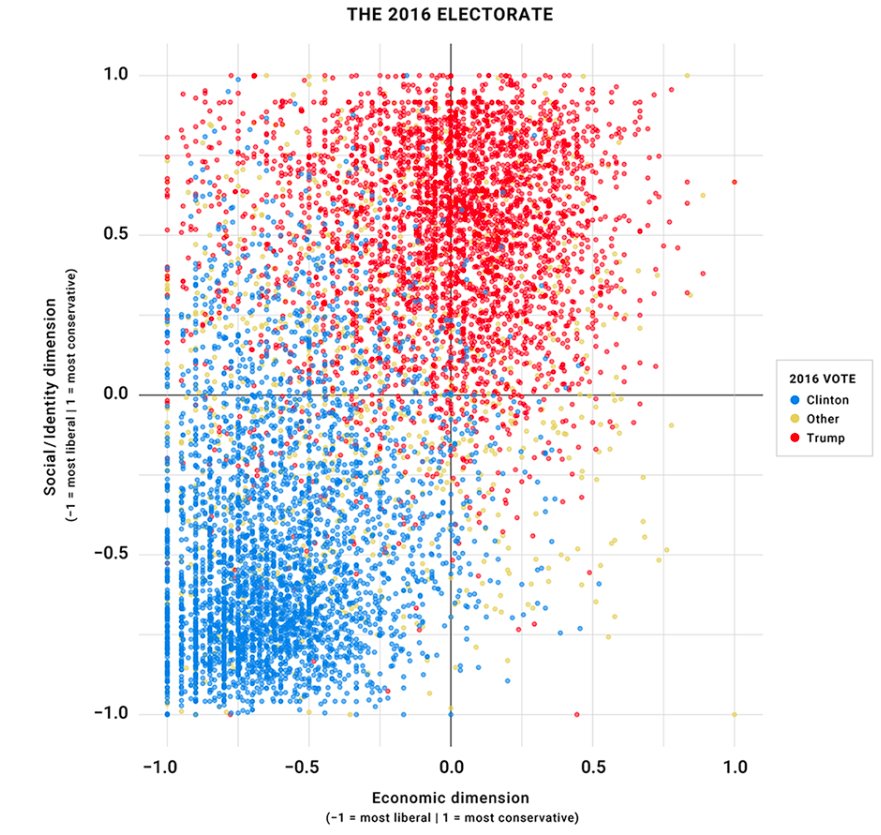
Not exactly sure what to make of this, conceptually it just sounds like 90s era Clintonite/Thatcherite consensus with some ranked voting and other stuff thrown in. The reason why the US is polarized (and most other places to a slightly lesser degree) is because that quadrant of the political spectrum is dead[1], and people have overall grown tired of this liberal (in a broad sense of the term) anti-politics which aims to disguise managerialism and technocratic government as 'non-ideological'.

[1]https://pbs.twimg.com/media/DyE_4e9V4AAW0od.jpg:large

Re: Andrew Yang Founds the Forward Party

#209
post #191
post #158

The top line, "Not Left. Not Right. Forward." kind of reminds me of Macron's "En Marche" ("Let's Go") that took over France in a storm, taking over the presidency AND the parliament only one year after its foundation, with very few previously known political figures in its ranks. The whole thing looked like doing management rather than politics, and offered an alternative to fed-up voters who didn't dare turn to the…

En Marche benefitted from the peculiarity of France's electoral system, which combines proportional representation in a 1st round with a "sudden death" 2nd round for the powerful presidency with only the two best-polling parties taking part. When it became clear that the far-right would be the largest single party, people ditched traditional party allegiances to back a candidate they found tolerable. (Apologies for p…

> which combines proportional representation in a 1st round

No it doesn't.

The french parliament is elected in 577 single member constituencies by a 2 round system: in the 1st round, voters vote for any candidate.

If no candidate wins >50% of all the votes in that constituency, a 2nd round is held, where candidates that came 1st or 2nd or got >12.5% of the vote, in the 1st round, can run.

Thus the French 2 round system is similar to Instant Runoff Voting, except that it isn't instant.

As an example of how the French system isn't proportional, En Marche got 32% of 1st-round votes but 61% of seats.

> for the powerful presidency

Presidential elections, like any other election that elects 1 candidate cannot in principle be proportional, because each party must either win 100% or 0% of the candidates elected.

> When it became clear that the far-right would be the largest single party

No, the National Front only got 13.2% of 1st round votes (and only ended up winning 8 seats, 1.4% of the total). They were nowhere near being the biggest party.

Re: Andrew Yang Founds the Forward Party

#210
post #63

I was excited about Yang’s candidacy in the NYC mayoral election, but it didn’t take very long to see that he was out of his depth. In the end, he didn’t even rank in my top 5 (NYC has ranked choice now). Why does he keep running for top positions? He clearly doesn’t have a record of success as an executive, either in private or public sectors. He seems like a nice guy. If he wants to get into politics, why not start…

> He clearly doesn’t have a record of success as an executive, either in private or public sectors.

You could say the same thing about Obama in 2008.

> He seems like a nice guy. If he wants to get into politics, why not start as a city councilor or something?

Nice job damning with faint praise there, well done!

Guess what, he's already in politics. He ran a wildly influential campaign for the Democratic presidential candidacy, and was a top contender in the NYC mayoral race. How many people "wanting to get into" politics could claim to have done that?

Post reply on HN