Live data from Hacker News

Who Americans spend their time with, by age

ourworldindata.org

201–210 of 432 posts

Re: Who Americans spend their time with, by age

#201
post #143

Earlier quoted context omitted.

Places CAN change, but there is a lot stopping suburbia from becoming more walkable. In the case of American suburbs, places will need to change by basically tearing everything down and rebuilding differently, either a piece at a time or all at once.

We can't mix together residential and commercial properties in the US (anymore) due to zoning laws, so walkable cities are effectively on life support and are only going to get more and more rare as time goes on. Each time a mixed-use building is demolished, another piece of a walkable city dies that likely won't ever come back. Suburbs and unaffordable metropolises are poised to kill off the ability to live without…

> We can't mix together residential and commercial properties in the US (anymore) due to zoning laws

You make this statement like there are national zoning laws. Doing exactly this is common in northeastern New Jersey, and the result is pretty dense and walkable suburban areas. That said, much of this is due to momentum; many of the suburbs were platted before car ownership was widespread and the later ones continued similar, familiar patterns.

Re: Who Americans spend their time with, by age

#202
post #182
post #130

Earlier quoted context omitted.

It's only meddling if you're way too stressed out by trying to keep up with capitalism. If you live a simple life without too much stress then it's not really meddling.

What? This makes no sense. Capitalism isn't the problem, lack of boundaries is. My best friend lived upstairs from her parents for years. It was her own apartment but the arrangement was hell on earth. Multiple times a day every day her mom would come barging in (and I do mean barging) to insert herself into whatever was going on in my friend's apartment, make nasty comments, or borrow/take something. Her mom eventua…

That is almost a form of abuse to be honest. I hope your friend has learned to set boundaries and enforce them. People like her mom are very good at manipulating their children and seeing absolutely nothing wrong with it.

Re: Who Americans spend their time with, by age

#204
post #146

Earlier quoted context omitted.

No it’s definitely meddling when you’re 30+ and your mom waltzes into your kitchen and says “Mmmmm are you sure that knife goes in that drawer? And when’s the last time you did the dishes anyway look at this mess”

And then heaven forbid if you have different political views from them, especially in 2020. My mom treats me very weirdly, not because I actually voted for Trump, but because I don't spend my days ranting about how he's Satan incarnate like she does. My sister aligns politically with my mom and she moved to MONGOLIA to get away from her. I'm glad for people who truly like their families, but not all of us won that pa…

Political tribes are taking over the role of family, even within families.

Re: Who Americans spend their time with, by age

#205

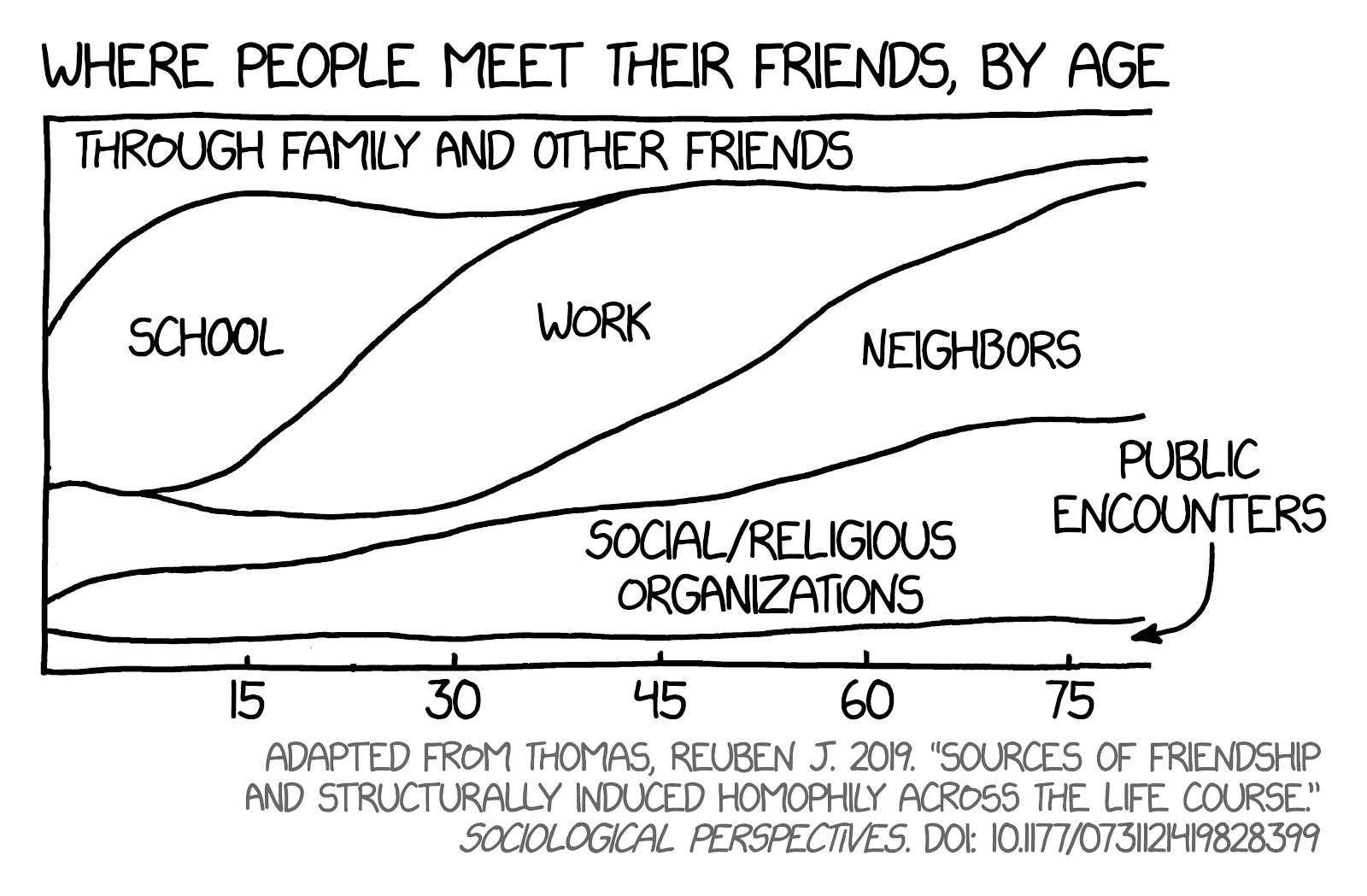
The thing that seems crazy to me is how much time alone increases with age. There are many many reasons for it, but one thing I think is especially sad is how much this is a consequence of our built environment. If you live in a village with multiple generations of a family around, it’s much easier for grandparents to be involved day too day in helping with little things in the village, especially keeping an eye on t…

This! Recently I had a discussion here on HN with a young person who wants to move into Palo Alto and finds the prices astronomical.(it was very enlightening conservation and if HN had a messaging system I would invite him to listen in here) Society blames seniors for ‘taking up spaces meant for ‘young growing families’. In CA, it’s usually their frustration over how they pay little taxes and live in big homes. The frustration is valid but misplaced. The solution is not to punitively tax them that would end up driving them out of their towns or homes and into isolated retirement communities.

I place the blame entirely on the govt that is squeezing and squeezing young working people for taxes and turning everyone against each other. Nowhere is this more obvious than in the undignified fight for land. Everything is instigated by the dissatisfaction of what do I get in return for the taxes I pay.

The govt should work for US. We are working for the govt. In California, this is gaslighting of the public at a state level. I want to shake people out of this stupor and show them that they are being abused by the politicians in Sacramento.

It starts at the public school level where children are indoctrinated to be sheep and follow the ‘leader’ because they are most vulnerable. It carries on to university level especially if the students are not in brain cell burning hard subjects or even anything that completely consumes them and suffuses them with concentration for the love of learning. They end up with too much time on their hands and go out in the world to tilt windmills.

Your last line: yes! There is an easy fix for this. Multigenerational family homes. This is high density living that is sustainable without any of the cons associated with it. And your are living with people you like. And still able to meet a variety of diverse people outside your home. Because communities that are multi generational have people of all ages. Older people have experience but not working productively. Young people can work but not as wealthy as older people. Children have nothing and have the all kinds of help from a multigenerational family..not just mothers, uncles and aunts along with grandparents but also siblings and cousins.

Having a huge compound that shares resources like water, electricity, micro grid, gardens, play spaces and shared vehicles. Home schooling is possible and most importantly childcare. Ideal family size would be 6 and can be as much 18-25 depending on how big the compound is...this is a lesser footprint.

The advantage of multigenerational families vs a large family is that the former has many people covering diff roles but in a family only the parents do every thing. There is more work distribution and allocation. Multi generational families frees women from the traditional chokehold of household duties by distributing it and they can go to work or study more because they know uncles or aunts or grandparents are around for caregiving of children.

I grew up in such a family, so I also know the downsides of it. In my generation, most families were multigenerational and like like. And I have thought long and hard about this and I think it comes down again to resources. When families are forced to be multigenerational due to necessity or tradition, it comes with its own set of issues. But if it’s a planned family with guidelines agreed upon by the family members themselves, it can function efficiently.
Re: Who Americans spend their time with, by age

#206
post #31

Earlier quoted context omitted.

The Western nuclear family is a very unnatural social arrangement. Anthropologists have found that in most hunter-gatherers, the average infant is held at one point or another by 30+ people in a typical day. The nuclear family has the twin downsides of putting tons of stress on parents of young kids, who shoulder the entire childcare burden, and deprives a lot of grandparents, aunts, cousins, and others of meaningful…

I'm not defending the nuclear family, but I don't think our primitive past says anything about what's "optimal". For example, human life expectancy is much longer now. I'd much rather be a modern person with modern technology and medicine than a hunter-gatherer. Evolution != good. It's just history, and history is often ugly.

I largely agree with you, but I don't think there's reason to believe this is the only way to live modernity. Being an industrialized nation with modern technology and medicine doesn't come as a single package with the nuclear family.

For example, I'm Mexican. Here it's quite normal to spend plenty of time with your extended family, live near them, have your parents help you take care of your kids for extended periods of time, etc. at least in my experience. We're an industrial nation and have modern medicine, but this is more a matter of culture and social attitudes I think.

Re: Who Americans spend their time with, by age

#207
post #146
post #130

Earlier quoted context omitted.

It's only meddling if you're way too stressed out by trying to keep up with capitalism. If you live a simple life without too much stress then it's not really meddling.

No it’s definitely meddling when you’re 30+ and your mom waltzes into your kitchen and says “Mmmmm are you sure that knife goes in that drawer? And when’s the last time you did the dishes anyway look at this mess”

I almost teared up when I read this. I miss my mum!!

Re: Who Americans spend their time with, by age

#208

Earlier quoted context omitted.

The very definition of suburbia prevents it from becoming elderly and walking friendly: large lots for houses with garages and multi car wide driveways, 6+ lane road crossings, parking lots spacing everything out. I can’t imagine any elderly person with mobility issues being able to cross any road with more than a 25mph speed limit, especially the main roads that are 4 to 8 lanes wide at intersections with 40mph spee…

In NZ lockdown really changed my perspective. With very little traffic the roads became the footpath and were heavily used by kids on bikes and families walking. Birds became were more numerous and it was very quiet. I’m not sure how you get to this without literally shutting down the country, but that aspect was nice.

Arguably the country was shut down by cars decades ago. You experienced it reopening, in a sense. Hate that we call it "closing the street" when we stop letting drivers terrorize people walking on them.

Re: Who Americans spend their time with, by age

#209

Earlier quoted context omitted.

My grandma sold her house and we used some of the money to convert our garage into an apartment for her so that she could live with our family. Certainly not everyone can do this but living with your parents/grandparents as they get older does seem like a reasonable “fix” to me.

It's nice that you feel this way about your parents and grandparents, but this is a nightmare scenario for me. I hope I die suddenly before I have to rely on anyone else to support me in any way, and if I'm being honest, I hope my own parents go out that way too.

There’s different levels of support. Shopping for groceries or helping your elders do laundry is different than changing their diapers and spoon feeding them.

Of course, it depends on the individual’s personalities and whether or not they can accept the compromises of living near or with each other.

I would want to commit suicide before I subject my kids or grandkids to permanently doing basic tasks like cleaning up my bodily functions or spoon feeding me, but I certainly don’t mind helping my elders with various tasks every now and then.

Re: Who Americans spend their time with, by age

#210
post #168
post #105

Earlier quoted context omitted.

Multi generational households were the norm for much of the history.

Depends where, but in western Europe for the last thousand years, probably not. I think the best data is for England, and centuries before the industrial revolution, the pattern is very strongly not multi-generational. Young couples expected to set up new households together, not to live with their parents. (The royal family & such of course were different, and still are.)

> Depends where, but in western Europe for the last thousand years, probably not.

This is definitely not true. At minimum you placed span from 1020, which means middle age, feudalism, powerty before French revolution and after, industrial revolution which meant completely overcrowded housing.

Living in multi generational household was normal, expectation to care about parents was normal. Building new house at the time of marriage where couple would live alone was not the expectation - at minimum it would be unaffordable for huge parts of population. Plus your social system was family, whether in old age or in sickness.

Post reply on HN