Live data from Hacker News

Enroute Airbus A380 wake flips Challenger business jet upside down

flightservicebureau.org

201–210 of 376 posts

Re: Enroute Airbus A380 wake flips Challenger business jet upside down

#201
post #177

Earlier quoted context omitted.

No, the effect is negligible if it wasn't planes wouldn't be able to fly upside down. It's the pitch of the wing that generates most of the lift. That's why helicopters don't alter the rotor RPM they adjust the pitch of the blades to take a larger bite.

And the pitch of the wing causes one side of the wing to be hit harder by air molecules than the other, just like GP said. Maybe you hit reply on the wrong post?

The 'air molecules impinging on the airfoil' theory of lift is not wrong, but does not account for a large fraction of the lift generated either. In a dense enough medium such as air at normal flight altitudes, you have to take into account how those air molecules interact with other air molecules and not only the airfoil. Sum up all those interactions, and you get fluid dynamics rather than a molecule hitting a surface in vacuum.
Re: Enroute Airbus A380 wake flips Challenger business jet upside down

#202
post #22

Earlier quoted context omitted.

Those wingtip and flap effects on 2 are gnarly! I assume that those occur near dewpoint? or some other atmospheric conditions?

If you recall Boyle's Law from high school physics - Temperature is proportional to pressure. Aircraft wings generate an intense area of low pressure over the top of the wing (which is what essentially generates the lift). This low pressure area is magnified when flaps and slats are deployed. On a humid day, the lowering of the pressure over the wings can basically force the air temperature at that point to lower and…

BTW the low pressure generating the lift thing is a myth. The lift is caused by the fact that the air is being deflected downward and good ol' Newton's Third Law.

Re: Enroute Airbus A380 wake flips Challenger business jet upside down

#203
post #176
post #86

Earlier quoted context omitted.

I don't know about that. I think mostly it has to do with having the power to pick and choose critical service providers, bully them, etc. If Michael Jackson and Steve Jobs had not been as wealthy and powerful as they had been, they would also both probably be alive. Neither has much to do with being risk-takers, although you might be right that a higher arousal threshold desensitized them to risk. It may also be tha…

> ... Steve Jobs had not been as wealthy and powerful as they had been, they would also both probably be alive. Steve Jobs got pancreatic cancer, IIRC. Which has a pretty low survival rate, per wikipedia 5% after 5 years from initial diagnosis. So most likely he'd be dead by now no matter what he would have done.

Not all pancreatic cancer is alike. IIRC he had a variant that would have had a ~80% chance of a favorable outcome, given he would have chosen the generally advised treatment

Re: Enroute Airbus A380 wake flips Challenger business jet upside down

#204

Earlier quoted context omitted.

Thanks for this. I read a million explanations of how airfoils worked as a boy and they all said the air had to travel faster over the top surface to catch up. Why does it have to catch up? I would scream internally. I'm stunned to find it was never true.

Probably like the Bohr model in Chemistry, it's an easy way to introduce the concept. Frankly I was under the impression it was true, too, and my dad was a small-plane pilot.

The Bohr model at least has simplicity going for it, and it's close enough to explain most things that are relevant to chemistry.

For aircraft lift, "equal transit time" is not easier to understand than "an angled wing pushes air down, because of conservation of momentum that pushes the aircraft up".

Re: Enroute Airbus A380 wake flips Challenger business jet upside down

#205

Earlier quoted context omitted.

Thanks for this. I read a million explanations of how airfoils worked as a boy and they all said the air had to travel faster over the top surface to catch up. Why does it have to catch up? I would scream internally. I'm stunned to find it was never true.

Probably like the Bohr model in Chemistry, it's an easy way to introduce the concept. Frankly I was under the impression it was true, too, and my dad was a small-plane pilot.

[deleted]

Re: Enroute Airbus A380 wake flips Challenger business jet upside down

#207
post #37

Had to google around to understand wake turbulence. If I read the wiki correctly, it's basically a horizontal tornado that emanates from the wings. That would explain the rolling that the aircraft encountered. On another note, I fly every week for work, can't imagine rolling five times and engines losing power with a drop of 10k feet. That's absolutely insane. I've had engines lose power before, but it was quickly re…

It's helpful to think of an aircraft's wake in two parts. The wing is deflecting air downward to provide lift; this creates a volume of downward-moving air behind the aircraft. There's higher pressure under the wing and lower pressure on top, so air from below tries to get above the wing at the wingtips. This causes circulatory motion, yielding wingtip vortices (see my top-level comment for some visualizations).

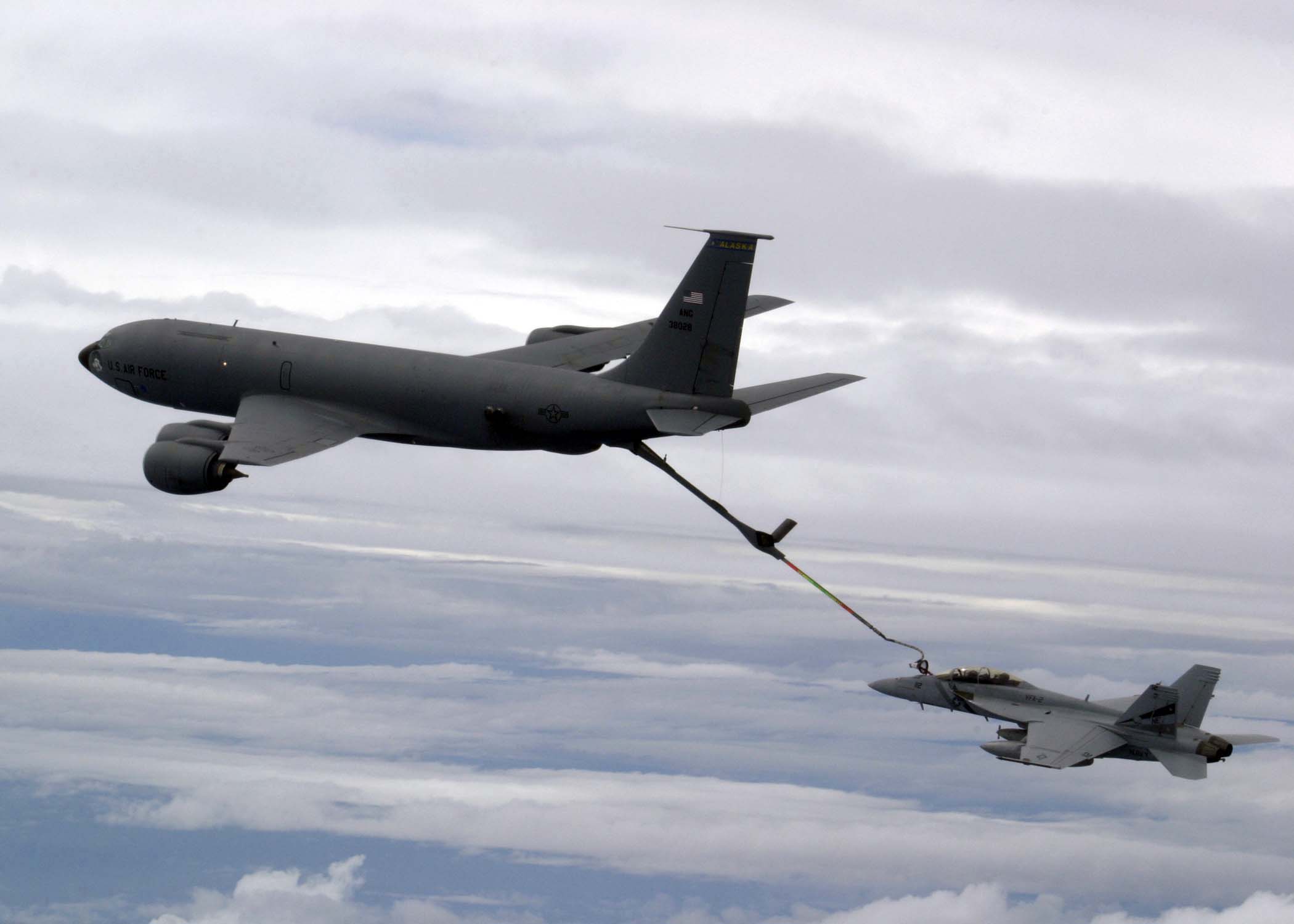
Do you happen to know how arial refueling works then ? E.g. in this image [1] the jet is flying where I would expect a lot of deflected air to be moving to ? Or is it just deflected much more steeply ?

[1]: https://upload.wikimedia.org/wikipedia/commons/d/d6/US_Navy_...

Re: Enroute Airbus A380 wake flips Challenger business jet upside down

#208

Earlier quoted context omitted.

If you recall Boyle's Law from high school physics - Temperature is proportional to pressure. Aircraft wings generate an intense area of low pressure over the top of the wing (which is what essentially generates the lift). This low pressure area is magnified when flaps and slats are deployed. On a humid day, the lowering of the pressure over the wings can basically force the air temperature at that point to lower and…

BTW the low pressure generating the lift thing is a myth. The lift is caused by the fact that the air is being deflected downward and good ol' Newton's Third Law.

The common explanation of lift for laypersons contains a number of non-sequiturs and even falsehoods, but this is not one of them. Newton's laws applied to the situation play out in complicated fluid dynamics, and result in a pressure difference over the wing, with a reduction above. That difference, summed over the wing, is the lift (and also the source of the induced drag, I believe, but that is a step beyond.)

Re: Enroute Airbus A380 wake flips Challenger business jet upside down

#209
post #207
post #37

Earlier quoted context omitted.

It's helpful to think of an aircraft's wake in two parts. The wing is deflecting air downward to provide lift; this creates a volume of downward-moving air behind the aircraft. There's higher pressure under the wing and lower pressure on top, so air from below tries to get above the wing at the wingtips. This causes circulatory motion, yielding wingtip vortices (see my top-level comment for some visualizations).

Do you happen to know how arial refueling works then ? E.g. in this image [1] the jet is flying where I would expect a lot of deflected air to be moving to ? Or is it just deflected much more steeply ? [1]: https://upload.wikimedia.org/wikipedia/commons/d/d6/US_Navy_...

From these two threads, it seems like its a combination of flying very close (avoiding wake from the wing tips) and steeply below the tanker:

https://aviation.stackexchange.com/questions/9572/how-do-air...

http://www.airliners.net/forum/viewtopic.php?t=1022271

Re: Enroute Airbus A380 wake flips Challenger business jet upside down

#210
post #54

Earlier quoted context omitted.

>There is an area of low pressure over the wing where air is taking a longer path than under the wing, but that is only responsible for a small fraction of the lift. The "equal transit time" theory that you appear to be referencing here (air over the top takes a longer path, thus it must go faster and air under the bottom takes a shorter path thus it goes slower) is a complete fallacy. There is no mechanism in physic…

Thanks for this. I read a million explanations of how airfoils worked as a boy and they all said the air had to travel faster over the top surface to catch up. Why does it have to catch up? I would scream internally. I'm stunned to find it was never true.

This [1] is one of the most comprehensive examinations of lift, written in layman terms.

You can read the HN discussion here [2], since this appeared on the front page a week ago, much to my surprise [3].

[1]1 http://ljjensen.net/Maritimt/A%20Review%20of%20Modern%20Sail...

[2] https://news.ycombinator.com/item?id=13829625

[3] https://news.ycombinator.com/item?id=13835243

Post reply on HN