I disagree, and this quote I've seen floating around the internet sort of sums the idea up to me (albeit with a music analogy): > I thought using loops was cheating, so I programmed my own using samples. I then thought using samples was cheating, so I recorded real drums. I then thought that programming it was cheating, so I learned to play drums for real. I then thought using bought drums was cheating, so I learned…
The idealized goat farmer will make a better musician than the one who simply uses others' samples. To bring the analogy back home, the programmer who understands silicon and circuits is better equipped than the one who relies on massive dependencies.
Kill Your Dependencies
201–210 of 229 posts
Re: Kill Your Dependencies
#202I disagree, and this quote I've seen floating around the internet sort of sums the idea up to me (albeit with a music analogy): > I thought using loops was cheating, so I programmed my own using samples. I then thought using samples was cheating, so I recorded real drums. I then thought that programming it was cheating, so I learned to play drums for real. I then thought using bought drums was cheating, so I learned…
Things are different if we’re talking live performance. You’d be fine with that multi-terabyte cello library on stage, but not if sampling plugin brought opaque nth-party dependencies you can’t vouch for and have no time to properly wrap your head around. You don’t want surprises and you want to know for sure there’s enough performance leeway on your concert laptop.
There are steps you’d take to reduce the error margin while you perform that have no parallels in software engineering realm. Maybe you’d bounce your cello loops to audio to never have that computation happening in real time. Maybe you’d bring analog synths, which are bulky and pricey but also simpler conceptually, self-sufficient, well-tested and never give blue screen of death.
Your song is essentially being created every moment your program is running or being developed. You’re putting even more trust in what you’re pulling—the black box abstraction boundaries around your dependencies can contract, the input you receive from audience is more direct, and importantly there’s no you actually playing instruments and directing the performance because the whole behavior is defined by algorithms that often end up partly delegated to dependencies.
Re: Kill Your Dependencies
#203To me, this seems more like an argument for optimizing beyond your own stack. Don't kill your own dependencies. Your app uses to much memory? Improve a dependency, you have now improved other peoples apps, too. Your app uses to much dependencies in total? Try to get all your first-level dependencies to standardize on the best http-client. (Which he is partially doing with his post.) Dependencies may have problems, bu…
Dependencies are great for the reasons you specified, and I saw nothing in that article suggesting otherwise. The part that feels the worst to read is:
> Can I implement the required minimal functionality myself? Own it.
This is largely a judgement call; "can I" and "minimal functionality" are subject to change based on many external circumstances. "Own it" also seems to imply owning it not as a dependency, based on the context, but rather as a part of a monolithic whole.
It is also interesting that the sidekiq product makes use of gem dependencies. At top level 5 without platform dependencies, which (mostly due to rails) expands out to many more. The message should not be to "kill your dependencies", because that mindset is outdated and slow.
So tired of hearing about how bad dependencies or scripting languages are. Would be much more excited to hear about how to contribute to open source dependencies, and how to write efficient scripts.
Re: Kill Your Dependencies
#204It itself does not have any dependencies that aren't in core:
http://deps.cpantesters.org/?module=Try%3A%3ATiny;perl=lates...
Re: Kill Your Dependencies
#205Re: Kill Your Dependencies
#206There is a counter example of his reasoning in the Python world. There is a HTTP client library "urllib" in the standard library, but nowadays everyone rather pulls in the external dependency "requests" because the urllib API is terrible. It is mature, well tested, good documented code though.
Re: Kill Your Dependencies
#207Earlier quoted context omitted.
The downside is that you bring in another layer of indirection and, as a result, greater cognitive load for yourself. Mycode -> facade -> library Navigating code becomes more cumbersome and stack traces longer. I do like this approach too but it isn't free.
Hah I stopped worrying about stack trace length when I started writing Scala ;) Usually only 1 or 2 lines of the trace matter, you learn to skip the rest pretty fast.
https://dzone.com/articles/spring-vs-java-ee-the-real-story-...
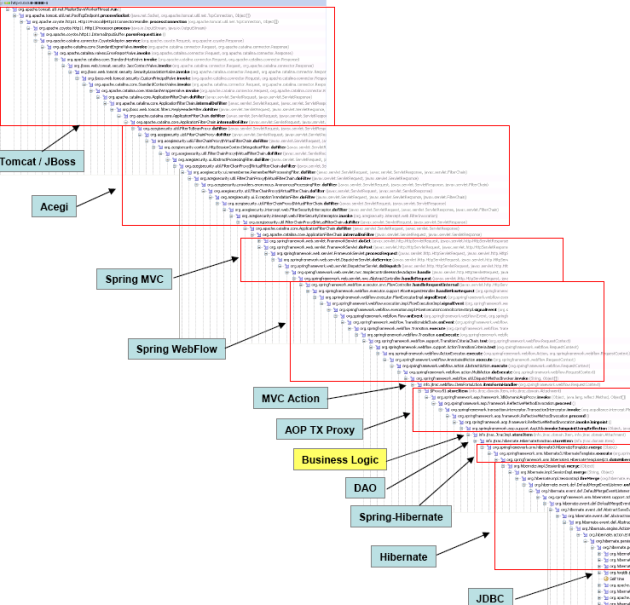
An even more breathtaking stack trace image can be found here:
https://ptrthomas.files.wordpress.com/2006/06/jtrac-callstac...
And the PDF version:
https://ptrthomas.files.wordpress.com/2006/06/jtrac-callstac...
Re: Kill Your Dependencies
#208Earlier quoted context omitted.
This is pretty much what Rob Pike advocates in Go: "A little copying is better than a little dependency." http://go-proverbs.github.io/
Nice list. He clearly doesn't like reflection: > Clear is better than clever. > Reflection is never clear. Of course, everything has its place, even reflection.
Re: Kill Your Dependencies
#209I'm not 100% sure I agree with this as stated. Sure if the functionality is in core lib, use it but... it depends... Consider these three statements: - No code runs faster than no code. - No code has fewer bugs than no code. - No code is easier to understand than no code. For a language like scala where there is no json processing in the standard lib, if there is a json library that is battle tested, then by removing…
> ... I've removed a whole bunch of code from my own library You removed a bunch of code you understood, and added a bunch more code you don't understand, along with whatever technical debt, edge cases, and performance issues which are lingering in that library. Adding a library is never removing code from your project, it's adding code you don't yet understand to your project. It can still be a net win, but it's not…
> You removed a bunch of code you understood, and added a bunch more code you don't understand, along with whatever technical debt, edge cases, and performance issues which are lingering in that library.
Not all code you've written is good code. Hell, not all code you've written you actually understand. Libraries and dependencies make sense in many cases. Don't write yet another JSON parsing library unless you really need to.
> Adding a library is never removing code from your project, it's adding code you don't yet understand to your project. It can still be a net win, but it's not less code for you to maintain.
It's referencing code that you don't maintain. If the maintainer is bad, use a different library.
Re: Kill Your Dependencies
#210Earlier quoted context omitted.
There's an important kind of compromise that isn't discussed as often: using an external library but behind an interface of your own design, an "anti corruption layer". If the external dependency is limited to one small bridge in your application, then it's so much easier to see what parts of the dependency you actually depend on, to upgrade the dependency when its API inevitably changes, to replace it entirely if it…
The downside is that you bring in another layer of indirection and, as a result, greater cognitive load for yourself. Mycode -> facade -> library Navigating code becomes more cumbersome and stack traces longer. I do like this approach too but it isn't free.
At one time there was a lot of zombie processes lingering for a long-ish time until the parent terminated and the zombies were reaped by init. I didn't bother to look at the implementation for xpopen, as I assumed it was just a call to popen. Turned out it wasnt; it was fork/exec with a socketpair turned into a FILE* with fdopen. The child was not waited for in xpclose.
I think there can be times when the facade pattern makes sense. I think there can be times when importing the world makes sense. I think there can be times when the opposite is true too. I think talking about these things in an abstract way can miss the point of the very insanity in some concrete solutions out there.