Live data from Hacker News

Student Solves Sol Lewitt Drawing Assignment in Pseudocode

cmuems.com

21–28 of 28 posts

Re: Student Solves Sol Lewitt Drawing Assignment in Pseudocode

#21
post #9

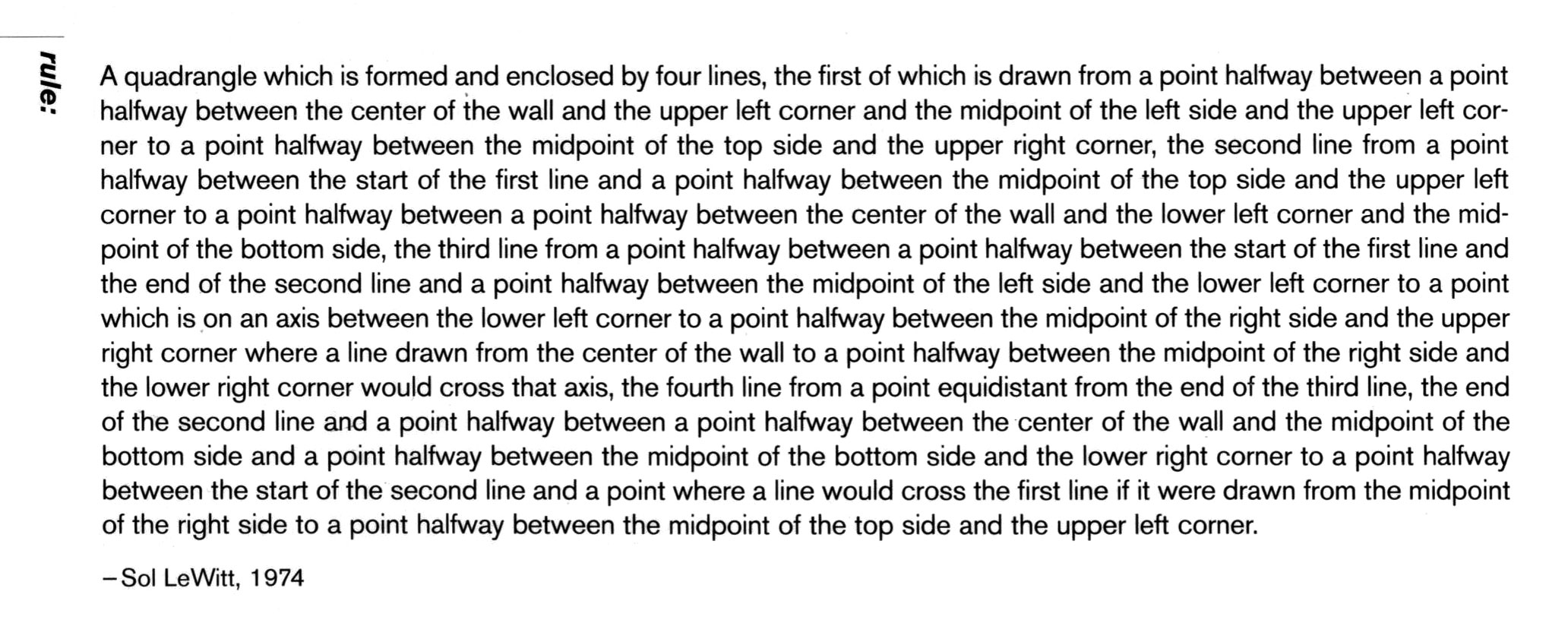
I ran OCR over the text (using the first website I could find that takes image urls directly), so you don't have to. A quadrangle which is formed and enclosed by four lines, the first of which is drawn from a point halfway between a point halfway between the center of the wall and the upper left corner and the midpoint of the left side and the upper left cor- ner to a point halfway between the midpoint of the top sid…

more readable image: http://cmuems.com/2012/a/files/2012/08/lewitt-instructions.j...

Re: Student Solves Sol Lewitt Drawing Assignment in Pseudocode

#22

He's really quite shameless and condescending about singling her out for praise and elevating her above all of the other students: > Melanie Nailed It > (diagrams showing wrong answers of other students) > (diagram labeled with "Lewitt" and "Melanie") > If I were Pace Gallery, I know whom I would hire. > each of the corners of Lewitt’s quadrilateral was reliably located by about a quarter of the students > marvelous…

What pedagogical purpose does this serve? I'm a fan of tough love from teachers. I'd rather get a low grade and learn a great deal than a high grade and learn nothing. For some instructors, part of that is being willing to say the equivalent of "this is complete shit" when your work is, in fact good, but not up to standards.

But the best ones do it in private, or in written feedback, or generally to everyone as a motivational tactic. All of that I'm willing to tolerate, and I've seen some (not many) user acerbic brutal feedback to achieve results out of me I'd never find possible.

But never have I seen a teacher signal out particular students, compare their work openly, while holding up other particular students as examples of what not to do.

Is that good or bad? The principle of rewarding individual excellence is good, and the attitude could even be forgiven in certain circumstances.

But there's a way to do that without being a dick. And if you're going to be a dick, you better b the extremely rare person that knows how to be a dick properly and effectively, usually with an undercurrent of good humor and in the pursuit of ultra-high standards.
Re: Student Solves Sol Lewitt Drawing Assignment in Pseudocode

#23
post #22

He's really quite shameless and condescending about singling her out for praise and elevating her above all of the other students: > Melanie Nailed It > (diagrams showing wrong answers of other students) > (diagram labeled with "Lewitt" and "Melanie") > If I were Pace Gallery, I know whom I would hire. > each of the corners of Lewitt’s quadrilateral was reliably located by about a quarter of the students > marvelous…

What pedagogical purpose does this serve? I'm a fan of tough love from teachers. I'd rather get a low grade and learn a great deal than a high grade and learn nothing. For some instructors, part of that is being willing to say the equivalent of "this is complete shit" when your work is, in fact good, but not up to standards. But the best ones do it in private, or in written feedback, or generally to everyone as a mot…

Keep in mind: This class is part of a conservatory-style BFA program. These students are already, or will soon be, custom to public critiques. And learning how to accept public criticism, positive and negative, is explicitly a goal of many such programs.

My two cents: While I would have hated such a thing in an engineering class, I really appreciated public discussion and criticism of my work in the arts. I found that such transparency, even when painful, was hugely valuable to me as I grew as an artist.

Re: Student Solves Sol Lewitt Drawing Assignment in Pseudocode

#24
post #22

Earlier quoted context omitted.

What pedagogical purpose does this serve? I'm a fan of tough love from teachers. I'd rather get a low grade and learn a great deal than a high grade and learn nothing. For some instructors, part of that is being willing to say the equivalent of "this is complete shit" when your work is, in fact good, but not up to standards. But the best ones do it in private, or in written feedback, or generally to everyone as a mot…

Keep in mind: This class is part of a conservatory-style BFA program. These students are already, or will soon be, custom to public critiques. And learning how to accept public criticism, positive and negative, is explicitly a goal of many such programs. My two cents: While I would have hated such a thing in an engineering class, I really appreciated public discussion and criticism of my work in the arts. I found tha…

Yes, that's a good point. I've certainly never examined the problem through the lens of a BFA conservatory-style program. If a necessary part of the skill-set a student wishes to learn is the ability to accept and process public criticism, it certainly makes sense to emulate that in the classroom.

Re: Student Solves Sol Lewitt Drawing Assignment in Pseudocode

#26
post #25

Could someone who understands art elaborate on why both the original work and this are important?

The classic description of this kind of thing is "the idea becomes a machine that makes the art", which is what Sol Levitt said about his work. It's a conceptual art strategy: instead of being about subjectivity, skill or the personal will of the artist, this kind of artwork is about rationality, objectivity and a neutral, abstract kind of mental process. Nothing particularly special about the pseudocode but it comes from Golan Levin's class: he is a a leading algorithmic artist (using code to make visual art). Lewitt's work could be seen as a forerunner or incunabulum in this field. http://www.moma.org/learn/moma_learning/themes/conceptual-ar...

Re: Student Solves Sol Lewitt Drawing Assignment in Pseudocode

#27
Here's an Irony Grammar [1] that can parse the proposed problem if the missing "a point halfway between" is added. And a screenshot of the Grammar Explorer [2] for the lazy ones.

It was fun to write :).

[1] https://gist.github.com/guillaume86/6423775

[2] https://dl.dropboxusercontent.com/u/177896/SolLewitt.PNG

Re: Student Solves Sol Lewitt Drawing Assignment in Pseudocode

#28
post #16

Earlier quoted context omitted.

The first line is given in the text as: "... first of which is drawn from a point halfway between a point halfway between the center of the wall and the upper left corner and the midpoint of the left side and the upper left corner to a point halfway between the midpoint of the top side and the upper right corner". Given that the line has a FROM and TO point, we can extract those: FROM a point halfway between a point…

I came to the same conclusion. Now I'm expecting someone to make a parser/interpreter and a Sol Lewitt image encoding format using the genetic algorythm that turn images into semi transparent polygons :).

Well I was a bit borred today, I made the Parser/Interpreter part, I can turn the instructions to a SVG document:

https://github.com/guillaume86/SolLewitt

Post reply on HN