Live data from Hacker News

The Raising of Chicago

en.wikipedia.org

21–30 of 76 posts

Re: The Raising of Chicago

#21
post #5

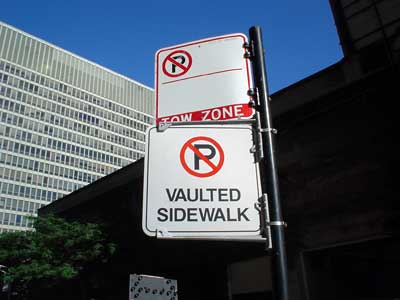
Living here in Chicago it's neat to see the vestiges of this still around - like 'vaulted sidewalks', where the current sidewalk sits over 5 feet of air, and then the old sidewalk is down below: http://gapersblock.com/airbags/archives/city_streets_how_chi...

Pictures or it isn't true!

These are the signs by my wife's office - it's really hard to visualize but at points in the sidewalk there are grates that you can see through down to the old sidewalk below

http://fuzzyco.com/news/archives/uploaded/2005-08-15/vaulted...
Re: The Raising of Chicago

#23
post #9

This is totally fascinating, but I'm still not sure I get the infrastructural context. Were traditional storm sewers impractical for Chicago at the time specifically because of the city's elevation?

Yep. You need a slope to get water to flow. The city is effectively at lake level. Having a storm sewer doesn't do you much good if the water can't go anywhere.

The city _was_ effectively at lake level. Between the raising of Chicago, the Chicago fire (which made sufficient debris to create Grant Park) and additional raising of the street grade, some buildings "ground floors" are three stories above the ground.

Re: The Raising of Chicago

#24

North American cities used to be enormously ambitious (see also, for example, Boston's Back Bay). Contrast the fear, trepidation and status-quo obstructionism that characterizes municipal affairs today.

My impression is that project overages have scared cities quite a bit. To use your Boston example, the Big Dig certainly has scared many other municipalities thinking of something like that. The Denver Airport fiasco most certainly scared away people from building new airports for decades.

Moving into speculation... I believe that society values lives a lot more. It would be very hard to cost effectively build another Golden Gate Bridge due to the lives involved. Is this really a bad thing? So instead we build skyscrapers.

Re: The Raising of Chicago

#25

I took a tour of Seattle, and the guides discussed Seattle going through a similar transition. Essentially the whole city was raised by one story. But the roads were done first, creating a sort of "waffle-like" city, where crossing the street as a pedestrian meant climbing a ladder, crossing the street, and descending the ladder on the other side. People were sometimes injured or killed by falling down the ladder, so…

See also: http://en.wikipedia.org/wiki/Regrading_in_Seattle

Re: The Raising of Chicago

#26

North American cities used to be enormously ambitious (see also, for example, Boston's Back Bay). Contrast the fear, trepidation and status-quo obstructionism that characterizes municipal affairs today.

Here's a gif of the land reclaimed by Boston over time:

http://wp.streetwise.co/wp-content/uploads/2011/06/filling_i...

Can you imagine anything of this scale happening today?

Re: The Raising of Chicago

#28

Earlier quoted context omitted.

You can take a cynical view of it if you want to, but you also have to remember the economic aspects in play. At the time the US was experiencing unprecedented growth. There was abundant amount of capital to throw around. That just isn't the case today. Contrast that to Southern China. Lots of insanely ambitious city projects, driven once again by tons of growth.

There's even more capital these days, it's just locked in securities and traded on exchanges instead of directly invested in enterprises.

It's common knowledge in the financial world that returns are expected to be very low in the near future. With that and the recession both financiers and economists (real economists, not random op-ed writers) are aware that the market and macro situation for government projects is ideal.

But it so happens that government projects today are very often financial disasters, particularly when backed by bonds or tax increases. There's no law of the market that says this should happen either, but it seems to be a feature of ossified political systems.

Re: The Raising of Chicago

#29

Earlier quoted context omitted.

You can take a cynical view of it if you want to, but you also have to remember the economic aspects in play. At the time the US was experiencing unprecedented growth. There was abundant amount of capital to throw around. That just isn't the case today. Contrast that to Southern China. Lots of insanely ambitious city projects, driven once again by tons of growth.

There's even more capital these days, it's just locked in securities and traded on exchanges instead of directly invested in enterprises.

Interesting to note, many economists in no small measure blame the recent financial crisis on the global cpital glut chasing returns. If you create an innovative instruments for financial capital to support physical capital (in this case US housing stock) you too can create a bubble.
Post reply on HN