Live data from Hacker News

The Anti-Mac User Interface (1996)

nngroup.com

21–25 of 25 posts

Re: The Anti-Mac User Interface (1996)

#21

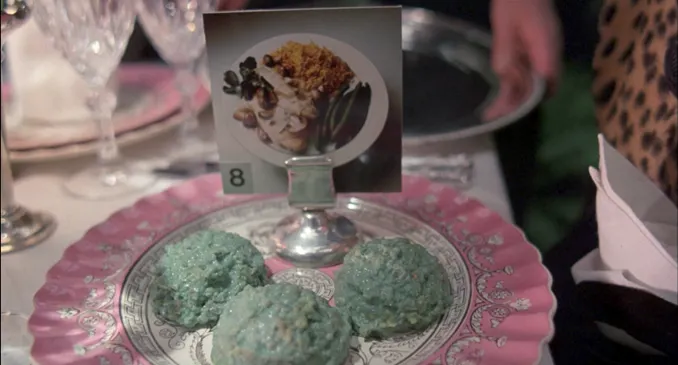
"If we want to order food in a country where we don't know the language at all, we're forced to go into the kitchen and use a see-and-point interface. With a little understanding of the language, we can point at menus to select our dinner from the dining room. But language allows us to discuss exactly what we would like to eat with the waiter or chef." Ironically, Japanese menus almost universally have pictures of th…

Terry Gillam's take...

https://miro.medium.com/v2/resize:fit:720/format:webp/1*NFPp...
Re: The Anti-Mac User Interface (1996)

#22

"If we want to order food in a country where we don't know the language at all, we're forced to go into the kitchen and use a see-and-point interface. With a little understanding of the language, we can point at menus to select our dinner from the dining room. But language allows us to discuss exactly what we would like to eat with the waiter or chef." Ironically, Japanese menus almost universally have pictures of th…

> Ironically, Japanese menus almost universally have pictures of the food

For restaurants frequented by foreign tourists, yes. But for most ordinary restaurants, probably not. Handwritten menus with no pictures at all are still very common in Japan.

I work in food tech in Japan.

Re: The Anti-Mac User Interface (1996)

#23

The description of interacting with a computer through language seems oddly prescient of LLMs.

This was always the holy grail, we just were never able to achieve this practically.

For example see the early Zork style games, or declarative style languages like SQL. It turns out that it's very tricky to get computers to "understand" language like humans do, and approximating it with pre-defined grammar and vocabulary is not enough.

Re: The Anti-Mac User Interface (1996)

#24

I got to use a real Magic Cap, one of the examples of alternative metaphors, in the article, a black and white view of a room with a desk full of old office oddities. It was the worst user interface that may have ever been designed, like an Alice In Wonderland nightmare. Click an envelope on a desk or a clock, and it starts some other metaphor like an image of a spreadsheet in a dialog, or something, which might appe…

I own a Sony Magic Link and you are 100% correct. The UI is the worst sort of point-n-click adventure game memes. Not only do you have to guess what visual elements actually do something you need to figure out what functionality they represent. The spacial metaphor is insipid because it takes a lot of taps to get from one "room" to another. None of this is helped by how slow the Magic Link is. Supposedly the DataRove…

The thing with General Magic is they were Mac team members without a lot of imagination. They thought the next GUI environment had to encompass the real world as the connected world. The problem statement is solid. Unfortunately they looked at the MAC’s desktop metaphor and decided the next logical step was to add legs to the metaphor and bridge the gap to the real world.

I have a Sony Magic Linknthat doesn’t boot.

Re: The Anti-Mac User Interface (1996)

#25
post #13

Earlier quoted context omitted.

Skeuomorphism was an interesting idea but should have been basically just that -- a design inspiration, not a full fledged embrace of extending old school ways of things. The folder metaphor for the Mac desktop was reasonable, but it effectively stopped there (as it should), rather than try to embed filing cabinets and document archives into pretty pictures to click and point as if it were a game to be played once ra…

People don't seem to remember, but the finder used to be spatial. You'd open a folder, and a new window would pop up atop your old one. We can still do this, but thankfully the ui paradigm seems to have advanced to the point that it assumes users don't need to see a stack of every directory they opened. And if they do, Miller columns are superior anyway

i wish miller columns were more popular. i did a search for linux. there are a few minor in development or abandoned file managers that have them. dolphin dropped them in 2012 because they were not used enough and to much work to maintain for the devs at the time. nautilus discussed and rejected them. interestingly i found a recent inofficial patch for nautilus, and dolphin is officially working on bringing them back. that's maybe even going to get me involved to test once i figure out how to build dolphin from source.
Post reply on HN