Earlier quoted context omitted.
Just a thought... would it make sense to maintain a govt/central registry of copyright owners, and have an "official" means of contacting them, on which they have an SLA to respond (say 3 months) which might be part of the ground rules for maintaining rights. From a macro societal perspective, would this evolve "copyright" into a more balanced (value generating) deal for all of society?
The whole basis of licensing law is everything is forbidden unless you have a written license permitting it from the copyright owner. This is contrary to most (all?) other parts of the law where everything is allowed that isn't forbidden. So it's the right of authors to ignore email requests to discuss a re-publication if they so wish.
The code and open-source tools I used to produce a science fiction anthology
21–30 of 50 posts
Re: The code and open-source tools I used to produce a science fiction anthology
#22It's quite an achievement. I was once interested in publishing a SF anthology. Formatting and editing was nbd -- I was going to use Amazon's KDP software package for most of it, which can take a .docx and output an ebook in 5 minutes. I've done it before for non-anthology books I've published, and it couldn't be easier, though I understand why people might avoid Amazon in this day and age. The real trouble was gettin…
Just a thought... would it make sense to maintain a govt/central registry of copyright owners, and have an "official" means of contacting them, on which they have an SLA to respond (say 3 months) which might be part of the ground rules for maintaining rights. From a macro societal perspective, would this evolve "copyright" into a more balanced (value generating) deal for all of society?
What would work is an orphan works exemption, whereby if a work is not available and its not possible to trace the copyright holders you could use it.
The other problem is the term of copyright is far too long. it is ridiculous that something written during the reign of Queen Victoria could remain in copyright into the 21st century in the UK and EU. US law is slightly saner (in avoiding bringing out of copyright works back into copyright) but not much.
Re: The code and open-source tools I used to produce a science fiction anthology
#23Earlier quoted context omitted.
The whole basis of licensing law is everything is forbidden unless you have a written license permitting it from the copyright owner. This is contrary to most (all?) other parts of the law where everything is allowed that isn't forbidden. So it's the right of authors to ignore email requests to discuss a re-publication if they so wish.
It is, but I think what the comment you're replying to is saying is that the world might be better if things didn't work that way.
Re: The code and open-source tools I used to produce a science fiction anthology
#24Re: The code and open-source tools I used to produce a science fiction anthology
#25I did this 10 or so years ago when I taught an ebook course to elementary students. We learned about ebooks, HTML, and they each write a short story, which was included in an ebook (and a physical book). Pretty amazing the tools we have access to. Of course, now I would use typst instead of latex for the physical book part.
There is also a wide choice of output formats.
Re: The code and open-source tools I used to produce a science fiction anthology
#26Earlier quoted context omitted.
Thanks for your support! I believe I understand where you're coming from, some of the stories have more novel concepts than others -- Twenty-Four Hours is hard to discuss without spoilers, but I selected it because the characters and setting felt very real, while at the same time it would completely fall apart without the technological concept. As I wrote in that blog you linked, I tried to interleave the stories so…
Thanks for sharing some of the methodology and code for how you put your book together. Are you comfortable speaking about the financial side? What does an editor get per copy sold, what does an author get? (In the science world, for instance, editors tend to get money often, but authors never get paid for articles or book chapters.) Hopefully, now that you have experience in the process and all your code ready, you…
The only addendum to that answer is that after being featured on HN last week I'm now over halfway toward break-even.
Re: The code and open-source tools I used to produce a science fiction anthology
#27If I could give you one tip it would be this one: make sure that your current production contains enough contact information and appeal to other authors to help you bootstrap the next iteration. That first one is the hardest, and any aspiring writers that have good stories sitting unpublished (of which there are very many) is always on the lookout for new places to get their stories published. This is how almost ever…
This anthology is actually a "Year's Best" -- they're reprints selected from a pool of 391 stories printed in the big science fiction magazines last year. So I'm not opening for submissions, or anything like that (I have done that before, back when I published a magazine). For this anthology I reached out to the authors about the best concept-driven stories I read last year, and fortunately they all agreed to let me publish their stories.
Re: The code and open-source tools I used to produce a science fiction anthology
#28I’m surprised handling meta data in several yaml files is easier than one excel workbook, but each to their own I guess.
Re: The code and open-source tools I used to produce a science fiction anthology
#29Earlier quoted context omitted.
Have a preferred typst template for ebooks?
Typst is so stupidly easy to use. It took me an hour to go from zero Typst knowledge to reproducing my résumé perfectly. The docs are easy to read and there’s a guide for making templates. I feel like if you’ve written CSS and are familiar with associating some kind of selector with some properties, then you’ll be able to pick up Typst and make whatever template you want in no time.
It served its purpose, but typst is so much better.
Re: The code and open-source tools I used to produce a science fiction anthology
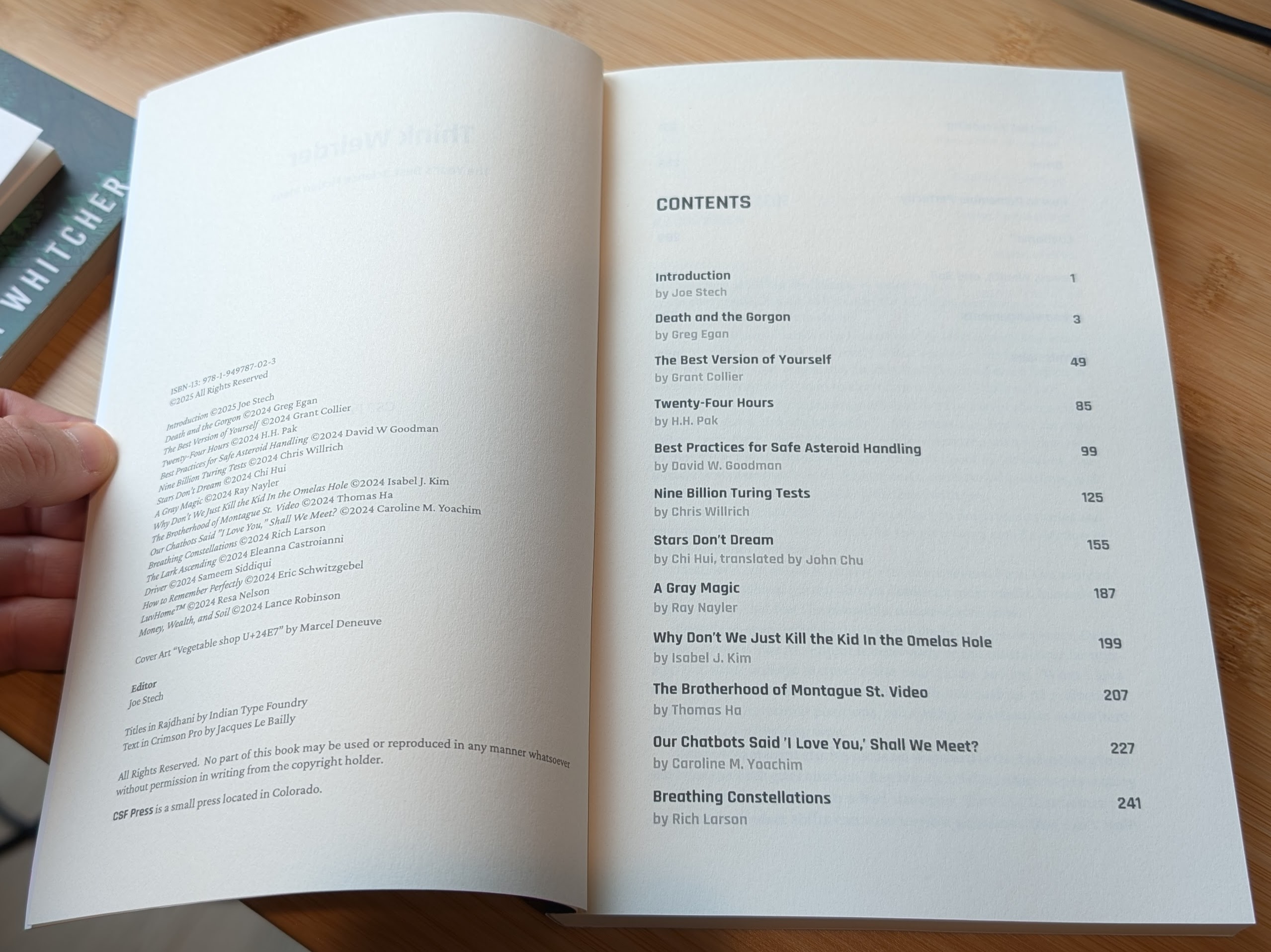
#30I’d love to see a few pictures of the resulting layout. I’m surprised handling meta data in several yaml files is easier than one excel workbook, but each to their own I guess.
I'm sure an excel pro would find excel much easier, I just like writing Python more than excel macros!