> Gateway to the Galaxy by Yujie Zhang
Are the "geometric buildings" real or just something she put up for the picture?
21–30 of 43 posts
Are the "geometric buildings" real or just something she put up for the picture?
> Gateway to the Galaxy by Yujie Zhang Are the "geometric buildings" real or just something she put up for the picture?
https://subsites.chinadaily.com.cn/ezhejiang/lishui/2025-01/...
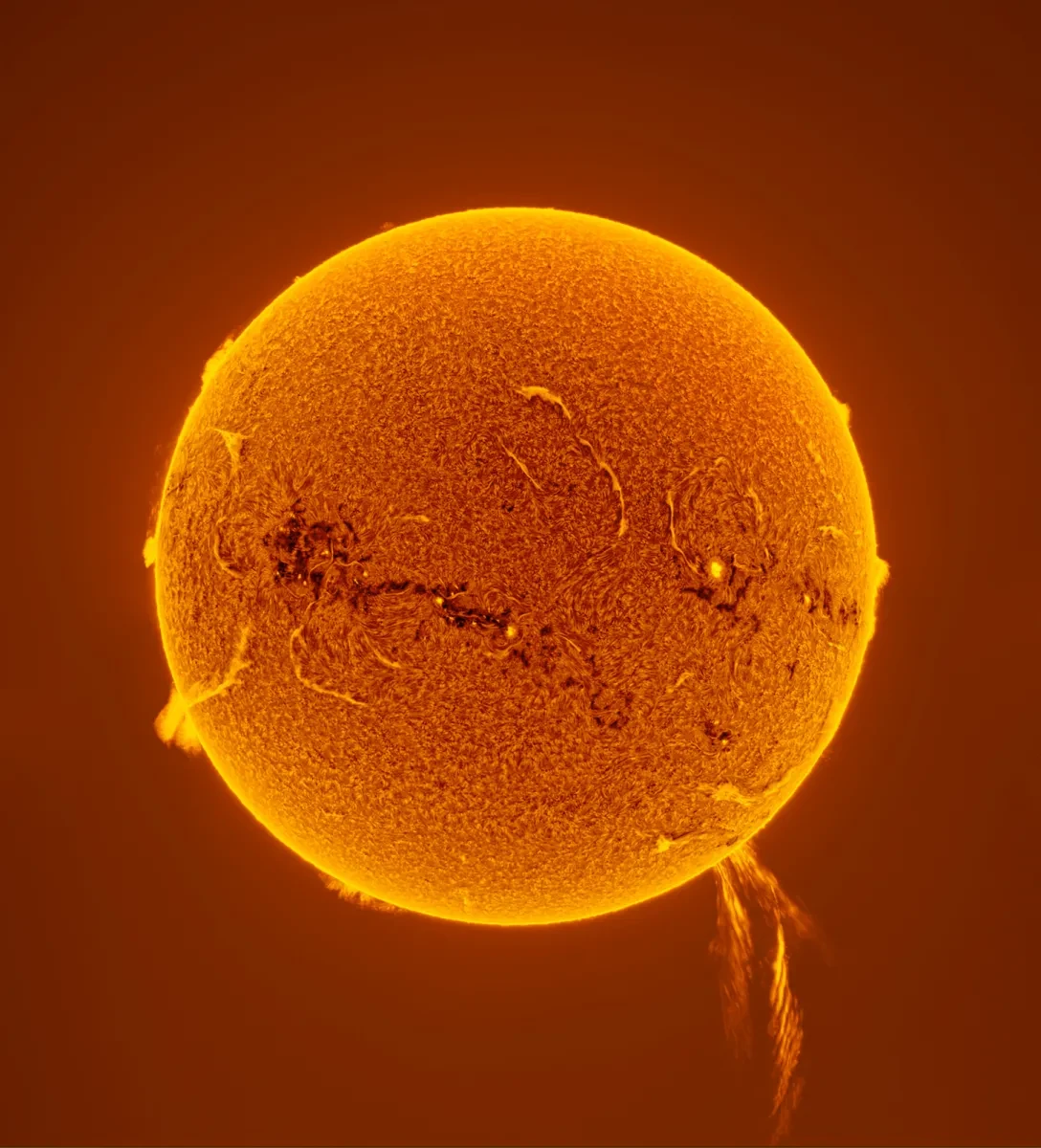
How did they do solar eruption? Must be some filters as Sun doesn't look like this to naked eye. I mean this image:
https://www.rmg.co.uk/sites/default/files/styles/large/publi...
Nice images. I personally prefer more of Space and less of Earth in astro. How did they do solar eruption? Must be some filters as Sun doesn't look like this to naked eye. I mean this image: https://www.rmg.co.uk/sites/default/files/styles/large/publi...
> Into the Past by Jim Hildreth The area in this photo -- the Caineville Mesa, Factory Butte, "Long Dong Silver" (I'm not aware of a more polite name) -- is some of the strangest land in America. It really is that lunar blue gray. The Temples of the Sun and Moon (enormous natural sandcastles) are also nearby, and are similarly eerie in the evening. The closest I've ever felt to being in space. Recommend!
Agree. Found his site, but that shot’s not listed: https://www.hildreth-photographer.com/portfolio.html?folio=F...
Factory Butte: https://www.instagram.com/tripodtales/p/C6gg-wpS-tr/
"Long Dong Silver": https://www.instagram.com/tripodtales/p/C-yLCskOGiC/
I can't look at this without asking myself "how many of these are completely generated"? Thanks for destroying trust, AI researchers and companies. On top of everything else.
Even if they are real, does it really matter when the camera is doing superhuman work with things like a 27 km zoomed in picture of a building or composite of 300 separate exposures. If you get to combine exposures, why not just expose a moon separately from a building and combine them in the computer?
Norwegian here. Not a young one. Ive seen my share of the northern lights and Ive also seen a lot of photos of it. The photos are attractive, but they are never like seen by the photographer with the naked eye. I blame that dark/night photography is an impossible task. The tricks like long exposure, ISO boost and noise cleanup, saturation, hdr or whatever you throw at it, just wont be like your eyes. Photographers ge…
I'm all for managing people's expectations, but I'm just not agreeing with your conclusion. Human vision is only capable of registering such a small piece of the spectrum that is there. Just because human eyeballs cannot perceive the information does not mean it is not there. This is true of pretty much any astronomy photographs, and that is why people do it. When you look at the milky way, you don't see all of the c…
Think someone who only ever saw waterfalls in long-time exposure shots, these frozen, milky streams that look nothing like actual water, while still being pretty to look at. Would you say that person has an understanding of what a waterfall actually looks like? No. But do they see something that is there, but others wouldn’t be able to sense in reality? Also no, as long as we use a subjective experience of time as the baseline.