The drawings are really good. Any idea what tool is used to make them? I emailed the author but have not heard back.
How does a screen work?
21–30 of 111 posts
Re: How does a screen work?
#22CRTs are still slightly magical to me. The image doesn't really exist. It's an illusion. If your eyes operated at electronic speeds, you would see a single incredibly bright dot-point drawing the raster pattern over and over. This YouTube video by "The Slow Mo Guys" shows this in action: https://youtu.be/3BJU2drrtCM?t=190
To me the magical part about CRTs is color. I don't quite understand how the shadow mask works. Like, yeah, there are three guns, one for each color channel, and the openings in the mask match their layout, and somehow the beam coming out of each gun can only ever hit its corresponding phosphor dots. Even after being deflected. But... how? Also, wouldn't the deflection coils affect each of the three beams slightly di…
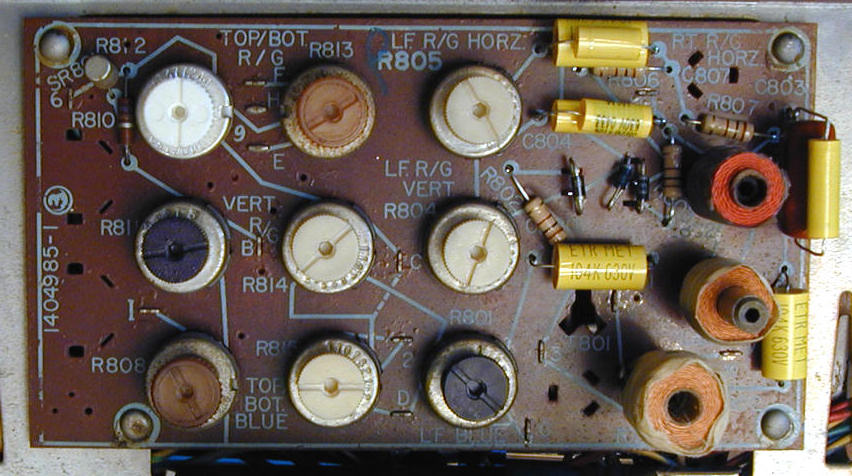
Each hole in the shadow mask acts as a pinhole camera, giving an inverted image (in electrons) of the three guns. All three beams get bent nearly the same amount, but yes there is some distortion which is traditionally corrected for by a set of convergence coils and corresponding circuit with knobs for static and dynamic convergence [0]. A pain to adjust, BTW.
[0] https://antiqueradio.org/art/RCACTC-11ConvergBoardNewRC.jpg
Re: How does a screen work?
#23The drawings are really good. Any idea what tool is used to make them? I emailed the author but have not heard back.
From the FAQ on the main page:
> How do you make the illustrations?
> By hand, in Figma. There's no secret - it's as complicated as it look
Re: How does a screen work?
#24LCD on paper you see lots of drawbacks, in practice modern state of the art LCD for TV is pretty damn good. We will soon have RGB LED Backlight LCD with WHVA+ Panel that is about as wide angle as IPS, 95%+ REC 2020 colour, and 1-2ms response time. Phosphorescent blue OLEDs should reduce current OLED display energy usage by 20-30%. But it still seems to be way off for phones and mass usage.
I think it's fairly common for technologies to get really good just as they're becoming obsolete. Vacuum tubes, CRTs, optical disks, photographic film... in fact, they're often in some respects better than the early generations of the technology that replaces them.
But OLEDs just have too many advantages where it actually matters. Much lower power consumption, physically more compact (no need for backlight layers), etc.
Re: How does a screen work?
#25Not only was the initial diagram all/explaining, but the "pop"-"pip" on zoom-unzoom of the image was just as nice as playing with a sheet of bubble wrap. Wow, and that ruler on the right side, even with the sound. One of the nicest pages I have been on. And the landing page... https://www.makingsoftware.com/ It just keeps on giving.
This appears to be a lovely project. I wish the author all possible luck and success. I haven't joined a mailing list in a very long time, but I sure did in this case.
Re: How does a screen work?
#26CRTs are still slightly magical to me. The image doesn't really exist. It's an illusion. If your eyes operated at electronic speeds, you would see a single incredibly bright dot-point drawing the raster pattern over and over. This YouTube video by "The Slow Mo Guys" shows this in action: https://youtu.be/3BJU2drrtCM?t=190
To me the magical part about CRTs is color. I don't quite understand how the shadow mask works. Like, yeah, there are three guns, one for each color channel, and the openings in the mask match their layout, and somehow the beam coming out of each gun can only ever hit its corresponding phosphor dots. Even after being deflected. But... how? Also, wouldn't the deflection coils affect each of the three beams slightly di…
It's parallax, basically. The pigment dots and mask holes are positioned such that when you look from the perspective of the "red" electron gun (*), you only see red pigment dots. Move a couple cm to the "blue" gun and the parallax shift now makes you to see only blue pigment dots instead. Or from the other direction, no matter which "red" dot you stand at, you only see the "red" gun through "your" hole.
The exact sizes, shapes, and positions of the pigment dot triples (and/or the mask holes) are presumably chosen so that this holds even away from the main axis. Also, the shape of the deflecting field is probably tuned to keep the rays as well-focused as possible. Similarly to how photographic lenses are carefully designed to minimize aberrations and softness even far from the optical axis.
(*) Simplifying a bit by assuming that the beam gets deflected immediately as it leaves the gun, which is of course inaccurate.
Re: How does a screen work?
#27what a beautiful project. cant wait for this to be completed
Re: How does a screen work?
#28Earlier quoted context omitted.
One random example is that your eyes are extremely sensitive to the tiniest defect or variation. So making a large display that looks good and is uniform is very challenging. Not to mention scaling up all the various processes like the photolithography and working with very large and thin glass panels. It's all engineering but it's surprisingly hard to move things from the lab to manufacturing at scale. Years and yea…
You are moving the goal posts from it being a consumer product to requiring it to be large, good, and uniform. Yes, there was engineering work to make such a consumer product, but it is something I would expect there to have been line of sight for.
I was just giving one example.
The first LCD products I remember were things like 7 segment digital watches and calculators where the LCD was passive and the "pixels" were large. I am not super familiar with how that went from lab to consumer product but I imagine even there it was non-trivial.
It took a long time to progress to modern LCD displays. It took years to get from small black and white displays, to small color, to larger and larger displays. Productizing this stuff includes building machines, factories, ASICs, and figuring out a lot of technology as you go along.
Some interesting history here: https://www.varjukass.ee/Kooli_asjad/Ylikool/telekom/displei...
Re: How does a screen work?
#29I can appreciate these articles as they are but I personally don’t like them. They are junk food level of infotainment to me. Something I’d find on a Wikipedia summary section that covers general points. A CRT - to name one - is a device whose actual understanding will challenge people in profound ways. To ask “how does a screen even work?” and to begin to answer this question will require a bit more than a summary f…
Agree. It is the equivalent of a coffee table book.
Re: How does a screen work?
#30Put a magnifying glass on your LCD display and you can see the sub pixel pattern... A few decades ago I worked on a huge machine that made LCD color filters.
Or just a drop of water…