[dead]
AI focused on brain regions recreates what you're looking at (2024)
21–30 of 40 posts
Re: AI focused on brain regions recreates what you're looking at (2024)
#22Earlier quoted context omitted.
I think the distinction you're drawing between "the central nervous system" and "the brain" is mistaken here -- the brain is part of the CNS. This kind of reflex basically has to involve the brain b/c it involves both the visual system and the motor system i.e. there's not a fast path from the retina to moving your appendages etc that doesn't include the brain. The "fully process" part is part of the story though --…
Some touch-based reflexes might avoid the higher parts of the brain though no?
Yeah I think there are multiple documented cases of this, where especially well-practiced motor-plans seem to be 'pushed down', and if they're interrupted, correction can start faster than a round trip to the brain.
Re: AI focused on brain regions recreates what you're looking at (2024)
#23The paper, at least as shown here, [1] is vague about which results came from implanted electrodes and which came from functional MRI data. Functional MRI data is showing blood flow. It's like looking at an IC with a thermal imager and trying to figure out what it is doing. [1] https://archive.is/650Az
Just to clarify, the paper [0] does use both implanted electrodes and fMRI data, but it is actually quite transparent about which data came from which source. The authors worked with two datasets: the B2G dataset, which includes multi-unit activity from implanted Utah arrays in macaques, and the Shen-19 dataset, which uses noninvasive fMRI from human participants.
You’re right that fMRI measures blood flow rather than direct neural activity, and the authors acknowledge that limitation. But the study doesn’t treat it as a direct window into brain function. Instead, it proposes a predictive attention mechanism (PAM) that learns to selectively weigh signals from different brain areas, depending on the task of reconstructing perceived images from those signals.
The “thermal imager” analogy might make sense in a different context, but in this case, the model is explicitly designed to deal with those signal differences and works across both modalities. If you’re curious, the paper is available here:
[0] https://www.biorxiv.org/content/10.1101/2024.06.04.596589v2....
Re: AI focused on brain regions recreates what you're looking at (2024)
#24Big jump when we go from decoding what you’re seeing to what you’re thinking.
In that case, you'll need the equivalent of ad-blockers for the brain, to prevent eavesdropping and intrusions by commercial and state actors.
Re: AI focused on brain regions recreates what you're looking at (2024)
#25I want to see a cats POV when its startled by a cucumber (Youtube has lots of examples). A theory is that part of the brain mistook it for a snake. Also research on "constant bearing, decreasing range (CBDR)" where drivers may not notice another car/cycle in a perfectly clear crossroads till its too late.'
For something like these kinds of reflexes, my understanding is that the response comes from the central nervous system, even before the brain has had the chance to fully process the input. This shortcut makes one avoid, say, burns or snakes, quicker than if it required the brain. Still, I agree with you that seeing what a cat sees (here or anywhere) would be awesome.
Reflexes do not necessarily have to exist in the brain, but they do exist in the central nervous system. The peripheral nervous system doesn't handle reflexes as far as I'm aware.
Re: AI focused on brain regions recreates what you're looking at (2024)
#26The paper, at least as shown here, [1] is vague about which results came from implanted electrodes and which came from functional MRI data. Functional MRI data is showing blood flow. It's like looking at an IC with a thermal imager and trying to figure out what it is doing. [1] https://archive.is/650Az
Just to clarify, the paper [0] does use both implanted electrodes and fMRI data, but it is actually quite transparent about which data came from which source. The authors worked with two datasets: the B2G dataset, which includes multi-unit activity from implanted Utah arrays in macaques, and the Shen-19 dataset, which uses noninvasive fMRI from human participants. You’re right that fMRI measures blood flow rather tha…
If you can extract private keys by measuring how much power a chip consumes I don’t really see a problem with extracting images from fMRI data….
Re: AI focused on brain regions recreates what you're looking at (2024)
#27Big jump when we go from decoding what you’re seeing to what you’re thinking.
This is a big jump ethically, but technically it feels like it's a hop away.
If we can do this for visual images, we could use the same strategy on patterns of thought - especially if the person is a skilled at visualisation.
Re: AI focused on brain regions recreates what you're looking at (2024)
#28Earlier quoted context omitted.
For something like these kinds of reflexes, my understanding is that the response comes from the central nervous system, even before the brain has had the chance to fully process the input. This shortcut makes one avoid, say, burns or snakes, quicker than if it required the brain. Still, I agree with you that seeing what a cat sees (here or anywhere) would be awesome.
Reflexes do not necessarily have to exist in the brain, but they do exist in the central nervous system. The peripheral nervous system doesn't handle reflexes as far as I'm aware.
PNS does not process reflexes, but it is essential for transmitting the sensory and motor components of reflex arcs though.
But yeah, reflexes are processed in the central nervous system (CNS), typically the spinal cord or brainstem, not necessarily the brain.
Re: AI focused on brain regions recreates what you're looking at (2024)
#29Earlier quoted context omitted.
For something like these kinds of reflexes, my understanding is that the response comes from the central nervous system, even before the brain has had the chance to fully process the input. This shortcut makes one avoid, say, burns or snakes, quicker than if it required the brain. Still, I agree with you that seeing what a cat sees (here or anywhere) would be awesome.
I think the distinction you're drawing between "the central nervous system" and "the brain" is mistaken here -- the brain is part of the CNS. This kind of reflex basically has to involve the brain b/c it involves both the visual system and the motor system i.e. there's not a fast path from the retina to moving your appendages etc that doesn't include the brain. The "fully process" part is part of the story though --…
In this article you can see a typical and a "broken" "visual to amygdala fear shortcuts" (the "broken" is MRI of the famous climber Honnold)
https://assets.nautil.us/10086_6412121cbb2dc2cb9e460cfee7046...
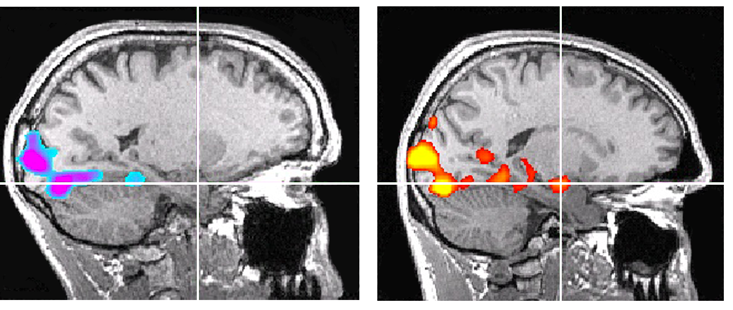
https://nautil.us/the-strange-brain-of-the-worlds-greatest-s...
(the path is from the back of the head (V5?) where the visual nerve comes into brain)
Re: AI focused on brain regions recreates what you're looking at (2024)
#30Earlier quoted context omitted.
Just to clarify, the paper [0] does use both implanted electrodes and fMRI data, but it is actually quite transparent about which data came from which source. The authors worked with two datasets: the B2G dataset, which includes multi-unit activity from implanted Utah arrays in macaques, and the Shen-19 dataset, which uses noninvasive fMRI from human participants. You’re right that fMRI measures blood flow rather tha…
If you can extract private keys by measuring how much power a chip consumes I don’t really see a problem with extracting images from fMRI data….
Fair point. Side-channel attacks show how much signal you can pull from noise. But fMRI is a different kind of beast. It’s slow, indirect, and coarse. You’re not measuring neural activity directly, just blood flow changes that lag by a few seconds.
The paper [0] doesn’t pretend otherwise. It trains a model (PAM) to learn which brain regions carry useful info for reconstructing images, and applies this to both fMRI data from humans and intracranial recordings from macaques. The two signal types are handled separately.
If you want an analogy, it’s less like tapping power lines and more like trying to figure out which YouTube video someone is watching by measuring heat on the back of their laptop every few seconds. There’s a pattern in there, but pulling it out takes work.
[0] https://www.biorxiv.org/content/10.1101/2024.06.04.596589v2....