[stub for offtopicness]
Transfinite NIM (the game, not the programming language)
21–28 of 28 posts
Re: Transfinite NIM (the game, not the programming language)
#22As I recall, the Nim strategy is in Courant, 'What is Mathematics'.
Re: Transfinite NIM (the game, not the programming language)
#23My grandpa was a fan of Nim, and at restaurants we’d play with sugar packets while waiting for food. It’s a great game to entertain kids. He also invented Dr. Nim which some gray beards may be familiar with. Turing Tumble is an evolution of Dr. Nim/DigiComp II.
I am so familiar with Dr Nim ... your grandpa invented that ?!? Kudos ...
Thanks, but I didn't do anything! He did a lot in his life, wish I realized that earlier and wrote more of it down.
I have his original prototype: https://youtu.be/X_IUoFDMhZ8
Also was recently reading this about the history of ESR which is interesting: https://retrocmp.com/attachments/article/302/Duerig.PDF
Re: Transfinite NIM (the game, not the programming language)
#24Earlier quoted context omitted.
I am so familiar with Dr Nim ... your grandpa invented that ?!? Kudos ...
Thanks, but I didn't do anything! He did a lot in his life, wish I realized that earlier and wrote more of it down. I have his original prototype: https://youtu.be/X_IUoFDMhZ8 Also was recently reading this about the history of ESR which is interesting: https://retrocmp.com/attachments/article/302/Duerig.PDF
It's worth mentioning that Dr NIM[0] did not play the NIM[1] studied by Combinatorial Game Theorists ... there are two things called "NIM".
One is as played by Dr NIM, where you have a single heap, and on each turn you can take 1, 2, or 3 tokens. Then the person taking the last token wins (in normal play), or loses in Misère play. This is now known as "The Subtraction Game".
The version of NIM that Game Theorists study has multiple heaps, and on each turn you choose a heap and take one or more from that heap, including possibly taking all of them. Again, as before, the winner is the person taking the last token (in normal play).
But Dr NIM is awesome.
Did he also have something to do with DigiComp II [2] ??
(Edit: Checking Wikipedia, I'm guessing he did. I played with an early version at Cliff Stoll's house last year ... so much fun.)
[0] https://en.wikipedia.org/wiki/Dr._Nim
Re: Transfinite NIM (the game, not the programming language)
#25Earlier quoted context omitted.
Thanks, but I didn't do anything! He did a lot in his life, wish I realized that earlier and wrote more of it down. I have his original prototype: https://youtu.be/X_IUoFDMhZ8 Also was recently reading this about the history of ESR which is interesting: https://retrocmp.com/attachments/article/302/Duerig.PDF
It's worth mentioning that Dr NIM[0] did not play the NIM[1] studied by Combinatorial Game Theorists ... there are two things called "NIM". One is as played by Dr NIM, where you have a single heap, and on each turn you can take 1, 2, or 3 tokens. Then the person taking the last token wins (in normal play), or loses in Misère play. This is now known as "The Subtraction Game". The version of NIM that Game Theorists stu…
Yes, we would play the multiple heaps version at restaurants - Make a triangle out of sugar packets. I still play it with my kids.
And yes - he invented the DigiComp II first, and Dr. Nim afterwards to convey the same concept more simply. There's a version with billiard balls at MIT Stata Center (https://scottaaronson.blog/?p=1902) and my uncle spoke there when they installed it. My mom and I are both constantly trying to get people to credit him, mostly successful, but there is at least one successful project that extended the idea and does not give him credit at all.
(Side note, I was curious if they weren't giving credit due to not wanting to imply infringing on patents, but a) looks like they're not close to infringing on the patent, and b) the patent is now owned by Crayola... https://patents.google.com/patent/US3390471A/en)
He also founded the first major startup in Pittsburgh, On-Line Systems, and I believe the second company ever selling mainframe compute (he phrased it as "second ever software business" but I'm pretty sure he meant second business selling compute, since I believe some unis sold compute before him), basically the OG AWS. And flew multiple bombing runs over Germany in WW2. I'll stop now, I think he's awesome but I'm biased.
https://www.legacy.com/us/obituaries/lsj/name/john-godfrey-o...
Re: Transfinite NIM (the game, not the programming language)
#26Earlier quoted context omitted.
Thanks, but I didn't do anything! He did a lot in his life, wish I realized that earlier and wrote more of it down. I have his original prototype: https://youtu.be/X_IUoFDMhZ8 Also was recently reading this about the history of ESR which is interesting: https://retrocmp.com/attachments/article/302/Duerig.PDF
It's worth mentioning that Dr NIM[0] did not play the NIM[1] studied by Combinatorial Game Theorists ... there are two things called "NIM". One is as played by Dr NIM, where you have a single heap, and on each turn you can take 1, 2, or 3 tokens. Then the person taking the last token wins (in normal play), or loses in Misère play. This is now known as "The Subtraction Game". The version of NIM that Game Theorists stu…
Oh wow! I finally just finished the Cuckoos Egg last December! That makes me so happy
Re: Transfinite NIM (the game, not the programming language)
#27Earlier quoted context omitted.
It's worth mentioning that Dr NIM[0] did not play the NIM[1] studied by Combinatorial Game Theorists ... there are two things called "NIM". One is as played by Dr NIM, where you have a single heap, and on each turn you can take 1, 2, or 3 tokens. Then the person taking the last token wins (in normal play), or loses in Misère play. This is now known as "The Subtraction Game". The version of NIM that Game Theorists stu…
Oh wow! I finally just finished the Cuckoos Egg last December! That makes me so happy
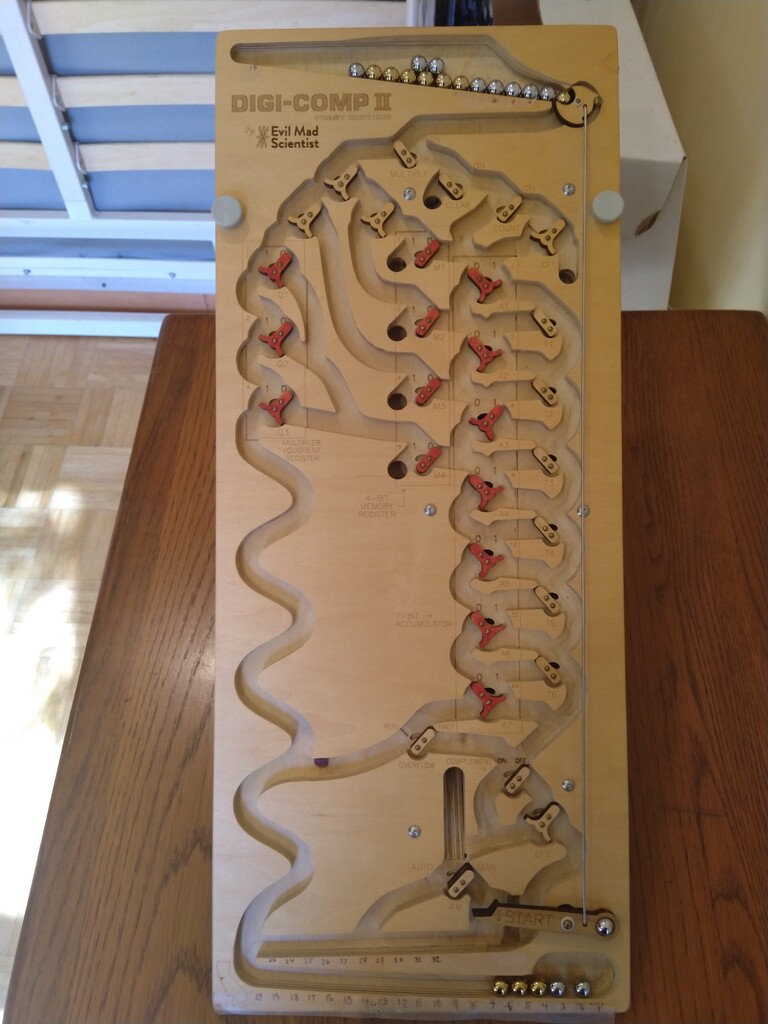
Taken at the time:
Re: Transfinite NIM (the game, not the programming language)
#28Earlier quoted context omitted.
Could you be a bit more explicit? (My understanding of how physicists use the term "momentum": they use it to describe a particular precisely defined physically meaningful quantity, which plays an important role in physics. This seems like an entirely reasonable, even admirable thing. But there seems to be a tone of disapproval in what you say. The obvious complaint about mathematicians' use of "game" would be someth…
https://youtube.com/watch?v=edXOIJZrLPo
To save everyone else a click (though the video is short and fun): the video laments the way that "momentum" in physics refers to a wide variety of concepts: the simple p=mv in Newtonian physics, the generalized versions you get in Lagrangian and Hamiltonian mechanics, the relativistic 4-vector version, the momentum operator in QM, etc., and also (this is kinda-sorta a different sort of difference) angular as opposed to linear momentum.
I'm not sure the analogy quite works.
What's going on with the physicists' notions of momentum is that if you start with the simple p=mv that goes back to Newton, you can (1) generalize it, getting the Lagrangian and Hamiltonian notions (of which "angular momentum" is then another special case), and (2) see that Newtonian mechanics isn't actually quite how the world works, and look for corresponding notions in more accurate theories, getting the quantum and relativistic versions.
In mathematics, the main notions of "game" are what you might call the Conway type and the von Neumann type[1], and those are much more different from one another than any two notions of "momentum" in physics. Then there are other things like the idea of a "topological game" which I guess you can kinda connect to those but is effectively a third largely unrelated thing.
[1] I do not recommend taking those names too seriously.
So the physicists (in this case) are looking at a single phenomenon and deepening and broadening their understandings of it, whereas the mathematicians (in this case) are looking at a variety of really quite different things that happen to have the same name.
Anyway, if I wasn't imagining the note of disapproval in your original comment, it may be worth saying that I don't think there's anything wrong with any of this. It's perfectly normal for words to have a variety of variously-related meanings. To jam something means to stick it into a tight place. Jam is a sweet gloopy thing made from fruit and sugar. If you're "in a jam", you're having difficulties that needn't involve any physical tight place and almost certainly don't involve fruit or sugar. If someone's "jammy" they're lucky in ways that, again, probably don't literally involve tightness or fruit. If you have a "jam session" you're getting together with other musicians for improvisatory fun. All of these meanings are ultimately related to one another but they're very different things. That's just how language works. Physicists' uses of "momentum" or mathematicians' uses of "game" aren't really any different.
(The normal everyday non-mathematical use of "game" is actually a famous example of this sort of thing: there are many things we call games, and probably no single definition that covers them cleanly; rather, we learn lots of examples of things that are "games" and things that aren't, and then we call something a "game" when it resembles other things that we have learned to call games.)
And it's perfectly normal for physicists and mathematicians to look at something that appears simple and find ways to make it more and more general, deep, or precise, usually at the cost of being increasingly difficult to understand. That's just what physics and mathematics are, and so far as I can tell there's no way to get the generality and depth and precision without the difficulty.