Live data from Hacker News

A web app to read Latin texts with inline translations

adi.earth

21–30 of 71 posts

Re: A web app to read Latin texts with inline translations

#21
post #19

I have been using LLMs to restore some of my very rusty Russian reading skills. I give them a text in Russian and ask them to explain it word by word and sentence by sentence, and I ask follow-up questions about parts I am still unsure of. It works quite well, and I haven’t noticed any mistakes yet. I just tried the same thing with the linked Latin text and Gemini Experimental 1206. The results appear below. Perhaps…

I used this method too and found several misstakes, it can be pretty gross mistakes where tone shift is not detected by choosing the wrong words. Idioms and fixed phrases are the hardest I guess. Usually I can get an explanation if I ask four-ten follow up questions it can be really hard to get it right. I hope you are not missing mistakes, and that it is just how I use it that makes it such a burden for me.

I have the worst time with transcripts, and email conversations.
Re: A web app to read Latin texts with inline translations

#22
post #21
post #19

I have been using LLMs to restore some of my very rusty Russian reading skills. I give them a text in Russian and ask them to explain it word by word and sentence by sentence, and I ask follow-up questions about parts I am still unsure of. It works quite well, and I haven’t noticed any mistakes yet. I just tried the same thing with the linked Latin text and Gemini Experimental 1206. The results appear below. Perhaps…

I used this method too and found several misstakes, it can be pretty gross mistakes where tone shift is not detected by choosing the wrong words. Idioms and fixed phrases are the hardest I guess. Usually I can get an explanation if I ask four-ten follow up questions it can be really hard to get it right. I hope you are not missing mistakes, and that it is just how I use it that makes it such a burden for me. I have t…

The accuracy of the results might depend on the language you’re reading, the LLM you’re using, the nature of the text, and the amount of context you give to the LLM. When I’ve tested the best models with more or less standard texts, such as excerpts from novels or news articles, in English, Japanese, and Russian, the results have been extremely good. The latest versions of ChatGPT, Claude, and Gemini are able to explain the meetings of words quite well, and they also get the grammar correct. (I say this as a long-time language teacher and lexicographer. I have written and edited many textbooks and dictionaries for learners of English and Japanese; LLMs come close to my ability and maybe exceed it sometimes.)

They are not always so good, however, with more granular aspects of language, particularly the way words are written or pronounced—the problem the models have with the word “strawberry” is well known. I’ve also seen them struggle with the meanings of words and sentences in isolation, as a lack of context can confuse them (as it can confuse people).

In the case of emails or transcripts, the text might contain mistakes or non-standard language that might trip up the LLMs as well.

In any case, at least for major languages and non-critical applications, I think LLM’s are a great way to understand what is written in another language.

Re: A web app to read Latin texts with inline translations

#23
post #7

TIL the sentence structure of Latin is wild

Latin’s sentence structure is much more flexible than languages such as English. For example, Latin uses cases for nouns to indicate which is the subject and which is the object, whereas English uses word order. This allows Latin sentences to be constructed in various orders without affecting meaning. It also leads to Latin’s reputation for trying the patience of students such as myself (studied for five years at sch…

I remember in school one trick was always to start finding the verb and then use that to build a broader context of the phrase

Re: A web app to read Latin texts with inline translations

#24

After finishing DuoLingo’s Latin course, I wanted to read some Latin texts, but I didn't find easy enough texts and going back and forth to a dictionary was cumbersome. So I created this app for reading basic Latin texts. The idea of the app is to have a Latin text with translation of each word under the paragraph line, which makes it easy to grasp the meaning but also focuses on reading the original Latin text. It o…

I love this mode of reading very much. I think this could be great for any language, not just Latin, and any target language, not just English. The only difficulty is sourcing good texts that are both fun to read and also suitable for language learning at various levels of skill.

Re: A web app to read Latin texts with inline translations

#25
post #19

I have been using LLMs to restore some of my very rusty Russian reading skills. I give them a text in Russian and ask them to explain it word by word and sentence by sentence, and I ask follow-up questions about parts I am still unsure of. It works quite well, and I haven’t noticed any mistakes yet. I just tried the same thing with the linked Latin text and Gemini Experimental 1206. The results appear below. Perhaps…

[deleted]

Re: A web app to read Latin texts with inline translations

#26
post #5

I suggest using ruby annotations for the translation part. I am building a sanskrit reader[1] and needed a feature that allowed users to tag words with notes/meaning. ruby annotations work wonderfully for that. [1] Site: https://www.adhyeta.org.in/ Backend: https://github.com/s-i-e-v-e/adhyeta (The vocabulary features require a login, which is not open to the public as of yet.)

I can see some texts in Sanskrit but I couldn't find any ruby annotations, nor a way to add/suggest any.

Re: A web app to read Latin texts with inline translations

#27
post #26
post #5

I suggest using ruby annotations for the translation part. I am building a sanskrit reader[1] and needed a feature that allowed users to tag words with notes/meaning. ruby annotations work wonderfully for that. [1] Site: https://www.adhyeta.org.in/ Backend: https://github.com/s-i-e-v-e/adhyeta (The vocabulary features require a login, which is not open to the public as of yet.)

I can see some texts in Sanskrit but I couldn't find any ruby annotations, nor a way to add/suggest any.

I am still working on the app part of the website (https://app.adhyeta.org.in/). Will enable registration/login in a week or two.

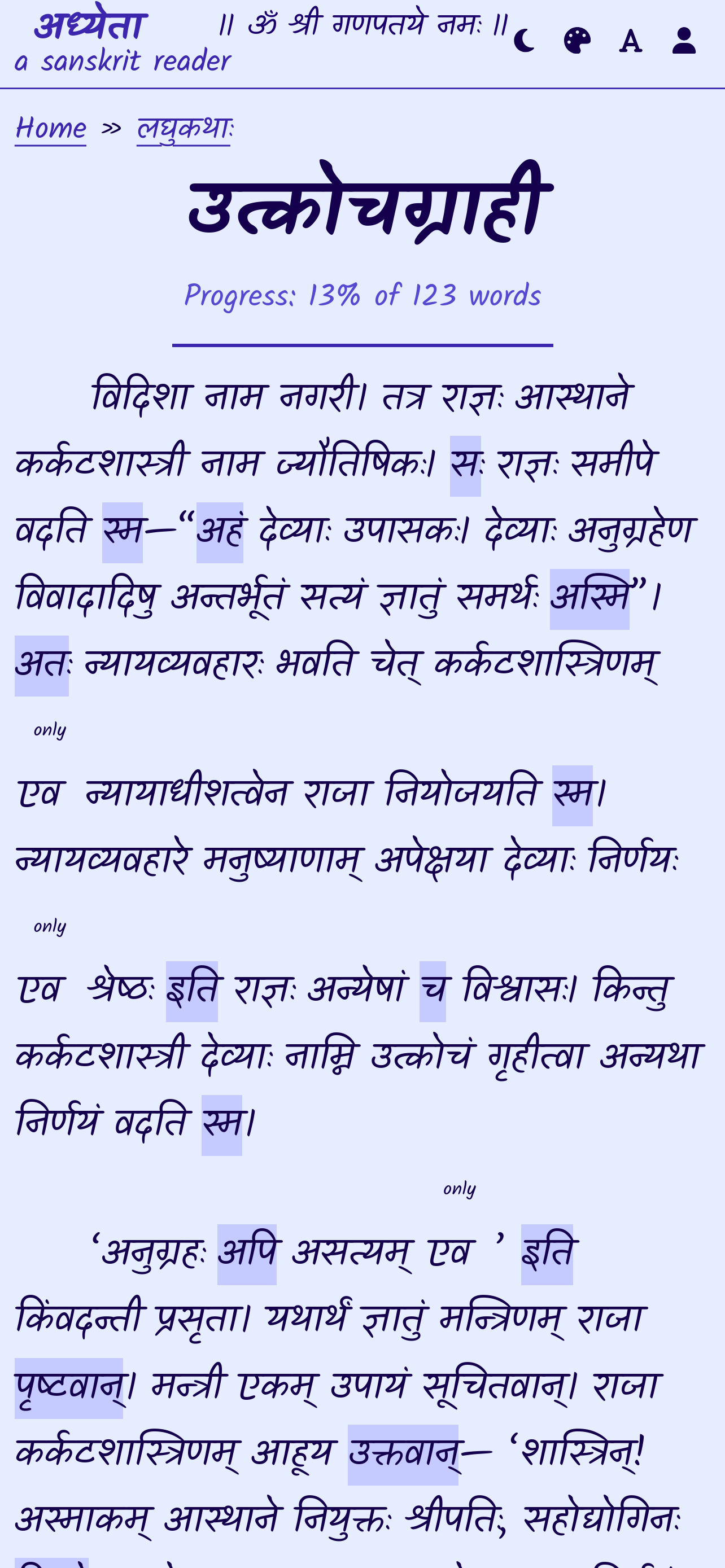
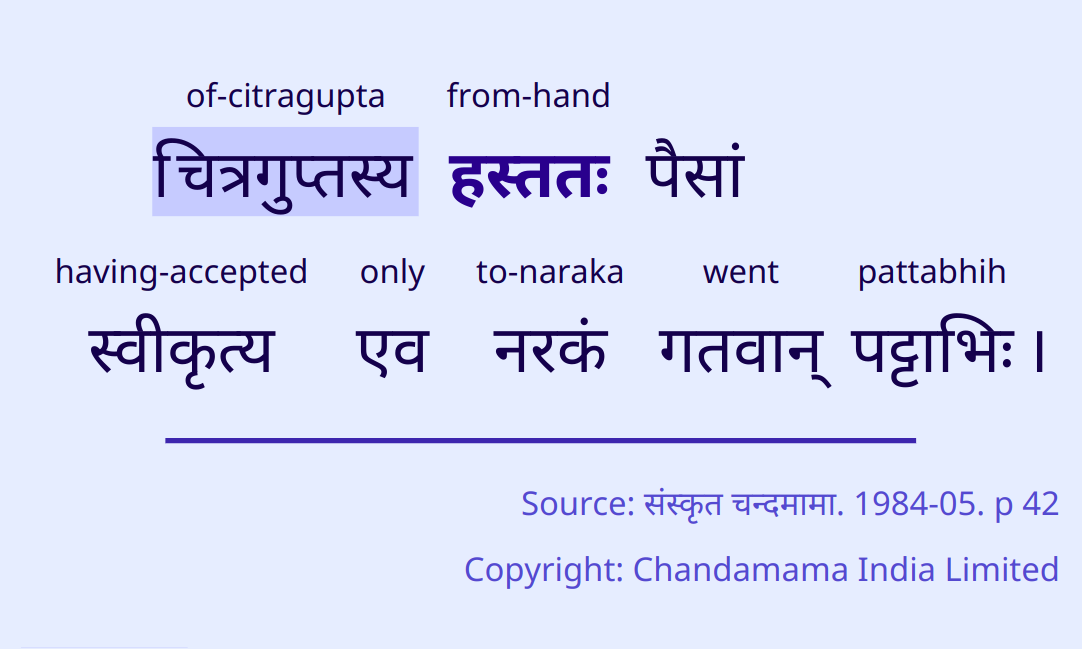
This is how the interface looks like/works, when logged in.

https://www.adhyeta.org.in/a/images/z85.png (ruby annotations can be seen floating above the source text)

https://www.adhyeta.org.in/a/images/z88.png

The "app" is laid out exactly the same way as the www version is. The only difference is that it provides tools to manipulate the status of words. Login is required because vocabulary progress has to be tracked on a per-user basis.

Re: A web app to read Latin texts with inline translations

#28
post #7

TIL the sentence structure of Latin is wild

Latin’s sentence structure is much more flexible than languages such as English. For example, Latin uses cases for nouns to indicate which is the subject and which is the object, whereas English uses word order. This allows Latin sentences to be constructed in various orders without affecting meaning. It also leads to Latin’s reputation for trying the patience of students such as myself (studied for five years at sch…

People might find it interesting to know that English still has remnants of its case system in its personal pronouns, for example I/me/my/mine, he/him/his, she/her/her, who/whom/whose.

Some people struggle with who/whom but in fact it’s the same as “he” versus “him”: if you replace “who” with “he” in the sentence and it sounds wrong then you should be using “whom”.

Re: A web app to read Latin texts with inline translations

#29
post #5

I suggest using ruby annotations for the translation part. I am building a sanskrit reader[1] and needed a feature that allowed users to tag words with notes/meaning. ruby annotations work wonderfully for that. [1] Site: https://www.adhyeta.org.in/ Backend: https://github.com/s-i-e-v-e/adhyeta (The vocabulary features require a login, which is not open to the public as of yet.)

How... how does it work?

Re: A web app to read Latin texts with inline translations

#30
This is nice! I do use ChatGPT a fair amount as I’m still crap at Latin and Greek, but a lot of scholarship just plonks it in untranslated. It has always worked fine for getting the gist. I am extremely lucky in that while moving house my wife allowed me to buy the complete Loeb collection but until then I spent a lot of time on Tufts’ Perseus library. The Latin and English sources (and Greek for that matter) are all in XML on GitHub, so some enterprising soul could probably hook up a wider set of books from here:

https://github.com/PerseusDL/canonical-latinLit/tree/master

Post reply on HN