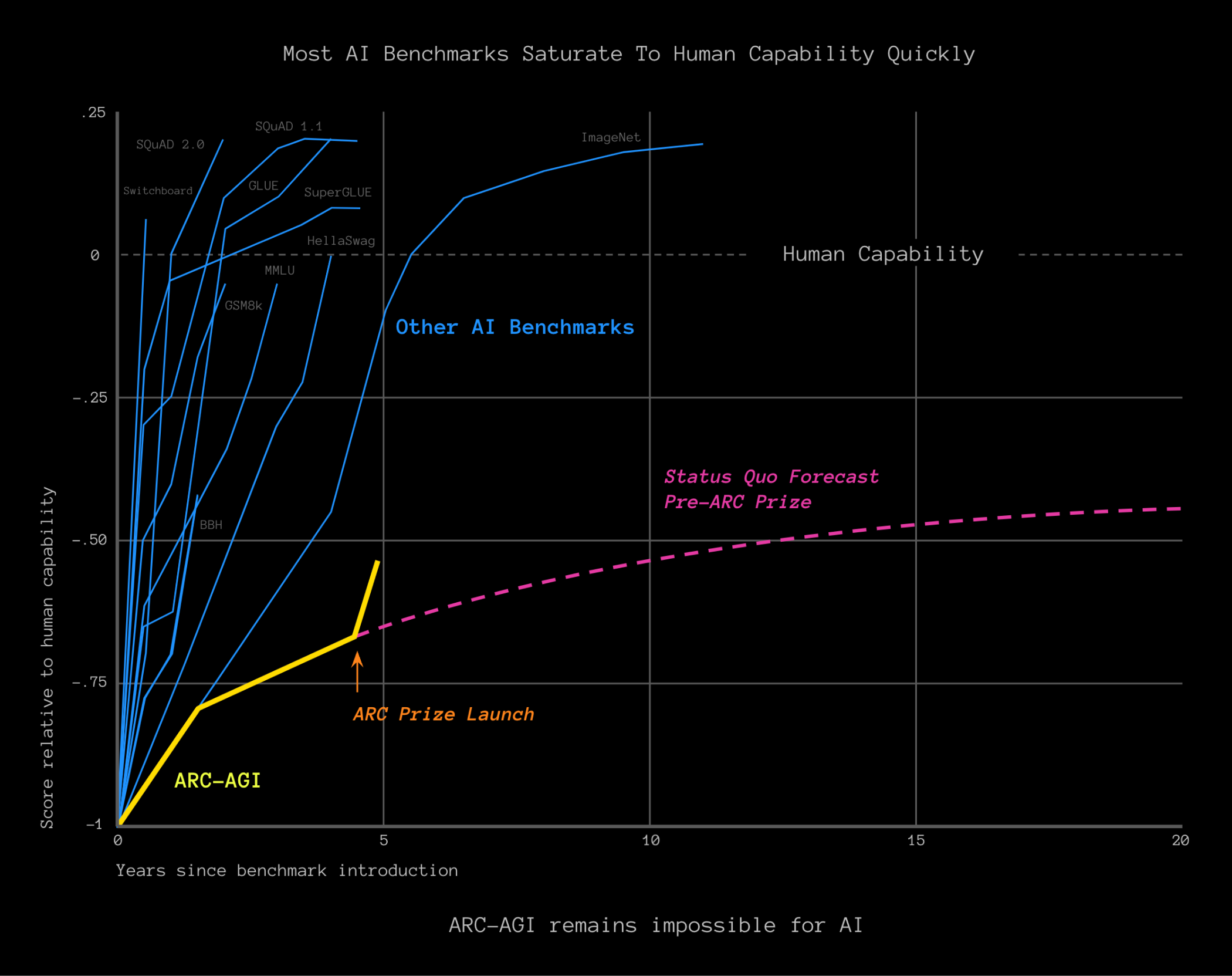
If I were to speculate, I would guess he quit Google. 2 days ago, his $1+ million Artificial General Intelligence competition ended. Chollet is now judging the submissions and will announce the winners in a few weeks. The timing there can't be a coincidence.
Francois Chollet is leaving Google
21–30 of 182 posts
Re: Francois Chollet is leaving Google
#22I wonder what he will be working on? Maybe he figured out a model that beats ARC-AGI by 85%?
> Maybe he figured out a model that beats ARC-AGI by 85%? People have, I think. One of the published approaches (BARC) uses GPT-4o to generate a lot more training data. The approach is scaling really well so far [1], and whether you expect linear scaling or exponential one [2], the 85% threshold can be reached, using the "transduction" model alone, after generating under 2 million tasks ($20K in OpenAI credits). Perh…
If the ARC-AGI challenge did not actually follow their expected graph[1], I see no reason to believe that any benchmark can be designed in a way where it cannot be gamed. Rather, it seems that the existing SOTA models just weren't well-optimized for that one task.
The only way to measure "AGI" is in however you define the "G". If your model can only do one thing, it is not AGI and doesn't really indicate you are closer, even if you very carefully designed your challenge.
Re: Francois Chollet is leaving Google
#23Earlier quoted context omitted.
FTA "With over two million users, Keras has become a cornerstone of AI development, streamlining complex workflows and democratizing access to cutting-edge technology. It powers numerous applications at Google and across the world, from the Waymo autonomous cars, to your daily YouTube, Netflix, and Spotify recommendations."
sure -- all true in 2018; right about then pyTorch passed TensforFlow in the raw numbers of research papers using it.. grad students later make products and product decisions.. currently, pyTorch is far more popular, the bulk of that is with LLMs source: pyTorch Foundation, news
Re: Francois Chollet is leaving Google
#24I guess they realized muilti-backend keras is futile? I never liked the tf.keras apis and the docs always promosed multi backend but then I guess they were never able to deliver that without breaking keras 3 changes. And even now.... "Keras 3 includes a brand new distribution API, the keras.distribution namespace, currently implemented for the JAX backend (coming soon to the TensorFlow and PyTorch backends)". I don't…
Why would you interpret this as Google disliking Keras? Seems a lot more likely he was poached by Anthropic.
Re: Francois Chollet is leaving Google
#25Earlier quoted context omitted.
> Maybe he figured out a model that beats ARC-AGI by 85%? People have, I think. One of the published approaches (BARC) uses GPT-4o to generate a lot more training data. The approach is scaling really well so far [1], and whether you expect linear scaling or exponential one [2], the 85% threshold can be reached, using the "transduction" model alone, after generating under 2 million tasks ($20K in OpenAI credits). Perh…
I like the idea of ARC-AGI and think it was worth a shot. But if someone has already hit the human-level threshold, I think the entire idea can be thrown out. If the ARC-AGI challenge did not actually follow their expected graph[1], I see no reason to believe that any benchmark can be designed in a way where it cannot be gamed. Rather, it seems that the existing SOTA models just weren't well-optimized for that one ta…
Re: Francois Chollet is leaving Google
#26Earlier quoted context omitted.
> Maybe he figured out a model that beats ARC-AGI by 85%? People have, I think. One of the published approaches (BARC) uses GPT-4o to generate a lot more training data. The approach is scaling really well so far [1], and whether you expect linear scaling or exponential one [2], the 85% threshold can be reached, using the "transduction" model alone, after generating under 2 million tasks ($20K in OpenAI credits). Perh…
I like the idea of ARC-AGI and think it was worth a shot. But if someone has already hit the human-level threshold, I think the entire idea can be thrown out. If the ARC-AGI challenge did not actually follow their expected graph[1], I see no reason to believe that any benchmark can be designed in a way where it cannot be gamed. Rather, it seems that the existing SOTA models just weren't well-optimized for that one ta…
"I" isn't usefully defined either.
At least most people agree on "Artificial"
Re: Francois Chollet is leaving Google
#27I read somewhere TF will not be developed actively down the road, Google switched to JAX internally and TF pretty much lost the war to Pytorch.
Re: Francois Chollet is leaving Google
#28Earlier quoted context omitted.
As someone who hasn't really used either, what's pytorch doing that's so much better?
A few things from personal experience: - LLM support with PyTorch is better (both at a tooling level and CUDA level). Hugging Face transformers does have support for both TensorFlow and PyTorch variants of LLMs but... - Almost all new LLMs are in PyTorch first and may or may not be ported to TensorFlow. This most notably includes embeddings models which are the most important area in my work. - Keras's training loop…
https://keras.io/examples/keras_recipes/trainer_pattern/
> - Keras's training loop assumes you can fit all the data in memory and that the data is fully preprocessed, which in the world of LLMs and big data is infeasible.
The Tensorflow backend has the excellent tf.data.Dataset API, which allows for out of core data and processing in a streaming way.
Re: Francois Chollet is leaving Google
#29Re: Francois Chollet is leaving Google
#30Earlier quoted context omitted.
> Maybe he figured out a model that beats ARC-AGI by 85%? People have, I think. One of the published approaches (BARC) uses GPT-4o to generate a lot more training data. The approach is scaling really well so far [1], and whether you expect linear scaling or exponential one [2], the 85% threshold can be reached, using the "transduction" model alone, after generating under 2 million tasks ($20K in OpenAI credits). Perh…
I like the idea of ARC-AGI and think it was worth a shot. But if someone has already hit the human-level threshold, I think the entire idea can be thrown out. If the ARC-AGI challenge did not actually follow their expected graph[1], I see no reason to believe that any benchmark can be designed in a way where it cannot be gamed. Rather, it seems that the existing SOTA models just weren't well-optimized for that one ta…
There is some controversy over what the human-level threshold is. A recent and very extensive study measured just 60.2% using Amazon Mechanical Turkers, for the same setup [1].
But the Turkers had no prior experience with the dataset, and were only given 5 tasks each.
Regardless, I believe ARC-AGI should aim for a higher threshold than what average humans achieve, because the ultimate goal of AGI is to supplement or replace high-IQ experts (who tend to do very well on ARC)
---
[1] Table 1 in https://arxiv.org/abs/2409.01374 2-shot Evaluation Set