Live data from Hacker News

Using the Moon as an Echo [video]

youtube.com

21–27 of 27 posts

Re: Using the Moon as an Echo [video]

#21
post #14

I've successfully used moon bounce one way, with my signal from California on a simple 8el yagi being heard by a big station in Italy. -- using a digital mode, of course, getting phone through requires a BIG station on both sides since there is about 250dB of path loss. I haven't managed a two way contact because there is some broadband noise on 2m in the same direction that the moon rises that raises my noise floor…

That’s awesome!

Did you connect with the Italy station before the EME to see if they could hear you, or did you just broadcast out into the void hoping for a listener somewhere else?

Re: Using the Moon as an Echo [video]

#22
post #14

I've successfully used moon bounce one way, with my signal from California on a simple 8el yagi being heard by a big station in Italy. -- using a digital mode, of course, getting phone through requires a BIG station on both sides since there is about 250dB of path loss. I haven't managed a two way contact because there is some broadband noise on 2m in the same direction that the moon rises that raises my noise floor…

That’s awesome! Did you connect with the Italy station before the EME to see if they could hear you, or did you just broadcast out into the void hoping for a listener somewhere else?

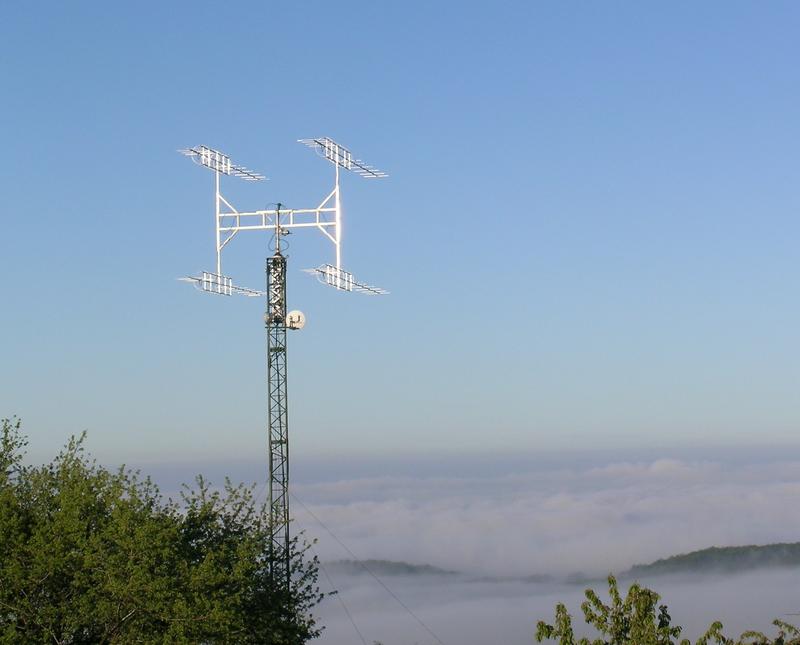
The latter! Then I got a signal report back online from I3MEK (who apparently has a fairly impressive looking quad antenna array: https://cdn-bio.qrz.com/k/i3mek/Dscn1593B.jpg ). I've also been heard via the EME path from Texas.

If I ever manage to squash my noise problem, I may bother trying to schedule some contacts as it's not unusual to do so for EME. But right now I don't want to waste people's time when I know that I'm deaf.

(It's really obvious that I'm deaf too, because I can just rotate the antenna and watch the noise floor drop).

Re: Using the Moon as an Echo [video]

#25
I remember wondering way back when (60s or 70s?) why the heck did radio astronomy get so much funding - so much money was poured in.

Only later was it revealed that once in a blue moon (heh), things were aligned so that the US could use bounces off the moon to detect and analyze a certain class of Soviet radars.

Those periods of use for the radio telescopes in question were booked well in advance.

Re: Using the Moon as an Echo [video]

#26
post #14

I've successfully used moon bounce one way, with my signal from California on a simple 8el yagi being heard by a big station in Italy. -- using a digital mode, of course, getting phone through requires a BIG station on both sides since there is about 250dB of path loss. I haven't managed a two way contact because there is some broadband noise on 2m in the same direction that the moon rises that raises my noise floor…

Now you gotta tell us more about the meteor scatter trick :)

Re: Using the Moon as an Echo [video]

#27
post #14

I've successfully used moon bounce one way, with my signal from California on a simple 8el yagi being heard by a big station in Italy. -- using a digital mode, of course, getting phone through requires a BIG station on both sides since there is about 250dB of path loss. I haven't managed a two way contact because there is some broadband noise on 2m in the same direction that the moon rises that raises my noise floor…

Now you gotta tell us more about the meteor scatter trick :)

The heavy lifting was done by the people who designed the modems for this stuff. https://wsjt.sourceforge.io/MSK144_Protocol_QEX.pdf

But in short, you use a modulation technique where your short messages are sent very quickly, e.g. in 72ms. You then transmit in burts 15 seconds long, repeating your 72ms message over and over again. Hopefully a meteor zips by, if it does far away stations will get a signal from you.

Parties take turns transmitting in either even or odd timeslots and listening in the other. Communication goes pretty slowly but it goes. Every morning around sunrise the part of the earth you are on is facing into the earths orbit and there are a few meteors. It works better during showers.

The receiver for these modes is computationally expensive: there is no time for a fixed synchronization pattern like most digital communications methods use, so instead the rx side does a brute force search.

My first meteor scatter contacts were with a high gain vertical omni, but a directional antenna works much better.

The geometry of a meteor scatter path allow contacts that go about 2000 km but 1000km is easier and more common.

Participation is a limiting factor, when I'm working msk144 outside of a meteor shower I may only get one or two contact in a day or none at all. And it's not unusual to for a normal exchange (which is just CQ MYCALL MYGRID; MYCALL THEIRCALL THEIRGRID; THEIRCALL MYCALL ROGER; MYCALL THEIRCALL BESTREGARDS) to take an hour-- depending on the luck of the falling rocks.
Post reply on HN